
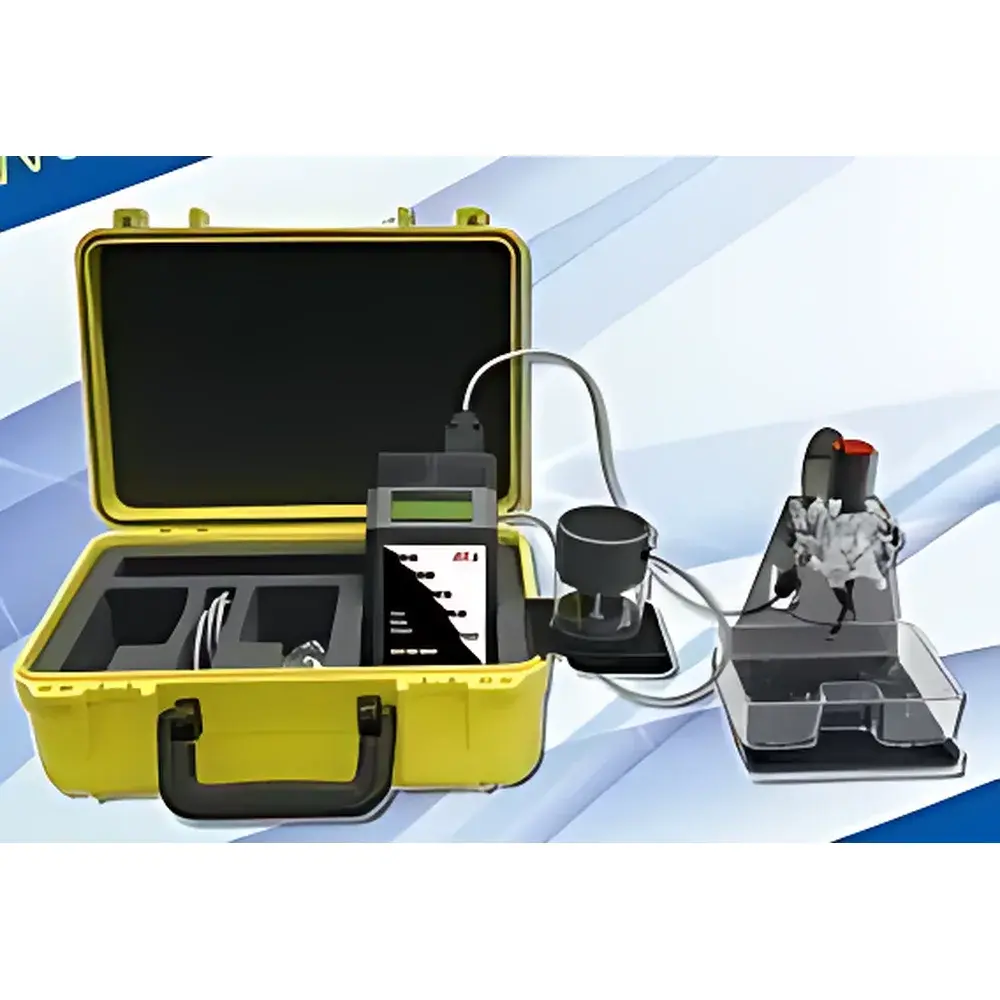
AVVOR 8000 Portable Anodic Stripping Voltammetry (ASV) Heavy Metals Analyzer
| Origin | USA |
|---|---|
| Manufacturer Type | Authorized Distributor |
| Origin Category | Imported |
| Model | AVVOR 8000 |
| Pricing | Available Upon Request |
Overview
The AVVOR 8000 is a field-deployable, laboratory-validated anodic stripping voltammetry (ASV) analyzer engineered for quantitative determination of trace heavy metals in complex matrices—including food products, drinking water, wastewater, soil leachates, beverages, and solid waste extracts. ASV is an electrochemical technique standardized under U.S. EPA Methods 7063 (for Pb, Cd, Cu, Zn), 7473 (for Hg), and 7196 (for Cr(VI)), and recognized by ISO 11969, ASTM D3559, and EN 16426 for regulatory compliance in food safety and environmental monitoring. The instrument operates by pre-concentrating target metal ions onto a mercury-film or bismuth-film working electrode at a controlled negative potential, followed by oxidative stripping with a linear potential sweep. The resulting current peaks are proportional to analyte concentration, enabling sub-ppb detection limits for most target elements without matrix interference from organic matter or common cations.
Key Features
- Multi-element capability: Simultaneous or sequential quantification of up to 18 elements—Cu, Cd, Pb, Zn, Ni, Hg, As, Fe, Mn, Sb, Tl, Se, Co, Mo, Au, Ag, Cr, Pd, Sn—via programmable waveform selection and electrode conditioning protocols.
- Rapid analysis cycle: Electrode preparation, deposition, and stripping completed in under 90 seconds per sample; minimal pre-treatment required for liquid samples (e.g., filtered aqueous extracts or acid-diluted food digests).
- Field-ready architecture: Integrated rechargeable Li-ion battery (≥8 h operation), ruggedized IP65-rated housing, and high-contrast backlit LCD display for real-time voltammogram visualization and concentration readout.
- Low operational cost: Disposable or reusable screen-printed electrodes (SPEs) and low-volume reagent kits (<5 mL per analysis); optional in-house preparation of supporting electrolytes (e.g., 0.1 M acetate buffer, 0.01 M HCl) compliant with EPA-recommended formulations.
- Modular electrode compatibility: Supports mercury-film, bismuth-film, and gold-film working electrodes—enabling method flexibility for Hg-free operation (per EU RoHS/REACH guidelines) or enhanced As(III)/As(V) speciation.
Sample Compatibility & Compliance
The AVVOR 8000 accommodates liquid samples (water, juice, digestates) directly after filtration (0.45 µm) and pH adjustment. For solid matrices—including raw or processed foods (cereals, seafood, dairy powders), soils, and sludges—standardized acid digestion (EPA Method 3050B or 3051A) or microwave-assisted extraction is required prior to analysis. All validated methods align with FDA’s Food Safety Modernization Act (FSMA) requirements for heavy metal screening in food commodities and satisfy GLP-compliant data integrity standards when paired with audit-trail-enabled software. Instrument performance verification includes daily calibration with NIST-traceable multi-metal standards and participation in inter-laboratory proficiency testing schemes (e.g., FAPAS, QUASIMEME).
Software & Data Management
PC-based control software (Windows-compatible) provides full method development, automated calibration curve generation, peak deconvolution, and statistical reporting (mean, SD, RSD, LOD/LOQ). Raw voltammograms and metadata (date/time, operator ID, electrode lot, calibration status) are stored in encrypted SQLite databases compliant with FDA 21 CFR Part 11 requirements for electronic records and signatures. Export options include CSV, PDF analytical reports, and XML files compatible with LIMS integration. On-device data logging retains ≥1,000 test records with timestamp and GPS coordinates (when paired with optional Bluetooth GNSS module).
Applications
- Food safety laboratories: Rapid screening of rice, infant formula, shellfish, and spices for As, Cd, Pb, and Hg per EU Commission Regulation (EC) No 1881/2006 and China GB 2762–2022 limits.
- Environmental field teams: Real-time monitoring of irrigation water, aquaculture effluents, and landfill leachates for regulatory reporting under Clean Water Act Section 304(a) guidelines.
- Academic research: Speciation studies (e.g., As(III) vs. As(V) redox behavior in fermented foods), method validation for novel extraction protocols, and sensor interface development.
- Contract testing facilities: High-throughput batch analysis with QC/QA flags for out-of-spec results, automatic recalibration prompts, and ISO/IEC 17025-aligned uncertainty estimation.
FAQ
What sample preparation is required for food matrices?
Homogenized solid foods must undergo microwave-assisted nitric-perchloric acid digestion (EPA 3052) or dilute-acid leaching (EN 13657), followed by centrifugation and filtration. Liquid foods (e.g., milk, wine) require only 10-fold dilution in supporting electrolyte.
Does the AVVOR 8000 comply with FDA or EU food testing regulations?
Yes—its ASV methodology is referenced in FDA’s Elemental Analysis Manual (EAM) Chapter 4 and validated against ISO 17294-2 for multi-element water analysis, which forms the technical basis for food extract testing under EU Regulation 2023/915.
Can it distinguish between inorganic and organic arsenic species?
No—ASV detects total electroactive As(III); speciation requires coupling with HPLC-ICP-MS. However, selective pre-reduction protocols enable differentiation of As(III)/As(V) in controlled digest conditions.
Is mercury electrode use mandatory?
No—bismuth-film electrodes provide comparable sensitivity for Cd, Pb, Zn, and Cu without mercury handling, meeting OSHA PEL and CLP disposal requirements.
How is instrument calibration verified during routine use?
Each analysis batch includes triplicate standard additions and a continuing calibration verification (CCV) standard. Drift correction is applied automatically using internal reference peaks (e.g., Cu²⁺ at −0.05 V vs. Ag/AgCl).
Related Products







