
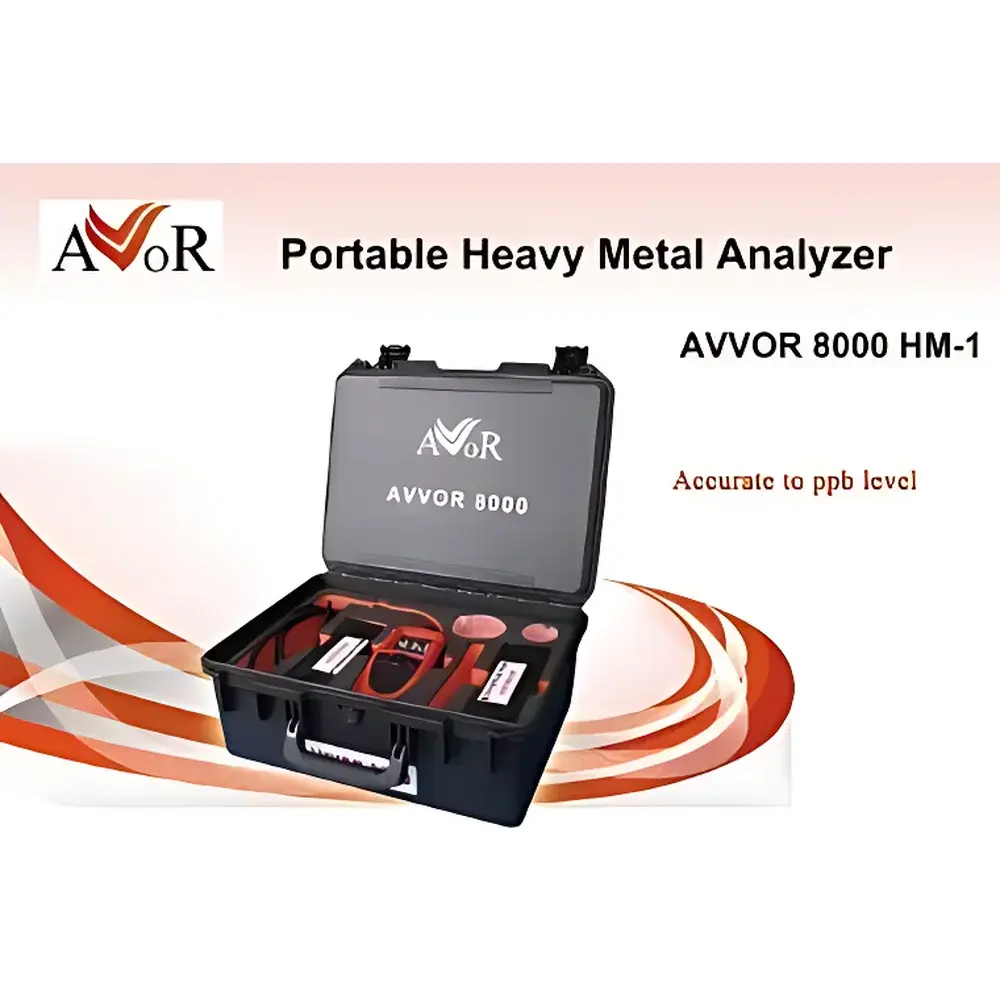
AVVOR 8000 HM-1 Portable Anodic Stripping Voltammetry (ASV) Heavy Metals Analyzer
| Brand | AVVOR |
|---|---|
| Origin | Fujian, China |
| Model | AVVOR 8000 HM-1 |
| Instrument Type | Portable |
| Detection Principle | Anodic Stripping Voltammetry (ASV) |
| Detectable Metals | As(III), Total As, Cd, Cu, Pb, Hg, Mn, Ni, Zn |
| Detection Time | < 300 s per metal |
| Accuracy | ±5% RSD (at 10× LOD) |
| Resolution | 0.1 ppb (for Cd, Pb, Cu in aqueous matrix) |
| IP Rating | IP67 |
| Data Storage | 1000 measurement records |
| Power Options | Rechargeable Li-ion battery, AC adapter, 12 V DC car socket |
| Interface | USB 2.0 |
| Display | Backlit LCD with joystick navigation |
| Electrode System | Triple-electrode immersed probe (WE/RE/AE), integrated stirrer and Pt100 temperature sensor |
| Expandability | Up to 3 interchangeable working electrodes in single probe housing |
| Software | Windows-based ASV Analysis Suite with audit trail, calibration history, and report export (PDF/CSV/XLSX) |
Overview
The AVVOR 8000 HM-1 is a field-deployable, portable heavy metals analyzer engineered for rapid, on-site quantification of toxic trace metals in water matrices—including drinking water, surface water, wastewater, and leachates. It employs anodic stripping voltammetry (ASV), an electrochemical technique standardized under ASTM D3559, EPA Method 7000B, and ISO 11969, which delivers laboratory-grade sensitivity and reproducibility without requiring centralized lab infrastructure. ASV operates through controlled electrodeposition of target metal ions onto a mercury-film or bismuth-film working electrode at a negative potential, followed by oxidative stripping under a linear potential sweep. The resulting current peaks are directly proportional to metal concentration, enabling sub-ppb detection limits for key analytes such as cadmium, lead, copper, mercury, and arsenic(III). Unlike atomic absorption or ICP-MS systems, the AVVOR 8000 HM-1 eliminates need for acid digestion, argon purge, or high-voltage plasma sources—making it suitable for real-time compliance screening in resource-constrained or remote settings.
Key Features
- Triple-electrode immersed probe with integrated Pt100 temperature sensor and magnetic stirrer—ensures precise thermal compensation and homogeneous mass transport during deposition and stripping phases.
- Modular electrode architecture: accepts up to three plug-in working electrodes (e.g., Hg-film, Bi-film, Au-coated) within a single probe housing; electrode replacement requires no tools or recalibration.
- IP67-rated ruggedized enclosure—tested for dust ingress resistance and immersion in 1 m water for 30 minutes; operational across –10 °C to +50 °C ambient range.
- Onboard data logger storing 1000 complete measurement sets—including raw voltammograms, calibration parameters, operator ID, GPS-tagged location (optional), and timestamped metadata.
- Intuitive joystick-driven UI with step-by-step graphical prompts—designed for operators with minimal electrochemical training; all method selection, calibration, and analysis executed via touchscreen-free navigation.
- Multi-power flexibility: supports continuous operation via rechargeable 7.4 V Li-ion battery (≥12 h runtime), universal AC adapter (100–240 V), or 12 V DC vehicle socket—enabling uninterrupted deployment during extended field campaigns.
Sample Compatibility & Compliance
The AVVOR 8000 HM-1 is validated for direct analysis of unfiltered, low-turbidity aqueous samples (0–5 NTU) with total dissolved solids (TDS) ≤ 500 mg/L. It meets performance criteria outlined in EPA SW-846 Method 7000B for ASV-based metal speciation and adheres to GLP data integrity requirements via built-in audit trail functionality—including user login logs, parameter change history, and electronic signature support. All firmware and software comply with FDA 21 CFR Part 11 for electronic records and signatures when used in regulated environmental monitoring programs. Sample introduction uses disposable 15 mL polypropylene cups with auto-leveling meniscus detection—eliminating pipetting errors and cross-contamination risks. No acid preservation or filtration is required for most routine screening applications; however, high-organic or high-chloride matrices may necessitate standard addition or matrix-matched calibration per ISO/IEC 17025 guidelines.
Software & Data Management
The included Windows-based ASV Analysis Suite provides full instrument control, method development, and regulatory-compliant reporting. Key capabilities include: automatic peak identification and integration using Savitzky-Golay smoothing and derivative-based thresholding; multi-point calibration curve generation with forced zero-intercept or linear regression options; batch processing of stored field data; and customizable report templates compliant with ISO 17025 Annex A and EU Water Framework Directive Annex V reporting formats. All data files are digitally signed and time-stamped; software enforces role-based access control (administrator/operator) and maintains immutable audit trails for every analytical action—fully satisfying GMP/GLP documentation requirements. Export formats include PDF (print-ready), CSV (for LIMS integration), and XLSX (for statistical review in Excel or R).
Applications
- Drinking water safety verification at distribution points, wells, and household taps per WHO guideline values (e.g., Pb ≤ 10 µg/L, As ≤ 10 µg/L).
- Rapid assessment of industrial effluent discharge compliance against national permits (e.g., China’s GB 8978-1996, US NPDES limits).
- Field screening of sediment porewater and soil leachates during brownfield site characterization.
- Emergency response to contamination events—e.g., post-flood metal mobilization or mining spill assessment—where turnaround time is critical.
- Educational use in university environmental chemistry labs for teaching fundamental electroanalytical techniques and trace metal speciation principles.
- Regulatory monitoring by municipal water authorities performing quarterly or event-driven surveillance per local public health ordinances.
FAQ
What electrochemical method does the AVVOR 8000 HM-1 use, and how is it validated?
It implements anodic stripping voltammetry (ASV) in accordance with ASTM D3559-22 and EPA Method 7000B. Validation includes spike recovery studies (85–115% across 0.1–100 ppb range), inter-laboratory comparison data, and long-term stability testing (>200 cycles per electrode).
Can the instrument measure total arsenic and arsenite separately?
Yes. As(III) is measured directly via ASV. Total As is determined after pre-reduction of As(V) to As(III) using L-cysteine at pH 2.0; differential results yield As(V) concentration.
Is method validation documentation provided for regulatory submissions?
Yes. Each unit ships with a Certificate of Conformance, Factory Calibration Report, and a comprehensive User Validation Guide aligned with ISO/IEC 17025 Section 5.4 and USP Analytical Instrument Qualification.
How often must electrodes be replaced or regenerated?
Hg-film electrodes are single-use per analysis sequence; Bi-film electrodes support ≥50 measurements before replacement. No polishing or chemical regeneration is required—electrode lifetime is tracked automatically in firmware.
Does the system support networked data transfer or cloud synchronization?
Not natively. Data export is USB-only; however, the CSV/XLSX output format enables seamless ingestion into enterprise LIMS or cloud-based environmental data platforms (e.g., ArcGIS Online, EQuIS Cloud) via third-party ETL workflows.
Related Products







