
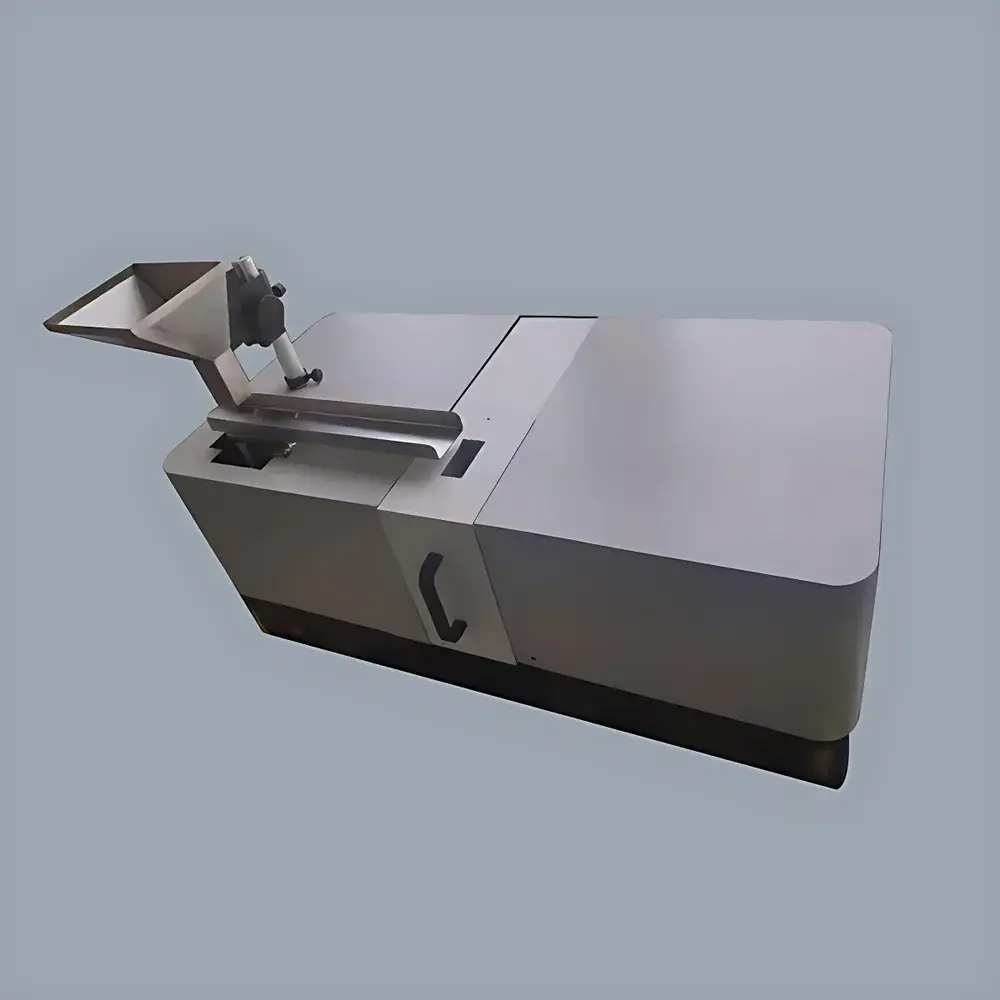
Winner 100 Wet-Dispersion Dynamic Particle Image Analyzer by Jinan Winner
| Brand | Jinan Winner |
|---|---|
| Origin | Shandong, China |
| Manufacturer Type | Direct Manufacturer |
| Regional Origin | Domestic (China) |
| Model | Winner 100 |
| Dispersion Method | Wet Dispersion |
| Instrument Type | Laboratory Particle Image Analyzer |
| Measurement Range | 2–6000 µm (range varies by optical configuration) |
| Repeatability | <3% RSD |
| Measurement Time | ≤1 minute |
| Compliance | ISO 13322-1:2004, GB/T 21649.1–2008 |
| Imaging Sensor | High-Speed CCD (1392 × 1040 resolution) |
| Shutter Speed | 10⁻⁶ s |
| Sample Handling | Integrated ultrasonic dispersion, mechanical stirring, and recirculation loop |
| Output Parameters | D₁₀, D₅₀, D₉₀ |
| Dimensions | 760 × 440 × 460 mm |
| Weight | 25 kg |
Overview
The Winner 100 Wet-Dispersion Dynamic Particle Image Analyzer is a laboratory-grade particle characterization system engineered for simultaneous morphological and size distribution analysis of particulate suspensions. Unlike static image analyzers—limited by low statistical sampling and poor dispersion stability—the Winner 100 employs real-time hydrodynamic sampling coupled with high-speed imaging to capture thousands of particles per second in continuous flow. Its core measurement principle relies on dynamic digital microscopy: particles suspended in liquid medium pass through an illuminated flow cell, where they are imaged at microsecond shutter speeds using a high-resolution progressive-scan CCD sensor. Each captured frame undergoes pixel-level segmentation and geometric feature extraction, enabling quantitative determination of both equivalent spherical diameter (ESD) and intrinsic shape descriptors—including aspect ratio, circularity, convexity, and sphericity—without reliance on scattering theory or calibration standards. This dual-mode capability bridges the gap between traditional laser diffraction (which infers size from ensemble scattering) and static microscopy (which suffers from sampling bias), making the Winner 100 particularly suited for R&D laboratories and QC environments where particle morphology directly impacts functional performance—such as dissolution kinetics in pharmaceuticals, packing density in battery electrode slurries, or dispersion stability in pigment formulations.
Key Features
- Real-time dynamic imaging with 1 µs shutter speed and 1392 × 1040 pixel resolution, eliminating motion blur during high-velocity flow
- Integrated wet dispersion module featuring programmable ultrasonic energy control (20–100 W), variable-speed magnetic stirring, and closed-loop recirculation (flow rate adjustable 50–500 mL/min)
- Automated focus stabilization and defocus compensation algorithm to maintain sub-pixel edge fidelity across varying particle depths in suspension
- Multi-modal statistical output: number-weighted, volume-weighted, and area-weighted distributions; standard percentile diameters (D10, D50, D90) and six common mean diameters (Xnl, Xns, Xnv, Xls, Xlv, Xsv)
- Shape parameter quantification per particle: aspect ratio (length/width), sphericity (π1/2·A1/2/L), convexity (area/convex hull area), and surface roughness index derived from boundary Fourier harmonics
- Rugged benchtop design (25 kg, IP20-rated enclosure) with CE-marked electrical safety and EMC compliance
Sample Compatibility & Compliance
The Winner 100 supports aqueous and organic suspensions across a broad refractive index range (1.33–1.75), accommodating fragile or reactive materials—including herbal extracts, magnetic nanoparticles, and pH-sensitive biopolymers—that degrade under dry dispersion or prolonged laser exposure. Its wet-flow architecture avoids static agglomeration artifacts common in slide-based imaging, while the recirculation path minimizes sedimentation bias. The instrument conforms to ISO 13322-1:2004 (Particle Size Analysis — Image Analysis Methods — Part 1: Static Image Analysis) for method validation and reporting, and meets the metrological traceability requirements outlined in GB/T 21649.1–2008 (Chinese national standard for dynamic image analysis). All raw image data and processing logs are timestamped and stored in vendor-neutral TIFF/CSV formats, supporting audit-ready documentation for GLP-compliant workflows.
Software & Data Management
The proprietary WinPAS v5.2 software provides full control over acquisition parameters, real-time visualization of particle streams, and batch post-processing with customizable filtering (e.g., minimum contrast, maximum eccentricity). It implements ASTM E2457-compliant particle classification rules and supports user-defined shape thresholds for automated pass/fail grading. Data export includes hierarchical HDF5 files containing metadata (instrument settings, calibration history, environmental conditions), raw image stacks, and tabular results compatible with JMP, MATLAB, and Python pandas. Audit trail functionality records operator ID, session start/end time, parameter modifications, and report generation events—fully compliant with FDA 21 CFR Part 11 requirements when deployed with Windows domain authentication and electronic signature modules.
Applications
- Pharmaceutical solid dosage development: correlating sphericity and surface roughness with tablet compressibility and dissolution uniformity
- Ceramic and additive manufacturing feedstocks: verifying particle angularity and aspect ratio to predict green strength and sintering shrinkage
- Coatings and ink formulation: quantifying pigment aspect ratio to model rheology and optical hiding power
- Environmental sediment analysis: distinguishing biogenic vs. lithogenic particles via convexity and edge fractal dimension
- Battery cathode slurry QC: detecting agglomerates and measuring primary particle aspect ratio in NMC/LFP suspensions
- Food powder processing: monitoring granulation efficiency via changes in D50 and sphericity distribution width
FAQ
Does the Winner 100 require calibration with reference standards?
No—image-based sizing is inherently traceable to pixel pitch and magnification factor, which are verified using NIST-traceable stage micrometers during installation. Shape parameters are geometrically derived and do not rely on empirical calibration.
Can it analyze particles smaller than 2 µm?
Not reliably—diffraction-limited resolution at visible wavelengths constrains lower detection to ~2 µm under optimal contrast conditions. Submicron analysis requires complementary techniques such as TEM or nanoparticle tracking analysis (NTA).
Is the software compatible with LIMS integration?
Yes—WinPAS v5.2 provides ODBC-compliant database connectivity and RESTful API endpoints for bidirectional data exchange with major LIMS platforms (e.g., LabWare, Thermo Fisher SampleManager).
What maintenance is required for long-term accuracy?
Annual verification of flow cell alignment, CCD dark-frame correction, and ultrasonic transducer output power is recommended. No consumables beyond standard cleaning solvents and replacement tubing are required.
How does it handle highly concentrated or opaque suspensions?
The system uses backlit LED illumination with adjustable intensity and dynamic exposure control. For turbid samples, dilution protocols and optional polarized lighting modules are available to enhance edge contrast without altering dispersion state.



