
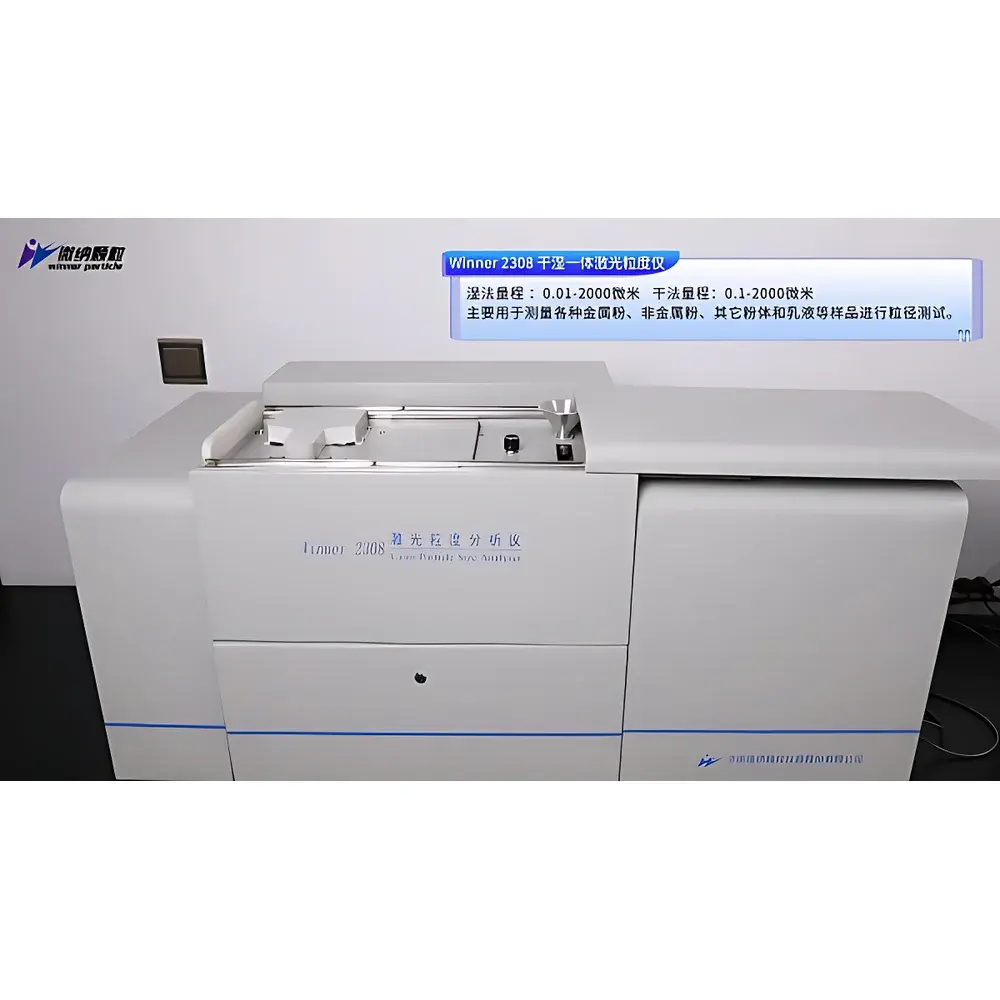
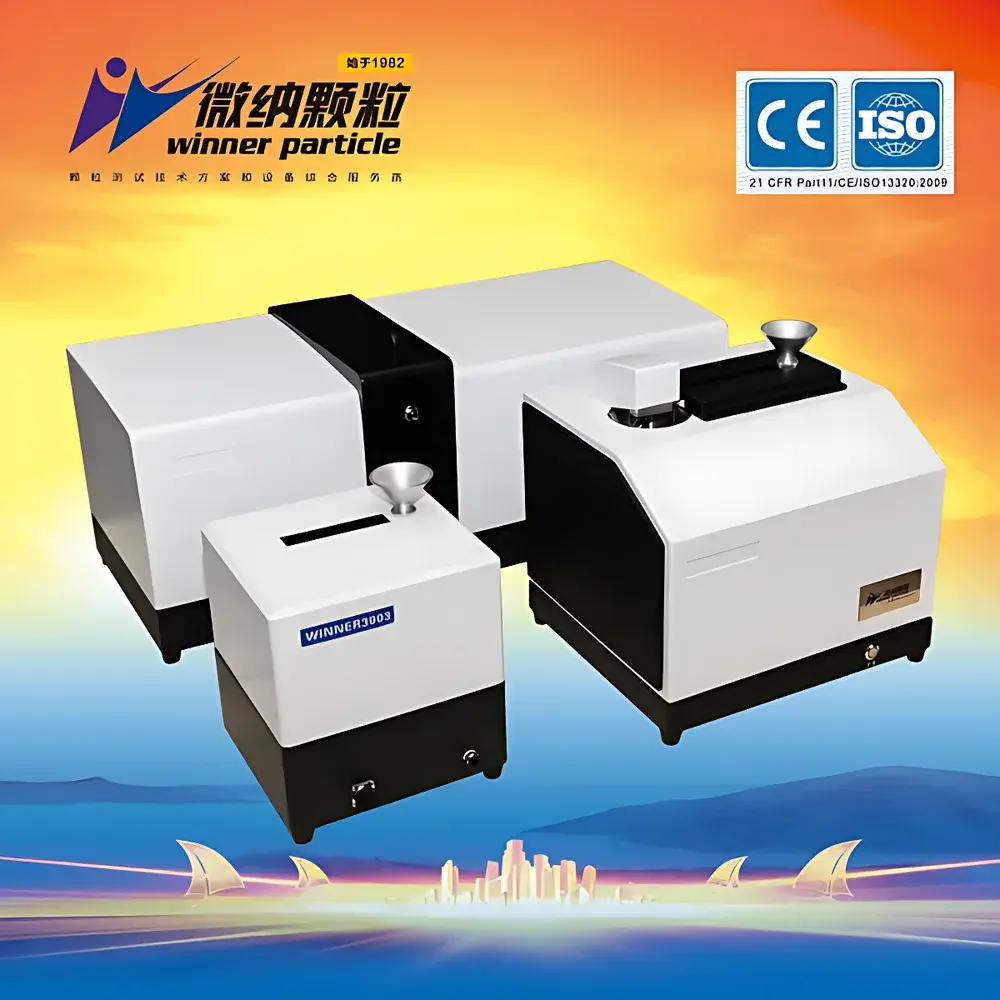
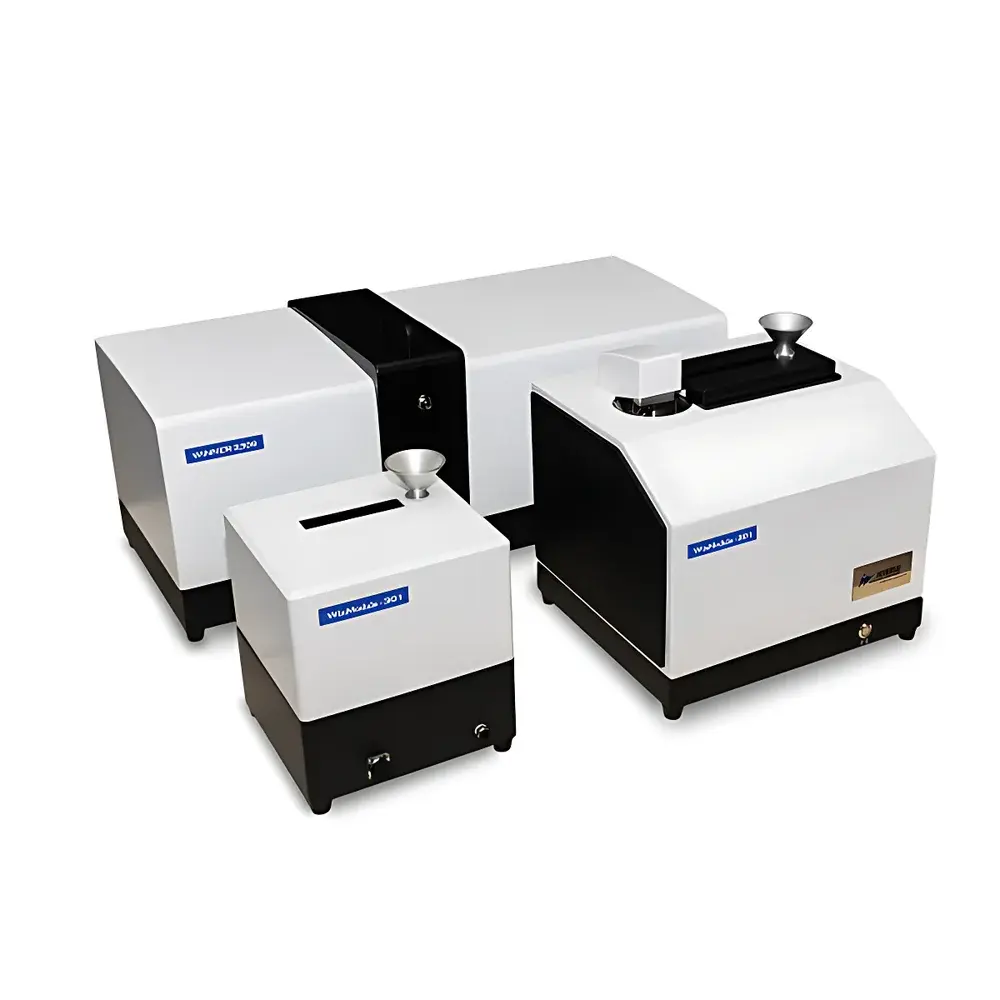
Winner2309B PRO Laser Particle Size Analyzer by Jinan Winner
| Brand | Jinan Winner |
|---|---|
| Origin | Shandong, China |
| Manufacturer Type | Direct Manufacturer |
| Origin Category | Domestic (China) |
| Model | Winner2309B PRO |
| Dispersion Method | Dry & Wet Dispersion |
| Instrument Type | Laboratory Laser Diffraction Particle Size Analyzer |
| Measurement Range | 0.01–2800 µm |
| Repeatability | ≥99.5% (wet), ≥99% (dry) |
| Measurement Time | 10–120 s |
Overview
The Winner2309B PRO Laser Particle Size Analyzer is a high-precision, dual-mode laboratory instrument engineered for universal particle size characterization across diverse industrial and research applications. It operates on the principle of laser diffraction—compliant with ISO 13320:2020 and GB/T 19077–2016—where particles suspended in liquid or dispersed in air scatter incident laser light at angles inversely proportional to their size. The system employs a dual-laser optical architecture: a primary red laser (λ = 639 nm, >2 mW) for broad-range detection and a secondary blue laser (λ = 405 nm, >2 mW) to enhance resolution for submicron particles (<1 µm). This multi-wavelength configuration enables robust detection across an extended dynamic range of 0.01–2800 µm, supporting both wet dispersion (for water-dispersible, non-hygroscopic materials) and dry dispersion (for moisture-sensitive, cohesive, or thermally unstable powders). Its modular design integrates independent, swappable sample introduction modules—WinModule-201 (wet) and WinModule-301 (dry)—while maintaining optical path consistency and measurement traceability between modes.
Key Features
- Modular dual-dispersion architecture: Fully independent wet and dry feed systems allow rapid, tool-free switching without recalibration or optical realignment.
- Dual-laser optical system: Red laser (639 nm) optimized for macro-to-meso particle detection; blue laser (405 nm) improves scattering signal fidelity for nanoparticles and fine fractions.
- Intelligent auto-alignment: Closed-loop stepper motor-driven optical centering with 0.1 µm positional resolution ensures long-term beam stability and measurement reproducibility.
- Hybrid dispersion control: Wet module features adjustable ultrasonic dispersion (40 kHz, 0–60 W, time-programmable); dry module utilizes vortex-assisted jet shear dispersion for deagglomeration of cohesive powders.
- Flexible flow management: Integrated peristaltic valve system enables seamless transition between recirculating mode (optimized for fine particles <100 µm) and direct-through mode (for coarse particles up to 2800 µm and continuous throughput).
- High-speed data acquisition: 10 kHz sampling rate captures transient dispersion events and ensures statistically representative particle population sampling.
Sample Compatibility & Compliance
The Winner2309B PRO accommodates a broad spectrum of particulate materials—including pharmaceutical actives, ceramic precursors, catalysts, metal oxides, pigments, cement clinker, coal ash, food-grade starches, and battery electrode slurries—without requiring method redevelopment when switching between dispersion modes. Its compliance framework supports regulatory workflows: software includes audit-trail logging, user-access controls, electronic signature support, and SOP-driven test protocols aligned with GLP and GMP documentation requirements. All measurement data adhere to ISO 13320:2020 validation criteria for diffraction-based sizing, including Mie theory-based optical modeling (with customizable complex refractive index input) and rigorous uncertainty quantification per ISO/IEC 17025 guidelines. Calibration verification is performed using NIST-traceable polystyrene latex standards (PSL), with D50 accuracy ≤0.5% (wet) and ≤1.0% (dry).
Software & Data Management
The embedded analysis software provides comprehensive post-processing capabilities compliant with analytical data integrity standards. It supports multiple distribution models—free (non-parametric) inversion, Rosin-Rammler, and log-normal—alongside volume-, number-, and surface-area-weighted statistics. Users may define custom percentile queries (e.g., D10/D50/D90), generate comparative overlays of up to 16 datasets, and export reports in PDF, Excel (.xlsx), Word (.docx), BMP, and plain-text formats. The interface supports multilingual operation (English, Chinese, and configurable UTF-8 locales) and allows full SOP scripting—including automated sequence control for dispersion duration, sonication power, stirrer RPM (0–3000 rpm), and flow rate (1000–8000 mL/min). All instrument parameters, raw intensity spectra, and final distributions are timestamped and stored with immutable metadata for retrospective review and FDA 21 CFR Part 11–compatible archiving.
Applications
This analyzer serves as a primary metrology tool in quality control laboratories across cement manufacturing (fineness grading of clinker and fly ash), pharmaceutical development (API particle size impact on dissolution and bioavailability), advanced ceramics (slurry homogeneity assessment), battery R&D (cathode/anode powder morphology correlation), and environmental monitoring (sediment grain-size classification per ASTM D422). Its wide dynamic range eliminates the need for complementary techniques such as sedimentation or electron microscopy for routine batch release testing. Researchers utilize its intelligent statistical comparison functions to evaluate milling efficiency, classify fracturing debris, validate spray-drying output, and correlate particle size distribution with rheological behavior in suspensions.
FAQ
Does the Winner2309B PRO require separate calibration for dry and wet modes?
No—its co-aligned optical train and shared detector array ensure measurement equivalence between dispersion methods; only sample-specific refractive index and absorption parameters must be entered.
Can the instrument meet FDA 21 CFR Part 11 requirements for electronic records?
Yes—the software supports role-based access control, electronic signatures, audit trails, and data immutability features required for regulated environments.
What is the minimum sample volume required for wet dispersion analysis?
Typical suspension volume is 300–600 mL in the 600 mL sample cell; minimum detectable mass depends on material density and optical contrast but is typically ≥1 mg for high-scattering samples.
Is Mie theory calculation enabled by default, and can users input custom complex refractive indices?
Yes—Mie theory is the default optical model, and users may enter real and imaginary components of refractive index for any material, drawing from an integrated database of >200 common substances.
How does the system handle highly cohesive or electrostatically charged powders in dry mode?
The WinModule-301 dry feeder uses pulsed air-jet shear combined with controlled turbulence to minimize agglomerate carryover; optional static-dissipative tubing and grounding kits are available for conductive powder handling.



