
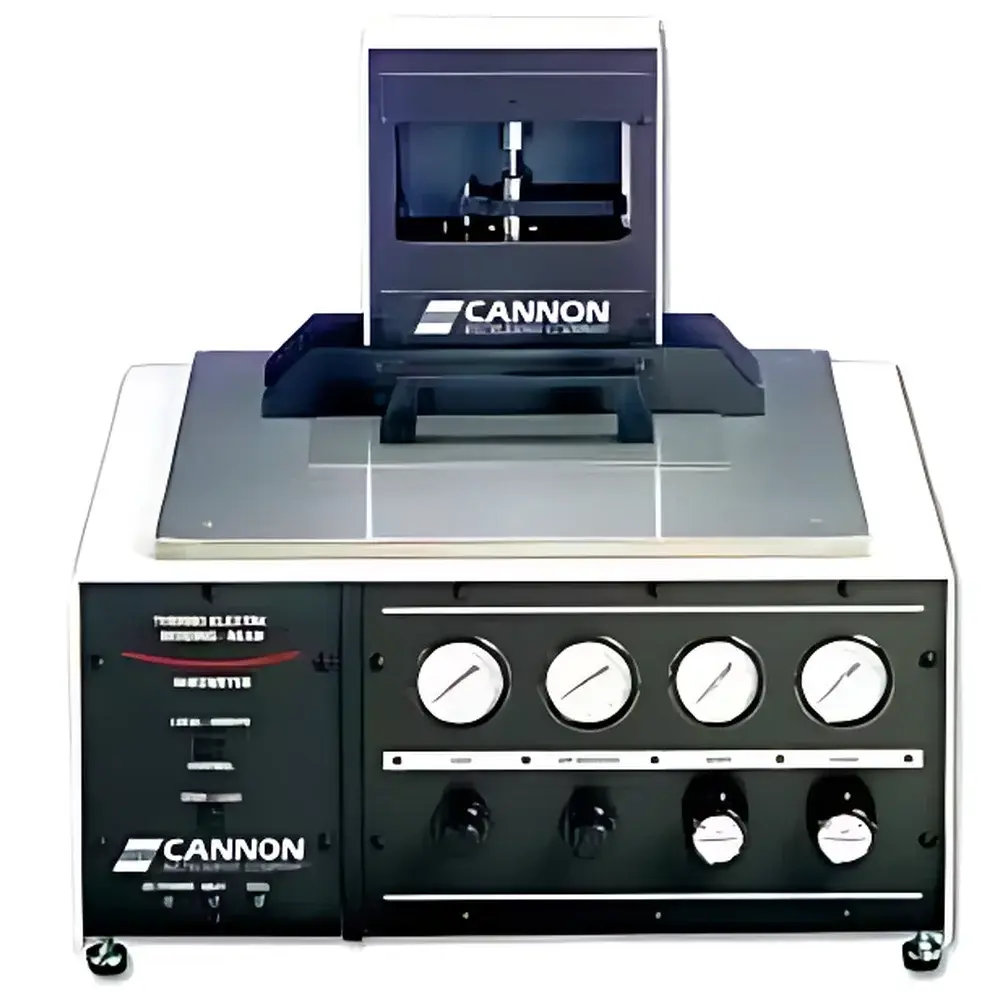
Cannon TE-BBR Bending Beam Rheometer (BBR) for Asphalt Low-Temperature Characterization
| Brand | Cannon |
|---|---|
| Origin | USA |
| Manufacturer Type | Authorized Distributor |
| Product Category | Imported Instrument |
| Model | TE-BBR |
| Instrument Type | Bending Beam Rheometer |
| Bearing Type | Air-bearing |
| Minimum Oscillation Frequency | 0.1 Hz |
| Frequency Range | 0.1–100 Hz |
| Maximum Oscillation Frequency | 100 Hz |
| Maximum Applied Load | 45 g (0.441 N) |
| Load Resolution | 0.015 g (0.147 mN) |
| Displacement Resolution | 0.155 µm |
| Temperature Control Stability | ±0.03 °C |
| Minimum Operating Temperature | –36 °C |
| Cooling Method | Thermoelectric (Peltier) with Air/Water Heat Exchange |
| Interface | RS-232 Serial |
| Software Platform | Windows 95/NT (v3.51 or later) |
| System Requirements | IBM-compatible PC, SVGA monitor, 16 MB RAM, 20 MB free HDD space, 1.44 MB floppy drive |
Overview
The Cannon TE-BBR Bending Beam Rheometer is a precision-engineered instrument designed specifically for the low-temperature mechanical characterization of asphalt binders in accordance with ASTM D6648, AASHTO T313, and SHRP TP-10 (now incorporated into AASHTO M320 and ASTM D7405). It implements the bending beam creep test principle—where a prismatic asphalt binder specimen is subjected to a constant vertical load while suspended across two supports—and measures time-dependent deflection under controlled thermal conditions. Unlike conventional cryogenic systems requiring external refrigerants or liquid nitrogen, the TE-BBR employs a solid-state thermoelectric (Peltier) cooling architecture capable of stabilizing bath temperatures from ambient down to –36 °C with exceptional uniformity and repeatability. Its air-bearing oscillation system eliminates mechanical friction, ensuring high-fidelity load application and displacement measurement critical for accurate stiffness (S) and m-value (rate of change of stiffness) determination per standardized protocols.
Key Features
- Thermoelectric cooling system with integrated air/water heat exchange—no hazardous refrigerants, no external chiller required
- Air-bearing actuation mechanism enabling ultra-low friction load application and precise frequency control (0.1–100 Hz)
- Temperature stability of ±0.03 °C over the full operating range (–36 °C to +25 °C), exceeding ASTM D6648 requirements
- High-resolution displacement transducer (0.155 µm) and load sensor (0.147 mN / 0.015 g) calibrated traceably to NIST standards
- Four independent pneumatic pressure regulators for fine-tuned control of main supply, air bearing, zero-balance, and loading pressures
- Magnetically driven variable-speed stirrer ensures homogeneous thermal distribution within the cooling bath
- Self-contained data acquisition with real-time analog-to-digital conversion and RS-232 serial output—no internal expansion cards required
Sample Compatibility & Compliance
The TE-BBR accommodates standard asphalt binder specimens measuring 12.5 mm × 12.5 mm × 101.6 mm (0.5″ × 0.5″ × 4″), prepared per ASTM D7175 or AASHTO T315 procedures. All hardware and calibration artifacts—including reference beams, calibration weights, and thermal verification probes—are supplied with NIST-traceable documentation. The system fully complies with the instrumentation and procedural specifications outlined in ASTM D6648 (Standard Test Method for Determining the Flexural Creep Stiffness of Asphalt Binder Using the Bending Beam Rheometer), AASHTO T313, and SH/T 0775 (Chinese national standard aligned with SHRP methodology). Its design supports GLP-compliant operation when paired with validated software and audit-trail-enabled data handling workflows.
Software & Data Management
The TE-BBR operates via dedicated Windows 95/NT software that provides full instrument control—including temperature ramping, load application timing, and real-time deflection monitoring. The interface enables graphical visualization of creep compliance curves, automatic calculation of S(t) and m(t) values at 60 s, and export of raw time-series data in ASCII format for post-processing in third-party analysis tools (e.g., MATLAB, Excel, or statistical packages). Firmware and software updates are delivered via downloadable binaries, ensuring long-term compatibility with evolving laboratory IT infrastructure. While the native software does not include FDA 21 CFR Part 11 electronic signature functionality, its structured data logging architecture facilitates integration into validated LIMS or ELN platforms supporting audit trail and user access control requirements.
Applications
- Determination of low-temperature stiffness (S) and relaxation rate (m-value) of PG-rated asphalt binders
- Quality assurance testing of polymer-modified and oxidized asphalt formulations
- Research-grade evaluation of aging effects (RTFOT, PAV) on low-temperature rheological performance
- Validation of rheological models (e.g., Generalized Maxwell, Burgers) used in mechanistic-empirical pavement design (MEPDG)
- Interlaboratory round-robin studies requiring high inter-unit reproducibility and metrological traceability
FAQ
What standards does the TE-BBR support?
ASTM D6648, AASHTO T313, SHRP TP-10 (now superseded by ASTM D7405), and SH/T 0775.
Does the TE-BBR require external refrigerant or cryogenic supply?
No—its thermoelectric cooling system operates independently without liquid nitrogen, Freon, or external chillers.
How is temperature uniformity maintained in the cooling bath?
Via a variable-speed magnetic stirrer located at the bath base, combined with optimized Peltier module geometry and forced-air/water heat dissipation.
Is the system compatible with modern Windows OS versions?
The native software was developed for Windows 95/NT; operation on Windows 10/11 requires virtualization or compatibility layer configuration—contact Cannon technical support for validated deployment options.
What is the calibration traceability pathway?
All force and displacement sensors are calibrated using NIST-traceable reference standards; full calibration certificates and uncertainty budgets are provided with each instrument shipment.



