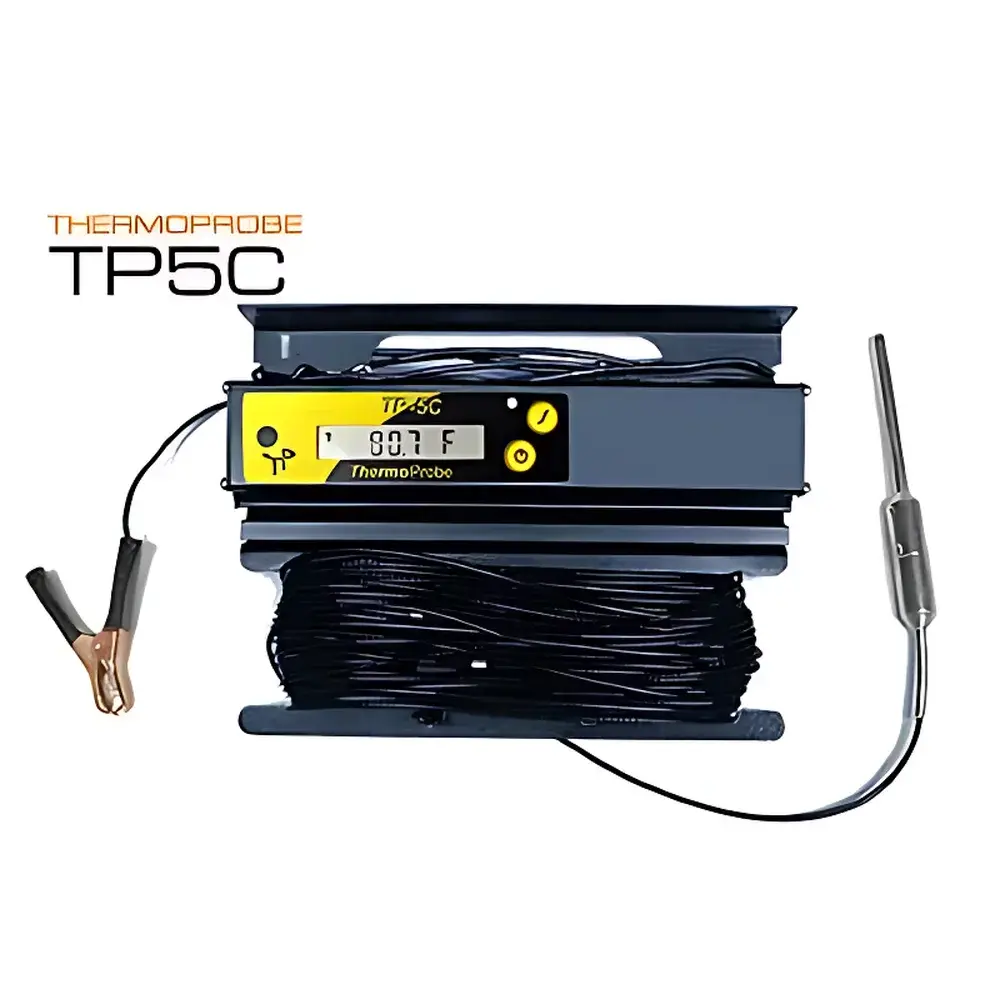
Thermoprobe TP5C Intrinsically Safe Portable Tank Thermometer
| Brand | Thermoprobe |
|---|---|
| Origin | USA |
| Model | TP5C |
| Temperature Range | -40°C to +204°C |
| Accuracy | ±0.2°F (-40°F to 200°F), ±0.5°F (200°F to 400°F) |
| Resolution | 0.1°C |
| Operating Ambient Temperature | -20°C to +54°C (-4°F to 130°F) |
| Display | LCD |
| Power Supply | 3V CR2032 coin cell battery |
| Dimensions | 9.5"L × 7.2"H × 1.76"W in (241 mm × 183 mm × 45 mm) |
| Weight | 124 g |
| Probe Material | 304 Stainless Steel |
| Safety Certification | UL Listed for Class I, Division 1, Groups B, C, D |
| Calibration | NIST-traceable 4-point calibration report |
Overview
The Thermoprobe TP5C is an intrinsically safe, handheld portable thermometer engineered specifically for temperature measurement in hazardous environments associated with petroleum storage, fuel transfer, and bulk liquid handling operations. It operates on the principle of precision thermistor-based sensing housed within a ruggedized 304 stainless steel probe, delivering high-reproducibility readings across a wide operational range. Designed for direct immersion into light hydrocarbon liquids—including gasoline, diesel, jet fuel, and crude oil—the TP5C complies with international standards for equipment used in explosive atmospheres (IEC 60079-0, IEC 60079-11). Its intrinsic safety design eliminates ignition risk by limiting electrical energy to levels incapable of igniting flammable gas mixtures—critical for use inside or adjacent to aboveground and underground storage tanks, tanker compartments, and loading racks where vapors may accumulate.
Key Features
- Intrinsically safe construction certified to UL 913 (Class I, Division 1, Groups B, C, D) and ATEX Directive 2014/34/EU (II 2 G EEx ib IIB T4), enabling safe deployment in Zone 1 hazardous locations.
- High-stability thermistor sensor with NIST-traceable 4-point calibration report, ensuring metrological integrity for audit-ready quality control and regulatory compliance.
- Robust aluminum housing with IP65-rated ingress protection against dust and low-pressure water jets—suitable for field use in refinery perimeters, marine terminals, and railcar inspection zones.
- Backlit LCD display with 0.1°C resolution and dual-scale readout (°C/°F), optimized for rapid visual verification under variable lighting conditions.
- Compact, ergonomic form factor (241 × 183 × 45 mm) and lightweight design (124 g) facilitate one-handed operation during tank gauging, dip-tape verification, and routine QC spot checks.
- CR2032 lithium coin cell power supply provides stable voltage output across the full operating ambient range (–20°C to +54°C); battery life exceeds 1,000 hours of typical intermittent use.
Sample Compatibility & Compliance
The TP5C is validated for direct contact measurement in non-viscous, low-conductivity hydrocarbon liquids including ASTM D975 diesel fuel, ASTM D1655 Jet A/A-1, and API RP 2552 refined products. It is not intended for use in conductive media (e.g., aqueous solutions, acids, or caustics) or high-viscosity oils without prior validation. The instrument meets requirements for field instrumentation under ISO 8502-9 (surface temperature measurement for coating application), ASTM D1250 (Petroleum Measurement Tables), and USP Analytical Instrument Qualification when deployed as part of a documented calibration management system. Its certification supports compliance with OSHA 1910.120 (Hazardous Waste Operations), EPA 40 CFR Part 63 Subpart GGG (National Emission Standards for Hazardous Air Pollutants), and EU Directive 1999/92/EC (ATEX Workplace Directive).
Software & Data Management
The TP5C is a standalone analog-digital hybrid instrument with no embedded firmware, wireless interface, or data logging capability—intentionally designed to minimize failure modes in safety-critical applications. All calibration records, including the supplied NIST-traceable 4-point test report, are retained as hard-copy documentation aligned with GLP and GMP record-keeping requirements. Users integrate TP5C measurements into enterprise systems via manual entry into LIMS (e.g., LabWare, Thermo Fisher SampleManager) or digital logbooks compliant with FDA 21 CFR Part 11 when paired with electronic signature workflows. Periodic recalibration is recommended annually or per internal SOPs, with traceability maintained through accredited calibration laboratories operating to ISO/IEC 17025.
Applications
- Temperature verification during custody transfer of petroleum products per API MPMS Chapter 9.1.
- Pre-fill and post-fill thermal monitoring of API 650 storage tanks to support volume correction calculations.
- Field validation of fixed tank temperature sensors (RTDs/thermocouples) in accordance with API RP 1170.
- Quality assurance testing of fuel batches prior to dispatch from terminal facilities.
- Hazardous area temperature auditing during turnaround inspections and PHA (Process Hazard Analysis) walkdowns.
- Supporting vapor pressure estimation (ASTM D323, D5191) and distillation curve correlation (ASTM D86).
FAQ
Is the TP5C suitable for measuring temperature in water or glycol solutions?
No. The TP5C is calibrated and certified exclusively for non-aqueous, low-polarity hydrocarbon liquids. Immersion in conductive or polar media may compromise sensor stability and invalidate intrinsic safety certification.
What is the recommended recalibration interval?
Annual recalibration is standard practice; however, frequency must be determined by risk assessment, usage intensity, and internal quality procedures per ISO/IEC 17025 Clause 6.6.
Can the TP5C be used in sub-zero ambient conditions below –20°C?
Operation below –20°C is not supported. Battery performance degrades significantly below this threshold, potentially causing display dropout or measurement drift—even if the probe itself remains functional.
Does the instrument include a probe sheath or protective cap?
Yes—a machined aluminum protective cap is included to shield the 304 SS probe tip during transport and storage, preserving mechanical integrity and minimizing contamination.
Is the LCD display readable in direct sunlight?
The monochrome backlit LCD provides adequate contrast under most ambient lighting, including shaded outdoor conditions; however, prolonged exposure to unfiltered solar irradiance may reduce visibility—users are advised to shade the display during critical readings.