
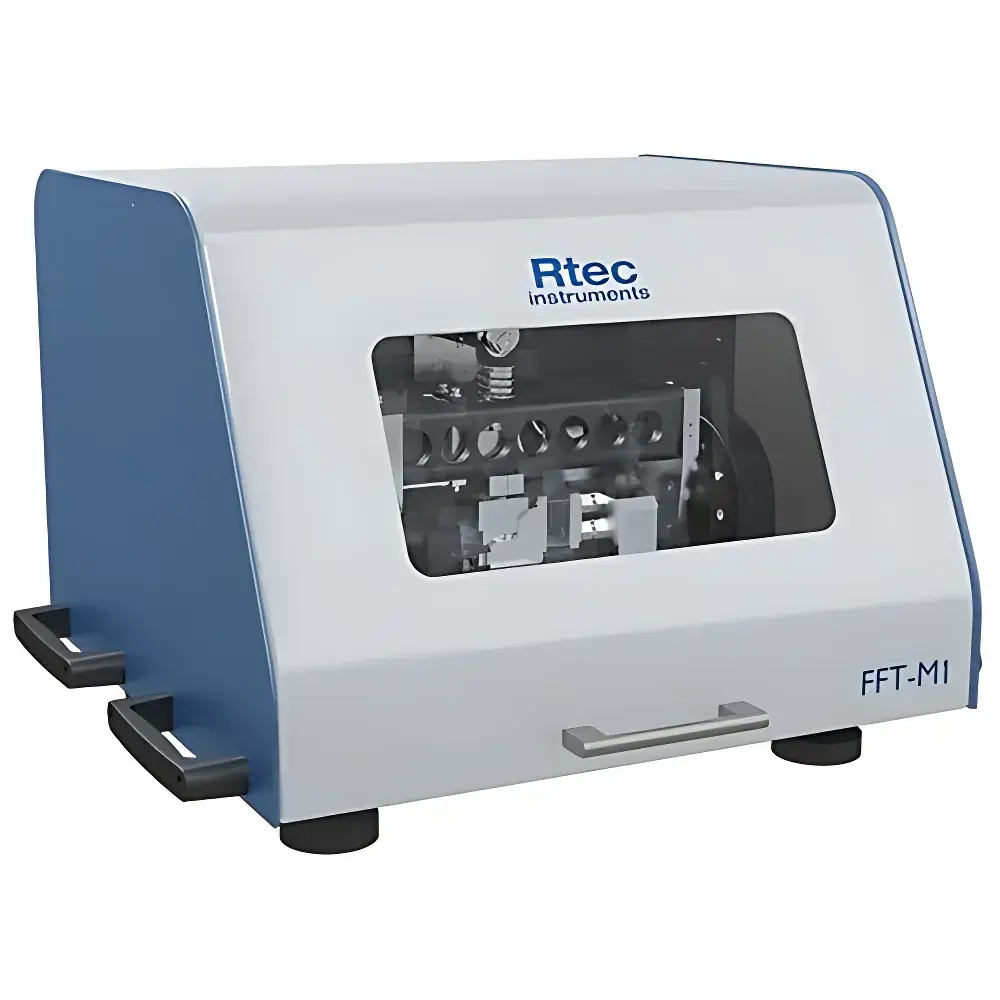
Rtec FFT-M1 High-Frequency Reciprocating Rig (HFRR)
| Brand | Rtec |
|---|---|
| Origin | USA |
| Model | FFT-M1 |
| Application | Tribological Evaluation of Fuels and Lubricants |
| Compliance | ASTM D6079, ISO 12156-1, SH/T 0765, EN 590, JPI-5S-50-9, IP 450 |
| Load Range | 0–1.0 kg |
| Frequency Range | 1–300 Hz |
| Stroke Amplitude | 0.005–2 mm |
| Operating Temperature | Ambient to +200 °C |
| Test Mode | Boundary Lubrication Assessment under Oscillatory Sliding Conditions |
Overview
The Rtec FFT-M1 High-Frequency Reciprocating Rig (HFRR) is an engineered tribometer designed for quantitative assessment of boundary lubrication performance in liquid fuels and lubricants under controlled oscillatory sliding conditions. It operates on the principle of high-frequency linear reciprocation between a stationary steel ball and a flat steel disc (or pin-on-flat configuration), generating reproducible wear scars and friction coefficient profiles under precisely regulated load, frequency, stroke, and temperature. This methodology aligns with internationally recognized test protocols for evaluating the anti-wear and lubricity characteristics of diesel fuel, engine oils, greases, and other hydrocarbon-based formulations—particularly where low-sulfur or alternative fuel blends exhibit marginal lubricity. The FFT-M1 delivers traceable, repeatable data essential for formulation development, quality control, and regulatory compliance in petroleum refining, additive manufacturing, and OEM lubricant qualification.
Key Features
- Modular, air-cooled or oil-heated temperature control system enabling stable operation from ambient to +200 °C—critical for simulating elevated under-hood or engine sump conditions.
- Digital closed-loop servo control for load (0–1.0 kg), frequency (1–300 Hz), and stroke amplitude (0.005–2 mm), ensuring sub-millisecond timing resolution and minimal hysteresis.
- Integrated high-resolution optical microscope with automated scar measurement software for ISO/ASTM-compliant wear scar diameter (WSD) analysis per ASTM D6079 Annex A1.
- Real-time friction coefficient monitoring via precision load cell and displacement transducer, sampled at ≥1 kHz for transient event capture during start-up, boundary transition, or film breakdown.
- Compact benchtop architecture with electromagnetic isolation base and rigid stainless-steel frame to minimize environmental vibration coupling and ensure measurement integrity.
- Interchangeable test fixtures supporting standard 6-mm steel balls (AISI E52100), flat discs (10-mm diameter), and optional coated or non-ferrous counterfaces for specialized material compatibility studies.
Sample Compatibility & Compliance
The FFT-M1 accommodates neat fuels (e.g., ultra-low-sulfur diesel, biodiesel blends, synthetic jet fuels), mineral and synthetic engine oils, gear oils, hydraulic fluids, and semi-solid greases (via solvent-dilution or heated reservoir protocols). All test configurations adhere to the mechanical and procedural requirements of ASTM D6079 (Standard Test Method for Determining the Lubricity of Diesel Fuels by the High-Frequency Reciprocating Rig), ISO 12156-1 (Petroleum products — Determination of the lubricity of diesel fuels — Part 1: High-frequency reciprocating rig (HFRR) method), and equivalent regional standards including SH/T 0765 (China), EN 590 (EU), and JPI-5S-50-9 (Japan Petroleum Institute). Instrument validation documentation supports GLP-compliant laboratory audits and satisfies data integrity expectations under FDA 21 CFR Part 11 when paired with Rtec’s validated software suite.
Software & Data Management
The FFT-M1 is operated via Rtec’s TRIBO™ Control Suite—a Windows-based application delivering full test sequence programming, real-time parameter visualization, and post-test analytical workflows. Software modules include automated WSD quantification using ISO-defined edge-detection algorithms, friction trend overlay across multiple runs, statistical process control (SPC) charting for QC batches, and export-ready reports compliant with LIMS integration (CSV, XML, PDF). Audit trail functionality logs all user actions, parameter modifications, and calibration events with time-stamped digital signatures. Data files are stored in vendor-neutral HDF5 format to ensure long-term archival stability and third-party analysis compatibility.
Applications
- Screening of lubricity-enhancing additives (e.g., fatty acid esters, amine derivatives) in diesel fuel formulations prior to engine testing.
- Comparative evaluation of biofuel lubricity degradation during oxidative aging or storage stability trials.
- Boundary lubrication characterization of low-viscosity engine oils (e.g., SAE 0W-16) under high-temperature, low-film-thickness conditions.
- Quality assurance of finished lubricants against batch-to-batch variation in wear protection performance.
- Research into tribofilm formation mechanisms on ferrous surfaces using in situ friction–temperature correlation mapping.
- Supporting OEM specification development (e.g., GM dexos®, Ford WSS-M2C945-A) requiring HFRR-based lubricity verification.
FAQ
What standards does the FFT-M1 directly support?
ASTM D6079, ISO 12156-1, SH/T 0765, EN 590, JPI-5S-50-9, and IP 450—all implemented via pre-configured test templates and certified calibration procedures.
Can the FFT-M1 test greases or viscous oils?
Yes; samples may be tested as heated liquids or diluted in volatile solvents (e.g., n-heptane), followed by controlled evaporation to deposit a uniform film on the test disc.
Is temperature control fully integrated and programmable?
Yes; the system includes a PID-controlled heating module with ±0.5 °C stability over the full 25–200 °C range, verified with NIST-traceable thermocouples.
How is wear scar measured and validated?
Via calibrated 10×–50× optical magnification and automated image analysis software that computes mean scar diameter per ISO 12156-1 Annex B, with operator review capability for outlier rejection.
Does the instrument meet regulatory data integrity requirements?
When deployed with TRIBO™ Control Suite v4.2+, it supports 21 CFR Part 11-compliant electronic records, including role-based access control, audit trails, and electronic signatures.





