
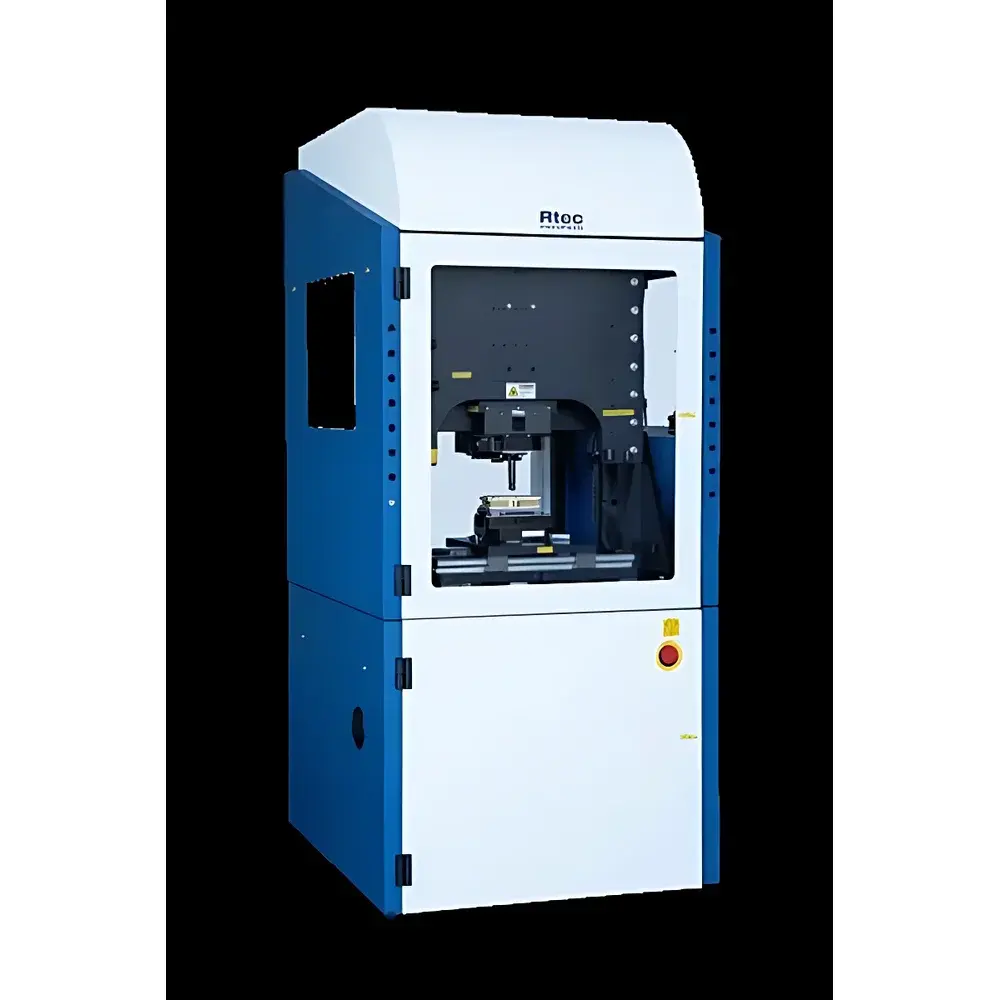
Rtec MFT-3000 Long-Stroke High-Frequency Reciprocating Tribometer
| Brand | Rtec |
|---|---|
| Origin | USA |
| Model | MFT-3000 |
| Load Range | 0–3000 N |
| Reciprocating Stroke | 0–30 mm |
| Frequency Range | 0–80 Hz |
| Temperature Control | Ambient to +500 °C (up to +1000 °C optional) |
| Low-Temperature Option | Ambient to –60 °C |
| Thermal Cycling Option | –40 °C to +180 °C |
| Rotational Mode (optional) | 0.1–5000 rpm, 0.1 rpm resolution |
| Compliance | ASTM G133, G181, G119, G174, D5706, D5707, SH/T 0784, SH/T 0721, DIN 51834 |
Overview
The Rtec MFT-3000 Long-Stroke High-Frequency Reciprocating Tribometer is a modular, high-precision tribological testing platform engineered for quantitative evaluation of friction, wear, and lubrication behavior under dynamically controlled mechanical and thermal boundary conditions. It operates on the principle of controlled reciprocating motion between two solid surfaces—typically a stationary counterface (e.g., ball, pin, or flat) and a driven sample—while simultaneously measuring real-time normal force, frictional force, displacement, and temperature. Its long-stroke capability (up to 30 mm) and high-frequency actuation (0–80 Hz) enable precise simulation of operational regimes ranging from quasi-static stick-slip transitions to high-cycle fatigue-driven wear mechanisms. The system supports both linear reciprocation and optional high-speed rotational motion (0.1–5000 rpm), allowing seamless transition between ASTM-standardized reciprocating protocols (e.g., G133 for wear mapping) and rotating configurations (e.g., ASTM D5707 for grease consistency). Designed for rigorous R&D environments, the MFT-3000 delivers high reproducibility in coefficient-of-friction (COF) measurement (< ±0.002), sub-micron displacement resolution, and synchronized multi-channel data acquisition at up to 10 kHz sampling rate.
Key Features
- Modular architecture supporting interchangeable test modules: reciprocating, rotational, linear oscillatory, and custom-configured tribo-pairs.
- High-force actuation system with closed-loop load control (0–3000 N), enabling simulation of heavy-duty bearing, gear, and piston-ring contact pressures.
- Precision stroke control (0–30 mm, ±0.5 µm repeatability) optimized for Stribeck curve characterization, boundary lubrication onset detection, and adhesion–sliding transition analysis.
- Integrated thermal management: standard ambient-to-+500 °C heating stage; optional extended-range furnace (to +1000 °C) and cryogenic cooling module (to –60 °C); full thermal cycling capability (–40 °C to +180 °C) with ramp rates up to 20 °C/min.
- Real-time synchronization of force, displacement, temperature, and acoustic emission signals via hardware-timed DAQ with anti-aliasing filtering and programmable trigger logic.
- Compliance-ready firmware architecture supporting audit trails, user access levels, electronic signatures, and data integrity features aligned with FDA 21 CFR Part 11 and GLP/GMP documentation requirements.
Sample Compatibility & Compliance
The MFT-3000 accommodates a broad range of specimen geometries—including disks, pins, balls, blocks, coatings on substrates, and thin-film layers—using standardized holders per ASTM and ISO conventions. Test configurations support ball-on-flat, pin-on-disk, block-on-ring, and custom multi-contact interfaces. All mechanical and thermal subsystems are calibrated traceably to NIST standards. The instrument meets or exceeds performance criteria specified in ASTM G133 (reciprocating wear), G181 (lubricant film thickness mapping), G119 (wear classification), G174 (scratch resistance), D5706 (grease wear under oscillation), D5707 (rotating four-ball), SH/T 0784 (Chinese standard for engine oil wear), SH/T 0721 (anti-wear additive evaluation), and DIN 51834 (tribological testing of lubricants). Calibration certificates, uncertainty budgets, and IQ/OQ documentation packages are available upon request for regulated laboratory deployment.
Software & Data Management
TriboSoft™ v5.2, the native control and analysis suite, provides scriptable test sequencing, real-time parameter visualization, and post-test tribological analytics including COF time-series decomposition, wear volume calculation via profilometry integration, wear scar morphology quantification (ISO 20808), and automated Stribeck curve generation. Raw data is stored in HDF5 format with embedded metadata (test parameters, calibration IDs, operator logs, environmental timestamps). Export options include CSV, MATLAB .mat, and ASTM E1447-compliant XML. The software supports role-based permissions, electronic signature workflows, and configurable report templates compliant with ISO/IEC 17025 reporting guidelines. Optional LIMS integration via RESTful API enables automated result ingestion into enterprise quality management systems.
Applications
- Development and qualification of advanced lubricants (engine oils, gear oils, greases, bio-lubricants) under extreme pressure, high-temperature, and low-speed/high-torque conditions.
- Evaluation of wear resistance and scuffing behavior of coated components (DLC, CrN, TiAlN) used in aerospace actuators, automotive transmissions, and medical implants.
- Quantitative assessment of material pairing compatibility (e.g., polymer composites vs. stainless steel) in sealing and bearing applications.
- Fundamental research into interfacial phenomena: third-body formation, tribofilm growth kinetics, shear-induced phase transitions in lubricant additives, and thermally activated wear mechanisms.
- Regulatory submission support for OEM lubricant approvals (e.g., API SP, ACEA C6, OEM-specific specifications such as GM dexos1, Ford WSS-M2C947-A).
FAQ
What ASTM standards does the MFT-3000 natively support?
The system includes preconfigured test methods for ASTM G133, G181, G119, G174, D5706, and D5707, with validated control algorithms and reporting templates.
Can the MFT-3000 operate under vacuum or controlled atmosphere?
Yes—optional environmental chambers support inert gas purging (N₂, Ar), humidity control (5–95% RH), and vacuum operation down to 10⁻³ mbar, with feedthroughs for electrical and optical access.
Is third-party calibration and certification available?
Rtec partners with ISO/IEC 17025-accredited metrology labs to provide annual calibration services, uncertainty analysis, and compliance verification reports.
How is data integrity ensured during long-duration tests (e.g., 100+ hours)?
Continuous checksum validation, redundant storage (local SSD + network backup), and automatic recovery from power interruption ensure zero data loss across multi-day experiments.
Does the system support in situ imaging or spectroscopy integration?
Yes—the MFT-3000 features standardized optical ports and mechanical mounting interfaces compatible with confocal microscopes, Raman spectrometers, and white-light interferometers for simultaneous topographical and chemical analysis.





