
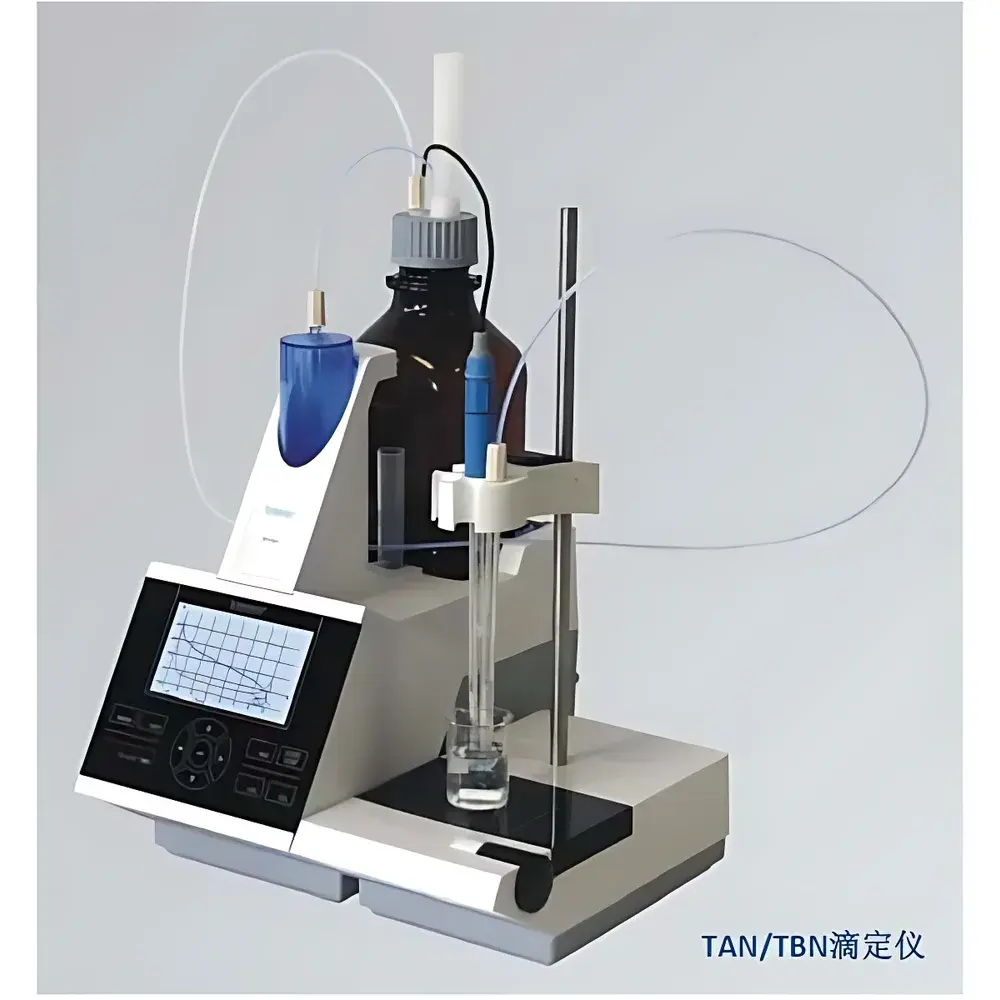
ECH TAN/TBN Titrator
| Brand | ECH |
|---|---|
| Origin | Germany |
| Model | TAN/TBN Titrator |
| Application Standard Compliance | IEC 62021-1, ISO 3771, ASTM D664, ASTM D2896, ASTM D4739 |
| Titration Method | Potentiometric Volumetric Titration in Anhydrous Medium |
| Measurement Range | 0.01–250 mg KOH/g |
| Resolution | 0.01 mg KOH/g |
| Power Supply | 100–240 V AC, 50/60 Hz, 30 VA |
| Stirrer Output | 12 V DC, 500 mA |
| Dimensions (W × H × D) | 30 × 45 × 30 cm (including reagent changer height) |
| Weight | ~3.5 kg (with reagent changer and empty bottles) |
Overview
The ECH TAN/TBN Titrator is a dedicated potentiometric volumetric titration system engineered for precise determination of Total Acid Number (TAN) and Total Base Number (TBN) in lubricating oils, transformer oils, and other petroleum-based fluids. It operates on the principle of potentiometric endpoint detection in anhydrous media—typically using non-aqueous solvents such as toluene–propanol mixtures and standardized alcoholic KOH or HCl titrants. The instrument implements real-time potential monitoring across a high-stability pH-sensitive electrode pair, enabling robust identification of inflection points in the titration curve without reliance on visual indicators. This electrochemical approach ensures high reproducibility, especially critical for low-TAN samples (<0.5 mg KOH/g) where conventional colorimetric methods suffer from subjectivity and poor sensitivity. Designed specifically for routine QC/QA laboratories in refineries, OEM lubricant testing centers, and independent oil analysis labs, the system meets the metrological and procedural requirements of internationally recognized standards including IEC 62021-1 (for insulating oils), ISO 3771 (TAN), ASTM D664 (potentiometric TAN), ASTM D2896 (TBN via perchloric acid), and ASTM D4739 (TBN via hydrochloric acid). Its architecture supports both single- and multi-sample workflows through integrated reagent handling and automated electrode conditioning sequences.
Key Features
- Full volumetric titration automation with closed-loop control algorithm that dynamically adjusts titrant delivery rate based on real-time slope analysis of the potential curve—minimizing overshoot and optimizing endpoint precision
- Preset method library compliant with ASTM, ISO, and IEC protocols; users may select, duplicate, or modify methods directly via touchscreen interface without programming knowledge
- Integrated reagent changer supporting up to four titrant/solvent reservoirs, enabling unattended sequential analysis of TAN and TBN on the same sample batch
- Formula generator module allowing custom unit conversion (e.g., mg KOH/g → mmol NaOH/kg) and result derivation using user-defined coefficients or stoichiometric factors
- Automatic electrode calibration and cleaning cycle triggered before each test, ensuring consistent electrode response and reducing manual maintenance intervals
- Real-time graphical display of titration curves with overlay capability for comparative analysis of multiple runs
Sample Compatibility & Compliance
The ECH TAN/TBN Titrator accommodates a broad range of petroleum-derived samples, including mineral and synthetic engine oils, hydraulic fluids, turbine oils, gear oils, and electrical insulating oils. Sample mass input (0.1–20 g) is entered manually prior to analysis, with automatic normalization of results to mg KOH/g. All hardware components—including burette drive mechanism, solvent delivery valves, and electrode interface—are constructed from chemically inert materials (e.g., PTFE, borosilicate glass, and ceramic junctions) to resist degradation by aggressive titrants and chlorinated solvents. The system complies with GLP documentation requirements: audit trails record operator ID, method version, timestamped raw potential data, endpoint confirmation status, and any manual intervention. Data integrity conforms to FDA 21 CFR Part 11 expectations when paired with validated LIMS integration or optional electronic signature modules.
Software & Data Management
The embedded firmware features a Linux-based operating system with a responsive 7-inch capacitive touchscreen GUI. Data are stored locally in encrypted SQLite databases with configurable auto-backup to USB drives or network shares. Export formats include CSV (for spreadsheet analysis), PDF (with embedded titration curve and metadata), and XML (compatible with ASTM E1384-compliant laboratory information systems). Audit trail logs capture all critical events—including method edits, calibration entries, and result approvals—with immutable timestamps and user attribution. Optional software upgrades provide advanced statistical tools (e.g., control charting per ASTM D6792), trend analysis across historical batches, and automated report generation aligned with ISO/IEC 17025 reporting clauses.
Applications
- Monitoring oxidative degradation in in-service engine oils via periodic TAN increase tracking
- Evaluating remaining reserve alkalinity in diesel engine oils to determine oil change intervals
- Verifying additive package integrity during lubricant formulation and quality release
- Assessing acid buildup in transformer oils as an early indicator of cellulose insulation aging
- Supporting root-cause analysis in field failures involving corrosion or sludge formation
- Providing traceable, auditable data for ISO 55001 asset management programs and API RP 546 compliance audits
FAQ
Does the instrument support both TAN and TBN measurements in a single run?
No—TAN and TBN require different titrants (KOH vs. HCl/perchloric acid) and distinct solvent systems; however, the reagent changer enables automatic switching between methods without manual intervention.
Can the system be integrated into an existing LIMS environment?
Yes, via configurable TCP/IP socket communication or OPC UA interface; protocol documentation and validation templates are provided for IQ/OQ execution.
Is electrode maintenance fully automated?
The system performs automatic rinsing and potential stabilization cycles pre- and post-titration, though periodic reference electrolyte refills and junction cleaning remain manual tasks per manufacturer schedule.
What is the minimum detectable TAN value under routine conditions?
With optimized sample mass (≥5 g) and fresh electrodes, the practical lower limit is 0.02 mg KOH/g at ≤2% RSD (n=6), consistent with ASTM D664 repeatability criteria.
Are calibration standards traceable to NIST or equivalent NMIs?
The instrument does not include certified reference materials; users must source CRM-grade titrants (e.g., NIST SRM 3600 for KOH) and document their traceability per ISO/IEC 17025 Clause 6.6.



