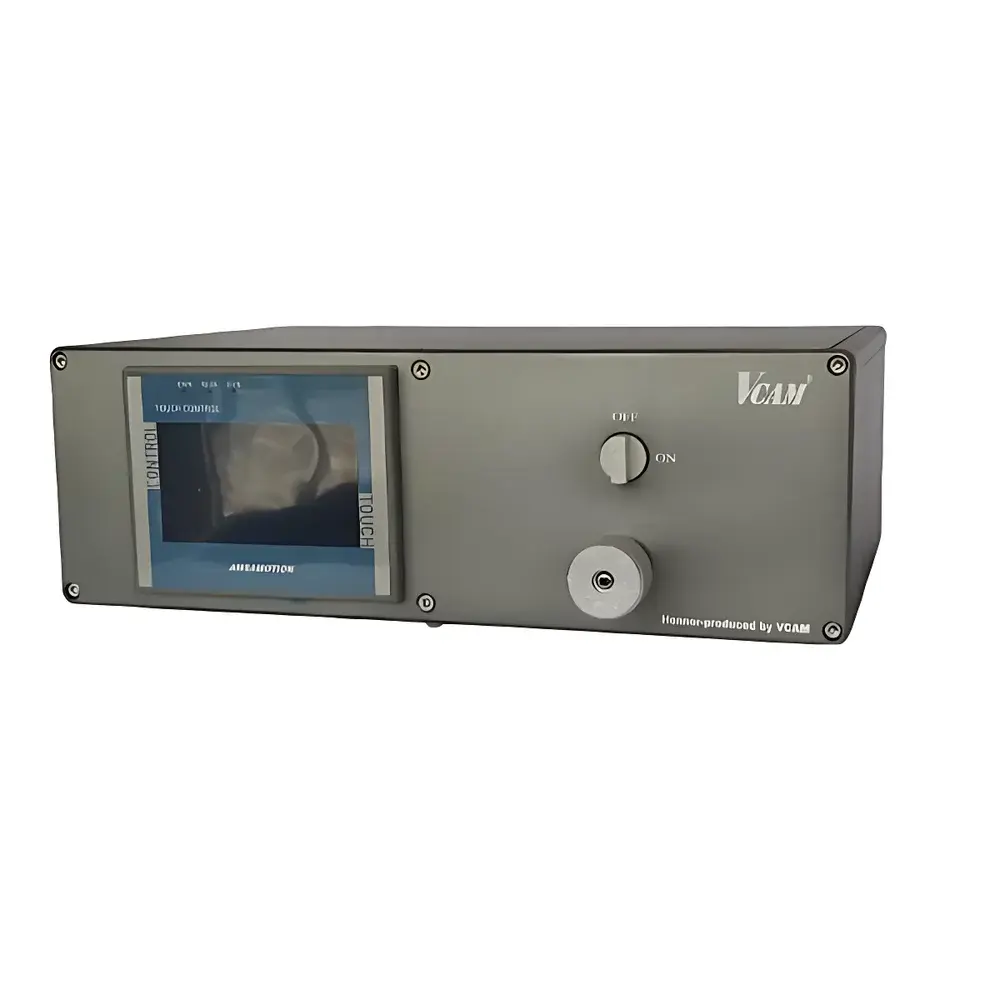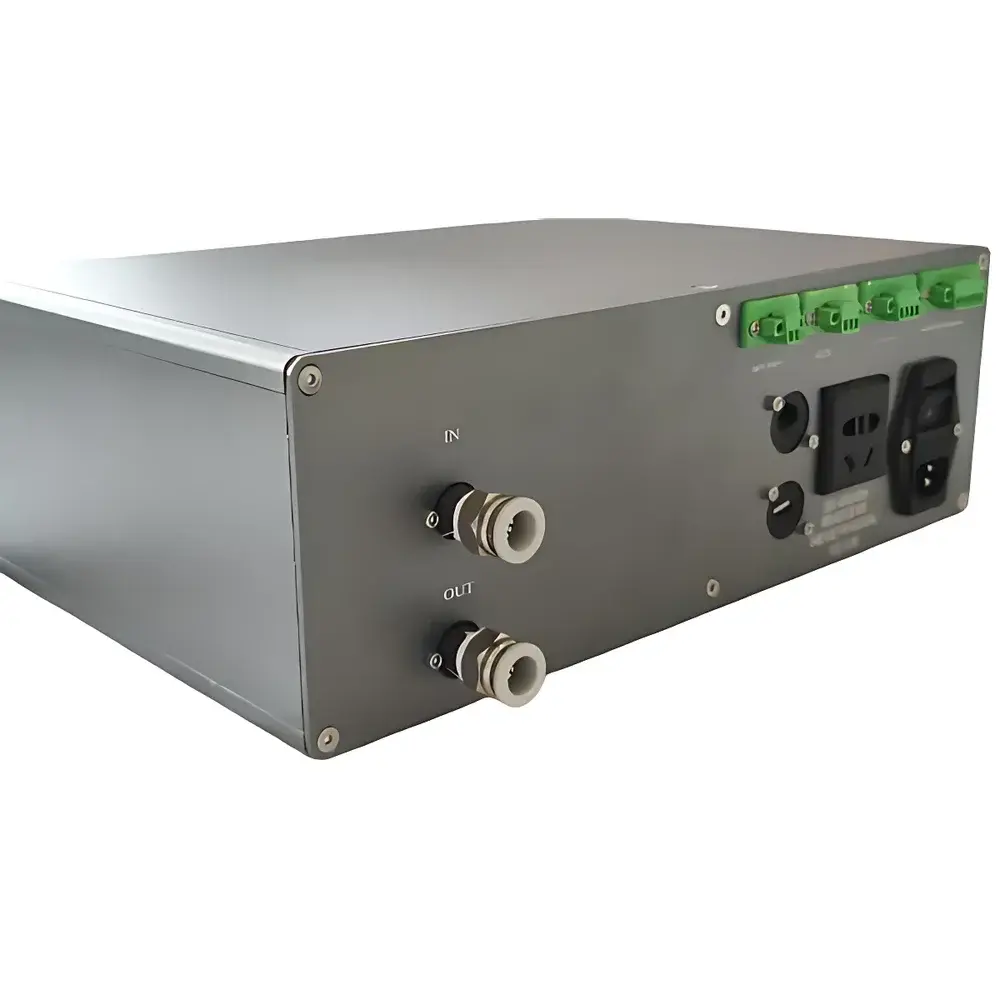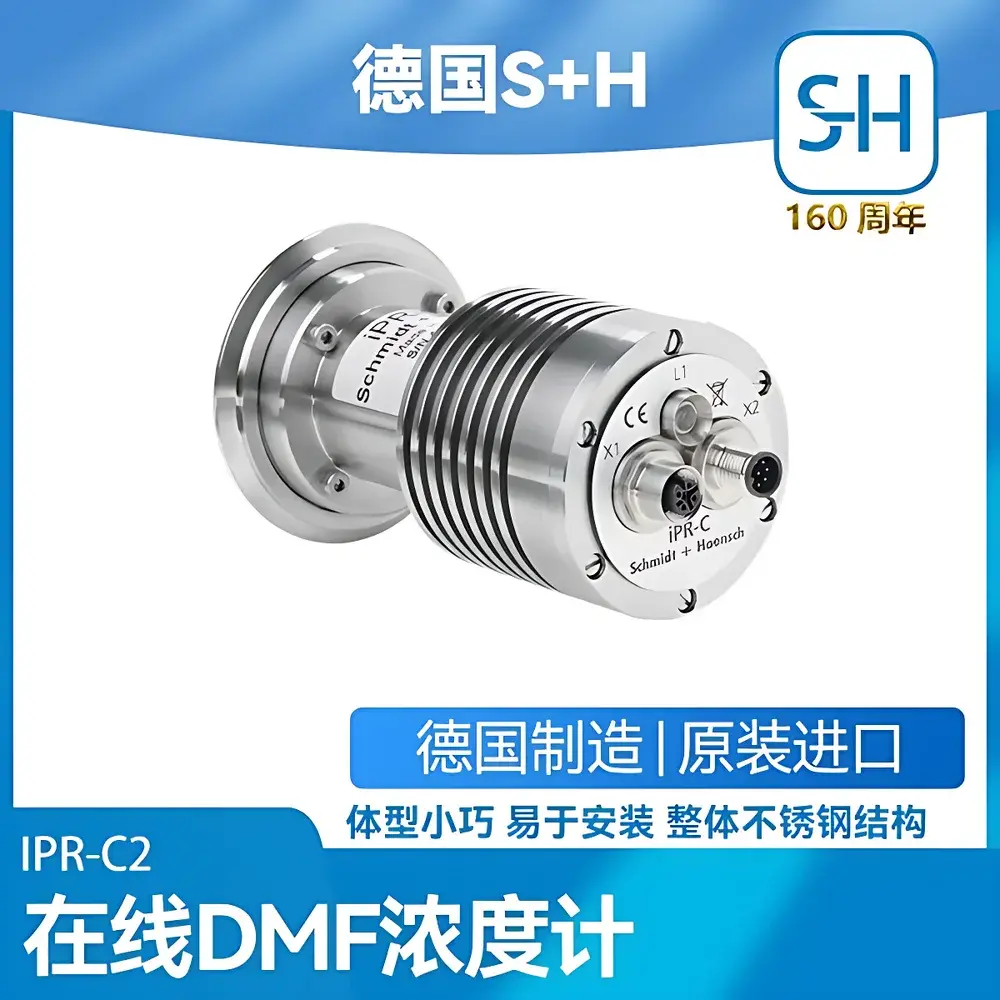
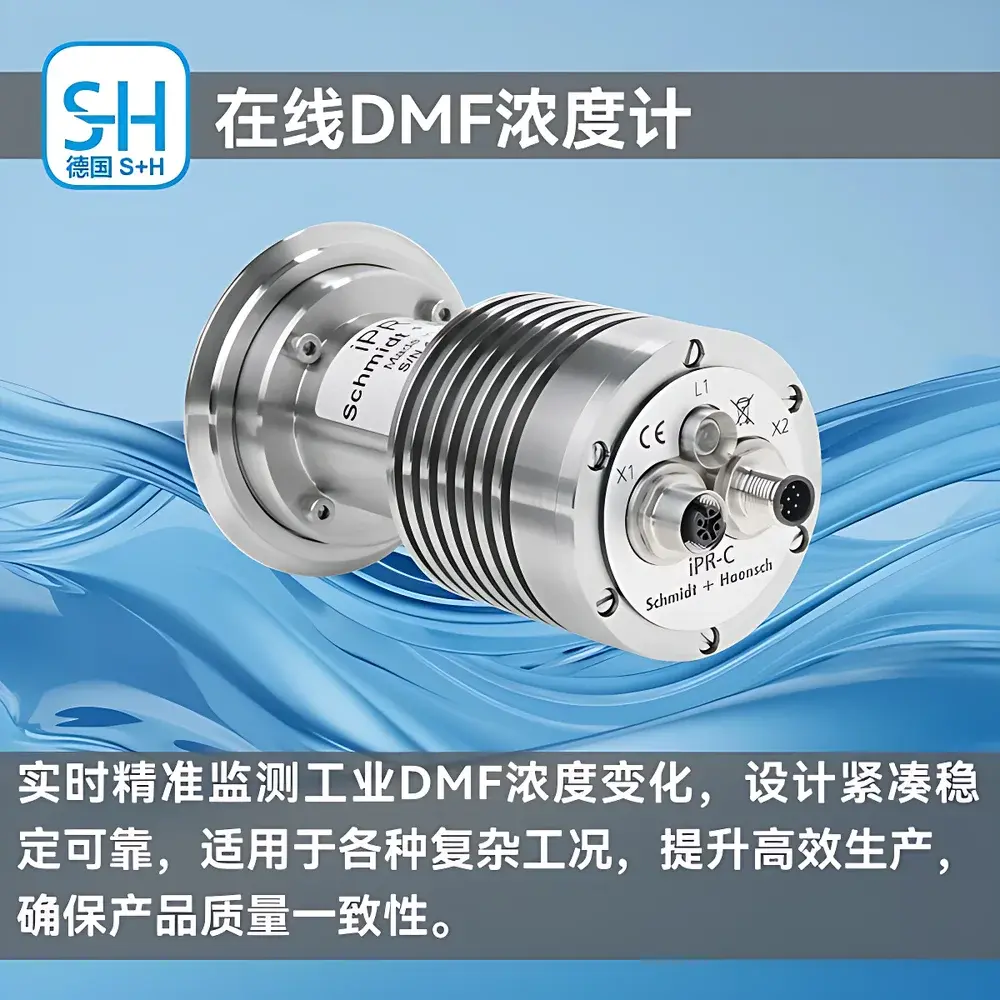
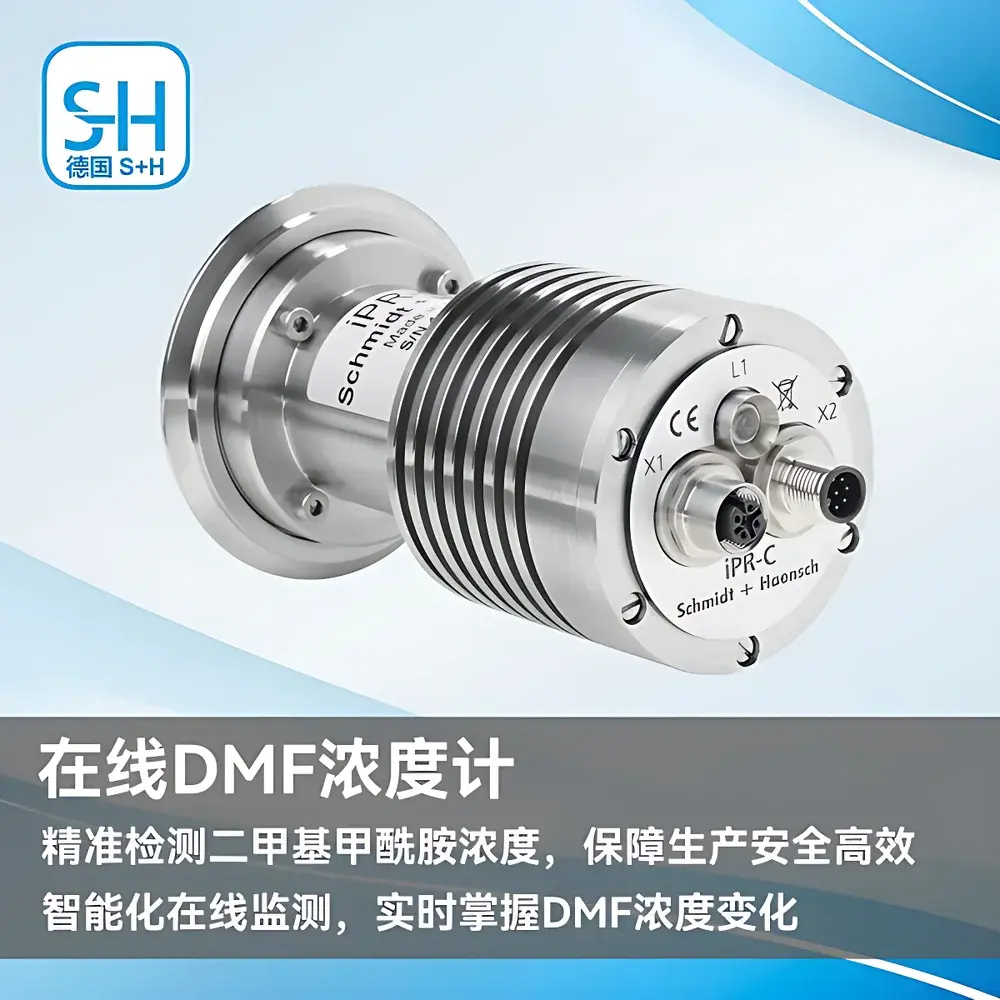
Schmidt+Haensch IPR-C2 Online Refractometer for DMF Concentration Monitoring
| Brand | Schmidt+Haensch (S+H) |
|---|---|
| Origin | Germany |
| Manufacturer Type | Original Equipment Manufacturer (OEM) |
| Product Category | Imported Industrial Process Analyzer |
| Model | IPR-C2 |
| Measurement Principle | Critical Angle Refractometry |
| Optical Interface | Sapphire Prism |
| Process Temperature Range | −20 °C to +80 °C |
| Process Pressure Rating | Up to 1 MPa (10 bar) |
| Refractive Index Range | 1.3200–1.4535 RIU |
| Accuracy | ±0.0002 RIU / ±0.15 °Brix |
| Output Signals | 4–20 mA, Digital Switches, RS232/RS485/RS422, USB |
| Power Supply | 24 V DC |
| Wetted Materials | Sapphire, 316L Stainless Steel |
| Temperature Compensation | Integrated, Real-Time |
Overview
The Schmidt+Haensch IPR-C2 Online Refractometer is an industrial-grade process analyzer engineered for continuous, real-time measurement of dimethylformamide (DMF) concentration in liquid streams. Leveraging the physical principle of critical-angle refractometry, the instrument determines refractive index (RI) with high metrological integrity and converts it into concentration values—either as mass percent (0–100%), °Brix, or user-defined calibration curves. Unlike offline sampling or spectroscopic methods, the IPR-C2 operates via direct optical contact with the process medium through a sapphire prism mounted in-line or on-vessel, delivering stable, drift-free measurements without dependence on sample color, turbidity, or viscosity. Its design adheres to fundamental optical metrology standards and is optimized for integration into automated control loops where precise solvent management—especially for high-value, hazardous solvents like DMF—is essential for process safety, regulatory compliance, and yield optimization.
Key Features
- Compact, all-stainless-steel housing (IP65-rated) with integrated electronics—no external transmitter or secondary instrumentation required
- Optical sensing head featuring a monolithic sapphire prism, chemically inert and abrasion-resistant for long-term stability in aggressive chemical environments
- Real-time automatic temperature compensation (ATC) using dual-point platinum RTD sensors embedded in the prism assembly, ensuring RI accuracy across −20 °C to +80 °C process temperatures
- Multi-protocol digital output (RS232/RS485/RS422/USB) alongside isolated 4–20 mA analog output and programmable digital switch outputs for alarm or control logic
- Factory-calibrated for DMF/water systems; supports user-defined calibration tables for other binary or pseudo-binary mixtures
- Robust mechanical design compliant with EN 61000-6-2 (immunity) and EN 61000-6-4 (emissions), suitable for Zone 2 hazardous area installations when paired with appropriate barriers
Sample Compatibility & Compliance
The IPR-C2 is validated for continuous monitoring of homogeneous, non-particulate DMF solutions—including aqueous DMF, DMF/methanol, and DMF/acetone blends—within its specified refractive index range (1.3200–1.4535 RIU). It is not intended for slurries, emulsions, or highly viscous media (>500 mPa·s) where boundary layer formation may affect optical coupling. The device meets key international standards for industrial process analyzers: IEC 61511 (functional safety for SIS applications), ISO 9001-compliant manufacturing, and CE marking per EU Machinery Directive 2006/42/EC and EMC Directive 2014/30/EU. For regulated industries, its data logging capability (via optional software) supports audit trails aligned with FDA 21 CFR Part 11 requirements when deployed with secure authentication and electronic signature protocols. Traceable calibration certificates are provided with NIST-traceable reference standards.
Software & Data Management
The IPR-C2 interfaces natively with industry-standard SCADA, DCS, and MES platforms via Modbus RTU/ASCII over RS485 or analog 4–20 mA. Optional PC-based configuration and diagnostics software (S+H RefracSoft) enables full parameter setup—including custom calibration curve import, alarm thresholds, linearization coefficients, and data export in CSV or Excel format. All configuration changes are timestamped and logged internally. When connected to a supervisory historian system, the instrument supports long-term trend analysis for process validation (e.g., batch consistency tracking), cleaning-in-place (CIP) endpoint detection, and solvent recovery efficiency quantification—critical for pharmaceutical and fine chemical manufacturers operating under cGMP/GLP frameworks.
Applications
- Real-time concentration control during DMF-based polymer precipitation (e.g., polyacrylonitrile fiber spinning)
- Monitoring distillation overheads and bottoms in DMF recovery columns to optimize energy use and minimize solvent loss
- Feedstock verification in API synthesis reactors where DMF concentration directly impacts reaction kinetics and impurity profiles
- In-line quality assurance for electronic-grade DMF used in semiconductor photoresist formulation
- Automated dilution control in wastewater pretreatment lines handling DMF-containing effluents prior to biological treatment
- Validation of membrane separation performance in DMF/solvent recycling units
FAQ
How does the IPR-C2 handle temperature fluctuations in unheated piping?
The integrated dual-sensor ATC system continuously measures both prism surface and bulk fluid temperature, applying dynamic correction based on the known thermo-optic coefficient of DMF—ensuring RI accuracy within ±0.0002 RIU across the full operating range.
Can the IPR-C2 be installed in vertical pipe sections?
Yes—provided flow velocity exceeds 0.3 m/s to prevent air pocket formation at the prism interface; orientation-specific mounting kits are available for top-, side-, or bottom-entry configurations.
Is recalibration required after installation?
No field recalibration is needed if factory calibration matches the target DMF/water composition range; however, periodic verification using certified reference standards (e.g., NIST-traceable sucrose or glycerol solutions) is recommended every 6–12 months per ISO/IEC 17025 guidelines.
What maintenance does the sapphire prism require?
Under normal operation, no routine cleaning is necessary; if fouling occurs, gentle wiping with lint-free cloth and isopropanol suffices—no abrasive agents or ultrasonic cleaning is permitted.
Does the IPR-C2 support hazardous area certification?
The base unit is rated for general-purpose use; intrinsic safety (Ex ia IIC T4 Ga) or flameproof (Ex d IIB T4 Gb) variants are available upon request with appropriate documentation for ATEX/IECEx compliance.
Related Products