
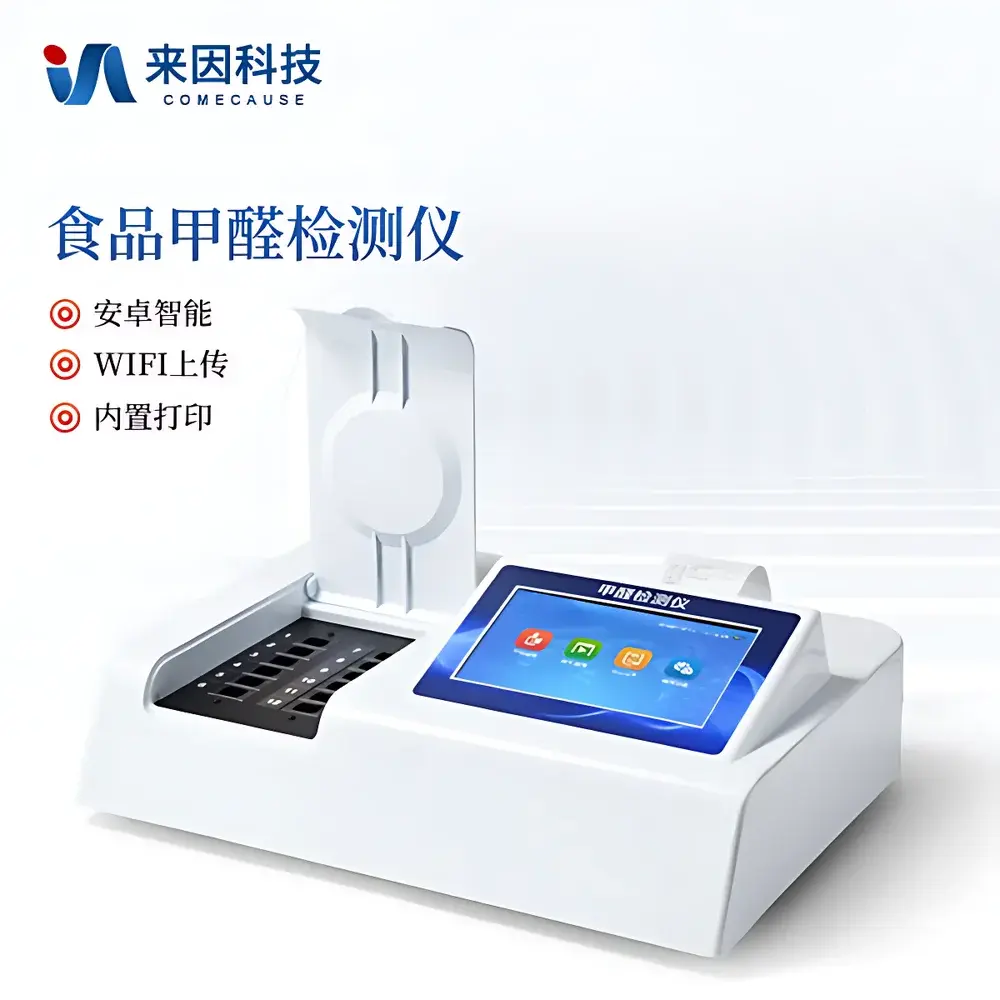
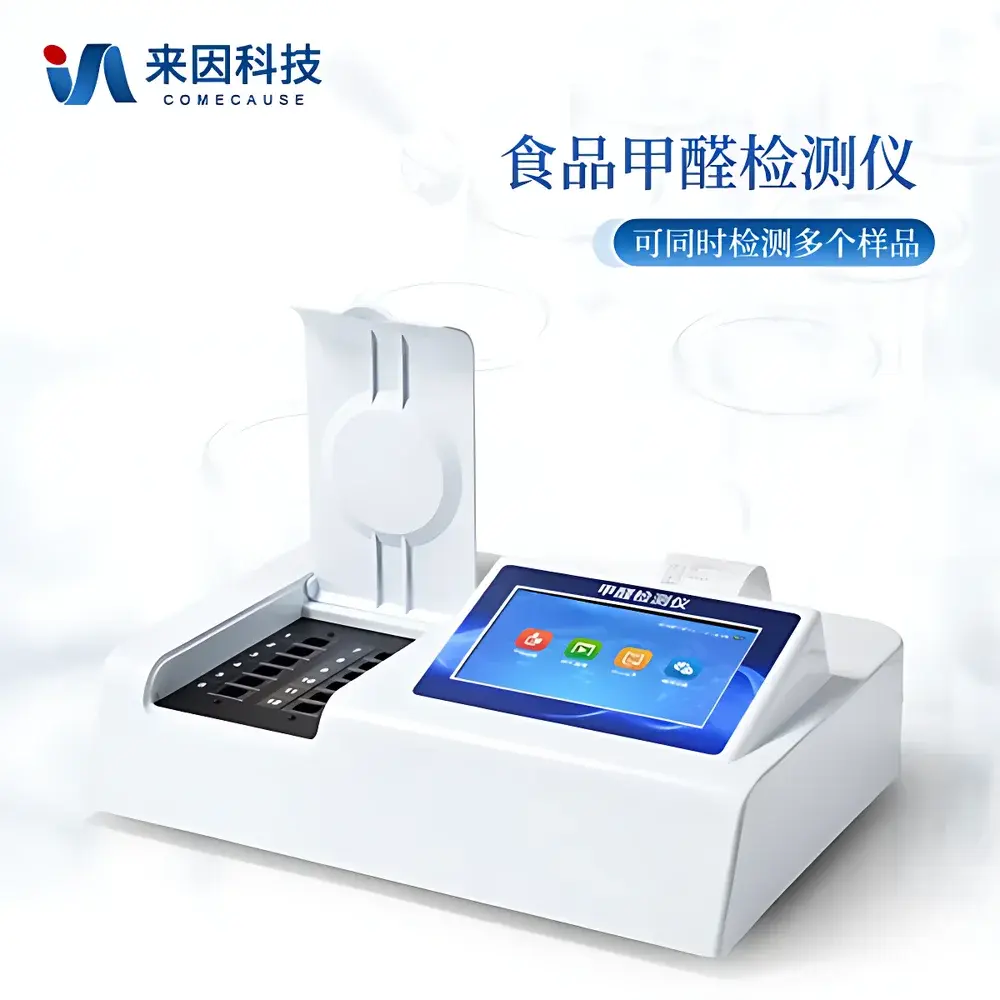
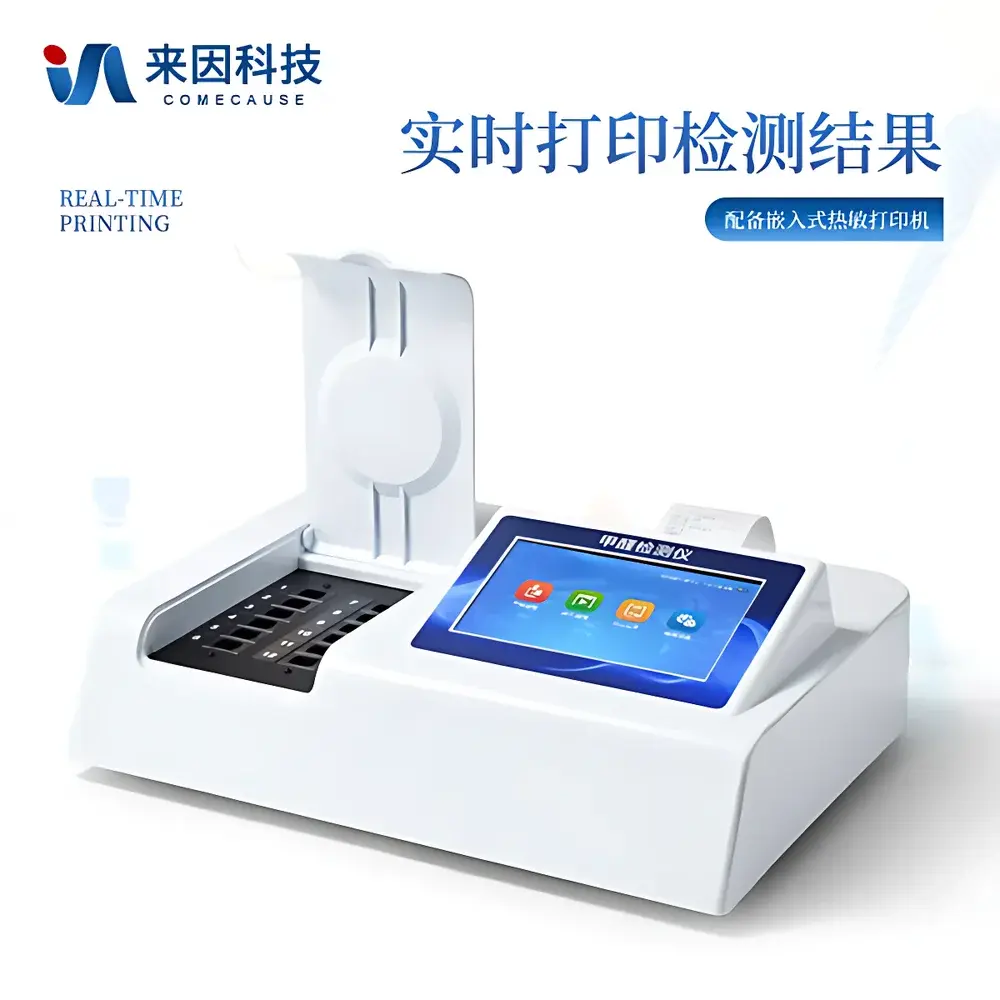
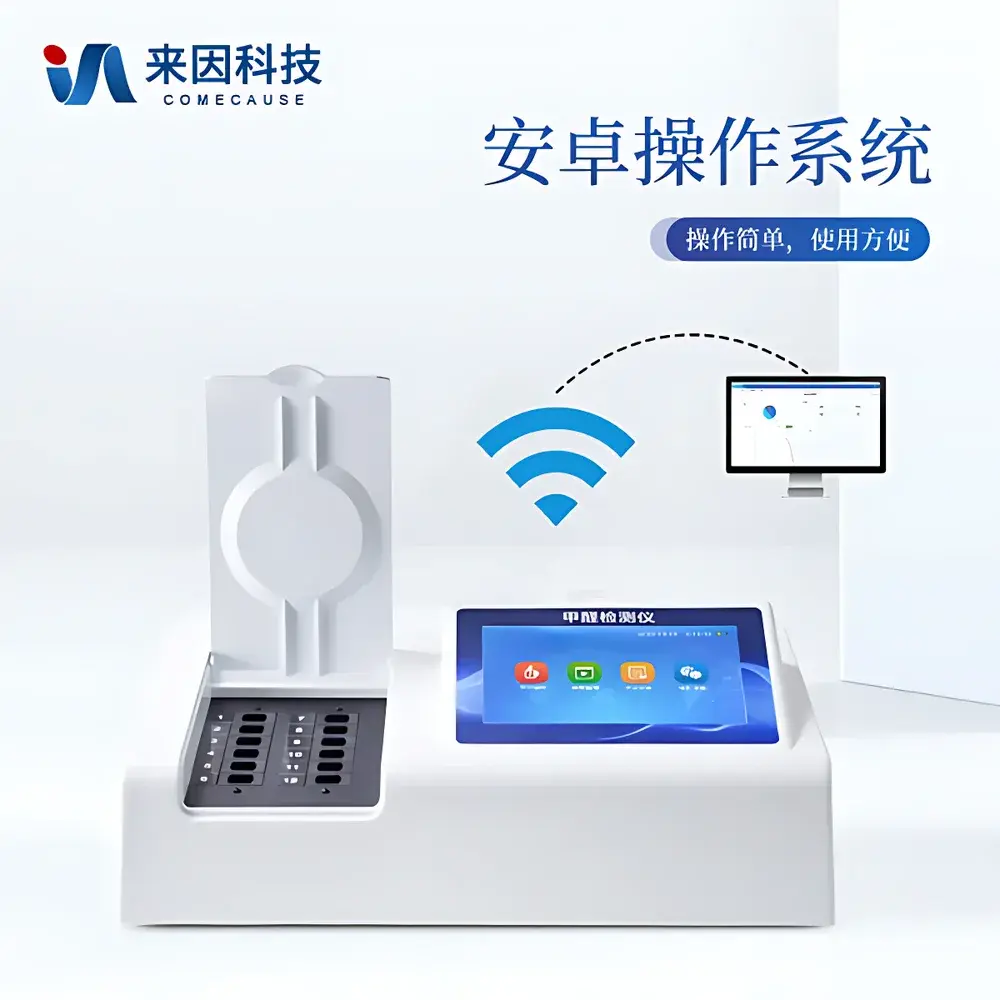
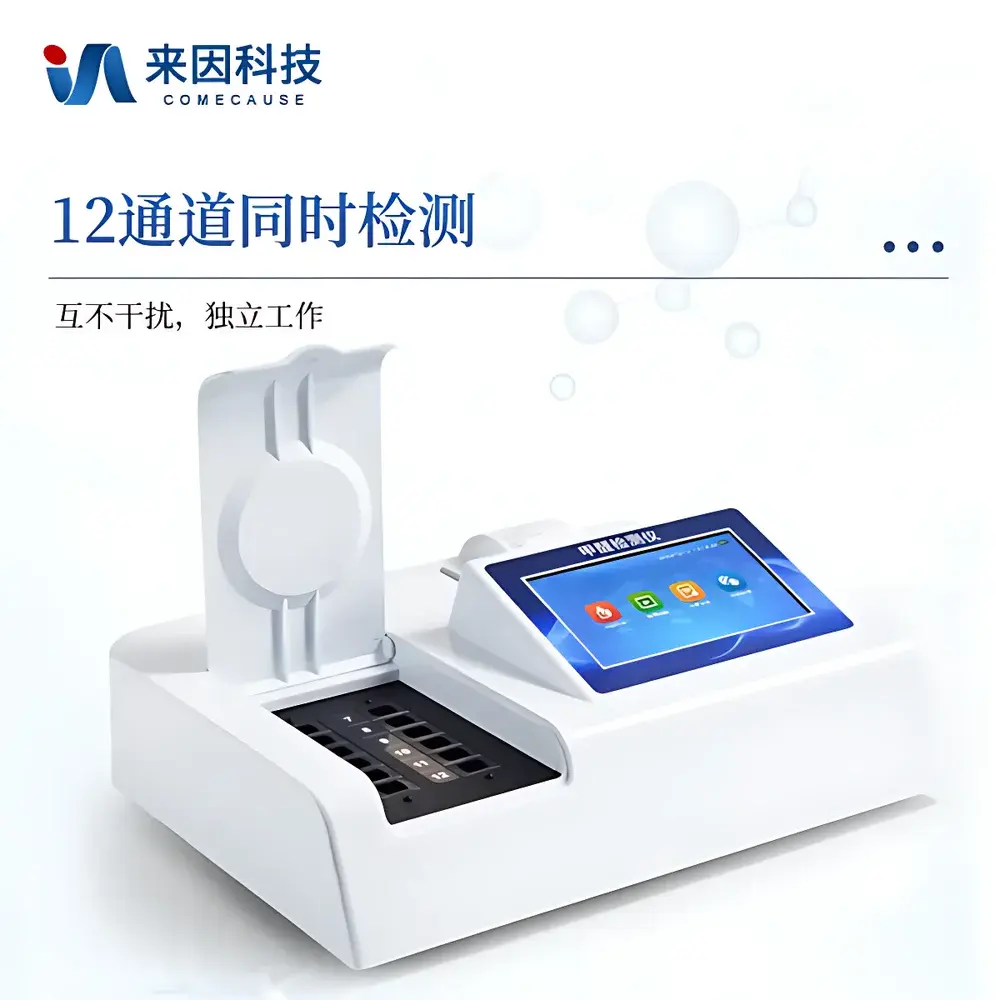
COMECAUSE IN-Q12 Food Formaldehyde Detector
| Brand | COMECAUSE |
|---|---|
| Origin | Shandong, China |
| Manufacturer Type | Manufacturer |
| Country of Origin | China |
| Model | IN-Q12 |
| Detection Limit | 1 mg/kg |
| Detection Range | 0–100 mg/kg |
| Absorbance Range | 0.000–4.000 A |
| Repeatability | ±0.1% (A) |
| Repeatability Error | ≤0.003 A |
| Photometric Drift | ±0.002 A (3 min) |
| Absorbance Accuracy | ±2.0% |
| Linearity Error | ±1.0% |
| Detection Channels | ≥12 |
| Processor | ARM Cortex-A7 RK3288 (4-core, 1.88 GHz) |
| Display | 7-inch capacitive touchscreen |
| Power Supply | DC 12 V (compatible with vehicle power & optional 6 Ah rechargeable Li-ion battery) |
| Connectivity | Wi-Fi, Ethernet, GPRS, USB 2.0 |
| Data Output | Thermal printer (embedded), QR code generation, cloud upload via regulatory platform |
Overview
The COMECAUSE IN-Q12 Food Formaldehyde Detector is a dedicated spectrophotometric analyzer engineered for rapid, quantitative determination of formaldehyde residues in food matrices—particularly seafood, meat products, wheat-based foods, and processed agricultural commodities. It operates on the principle of colorimetric reaction coupled with visible-light absorbance measurement at standardized 1 cm optical pathlength. Formaldehyde in sample extracts reacts with acetylacetone under acidic heating conditions to form a yellow chromophore (3,5-diacetyl-1,4-dihydrolutidine), whose intensity at ~412 nm is directly proportional to analyte concentration. The instrument implements fixed-wavelength photometry using high-stability, imported LED light sources and solid-state photodetectors—eliminating thermal drift and enabling reliable field-deployable operation without recalibration between batches. Designed in compliance with national food safety standards (GB 5009.49–2023 for formaldehyde in food), the IN-Q12 supports trace-level quantification down to 1 mg/kg across a linear dynamic range of 0–100 mg/kg, meeting routine surveillance requirements for regulatory labs, QC departments, and mobile inspection units.
Key Features
- Twelve independent detection channels enable parallel analysis of up to 12 samples per run—each channel fully programmable for individual reagent timing, incubation temperature, and measurement sequence.
- Integrated Android-based operating system (ARM Cortex-A7 RK3288 quad-core processor, 1.88 GHz) delivers responsive touchscreen interaction, multi-language UI support, and seamless firmware updates over-the-air or via USB.
- Pre-programmed calibration curves eliminate the need for daily standard solution preparation; zero-point correction with blank reagent suffices for routine operation.
- Optimized optical architecture features auto-switching LED illumination with >100,000-hour lifetime, real-time photometric self-calibration, and thermal drift compensation—ensuring absorbance stability within ±0.002 A over 3 minutes.
- Dedicated sample processing accessories—including digestion blocks, centrifuge tubes, extraction kits, and pre-formulated reagent tablets—ensure method reproducibility and minimize operator variability.
- Built-in thermal printer generates tamper-evident reports with embedded QR codes linking to raw data, timestamps, operator ID, and instrument serial number—supporting audit-ready documentation.
Sample Compatibility & Compliance
The IN-Q12 is validated for use with homogenized, aqueous extracts from diverse food categories: fresh/frozen fish and shellfish, cured meats, tofu, noodles, rice vermicelli, and preserved vegetables. Sample preparation follows AOAC Official Method 2005.02–derived protocols adapted for formaldehyde release under controlled distillation or acid hydrolysis. Instrument output complies with data integrity requirements outlined in GLP and ISO/IEC 17025:2017 Annex A (data recording, traceability, electronic signatures). All measurement logs—including absorbance values, curve fit residuals, and pass/fail flags—are time-stamped, user-authenticated, and exportable in CSV or PDF format. Cloud synchronization enables centralized oversight through the integrated regulatory platform, facilitating cross-site trend analysis and early anomaly detection per HACCP Principle 4.
Software & Data Management
Data acquisition and reporting are managed via embedded Linux-based firmware interfaced with a web-accessible cloud dashboard. Each test record includes sample ID auto-increment, channel-specific metadata, environmental temperature/humidity logging (via optional external sensor), and full audit trail per FDA 21 CFR Part 11 Annex A expectations (user roles, electronic signatures, immutable log history). Raw absorbance data, calibration coefficients, and QC control charts are stored locally on internal eMMC and simultaneously mirrored to encrypted cloud storage. Batch export supports regulatory submission formats required by SAMR (State Administration for Market Regulation) and provincial CDC laboratories. USB 2.0 host interface allows direct transfer to LIMS systems without driver installation; Wi-Fi and GPRS modules ensure connectivity in low-infrastructure environments including cold-chain trucks and rural inspection stations.
Applications
- Routine screening of formaldehyde adulteration in aquatic products (e.g., soaked squid, cuttlefish, shrimp)
- Verification of preservative compliance in soy-based and gluten-containing foods
- On-site verification during food safety inspections at wholesale markets and border checkpoints
- QC release testing in food processing facilities producing ready-to-eat meals and chilled delicatessen items
- Method development and validation support for accredited laboratories seeking CNAS accreditation under ISO/IEC 17025
- Training and capacity building for municipal food safety bureaus conducting annual risk monitoring programs
FAQ
What regulatory standards does the IN-Q12 comply with for formaldehyde testing in food?
The instrument implements methodology aligned with GB 5009.49–2023 and references AOAC 2005.02 principles. Its data handling conforms to ISO/IEC 17025:2017 documentation requirements and supports GLP-compliant workflows.
Can the IN-Q12 be used for non-food matrices such as cosmetics or indoor air samples?
No—it is specifically optimized and validated for food-derived aqueous extracts. Air or cosmetic sample types require different sampling protocols, derivatization chemistry, and detection sensitivity not supported by this configuration.
Is remote software update capability available without physical access to the device?
Yes. Firmware and application updates can be delivered over Wi-Fi or GPRS via secure HTTPS push from the manufacturer’s update server, with version rollback and signature verification enabled.
How is measurement traceability maintained across multiple operators and shifts?
Each login session requires unique credentials; all measurements are tagged with operator ID, timestamp, and instrument serial number. Audit logs record every calibration event, curve modification, and result export action.
Does the instrument support third-party LIMS integration?
Yes—through standardized CSV export, HTTP API endpoints, and configurable field mapping for common LIMS platforms including LabWare, STARLIMS, and Thermo Fisher SampleManager.




