
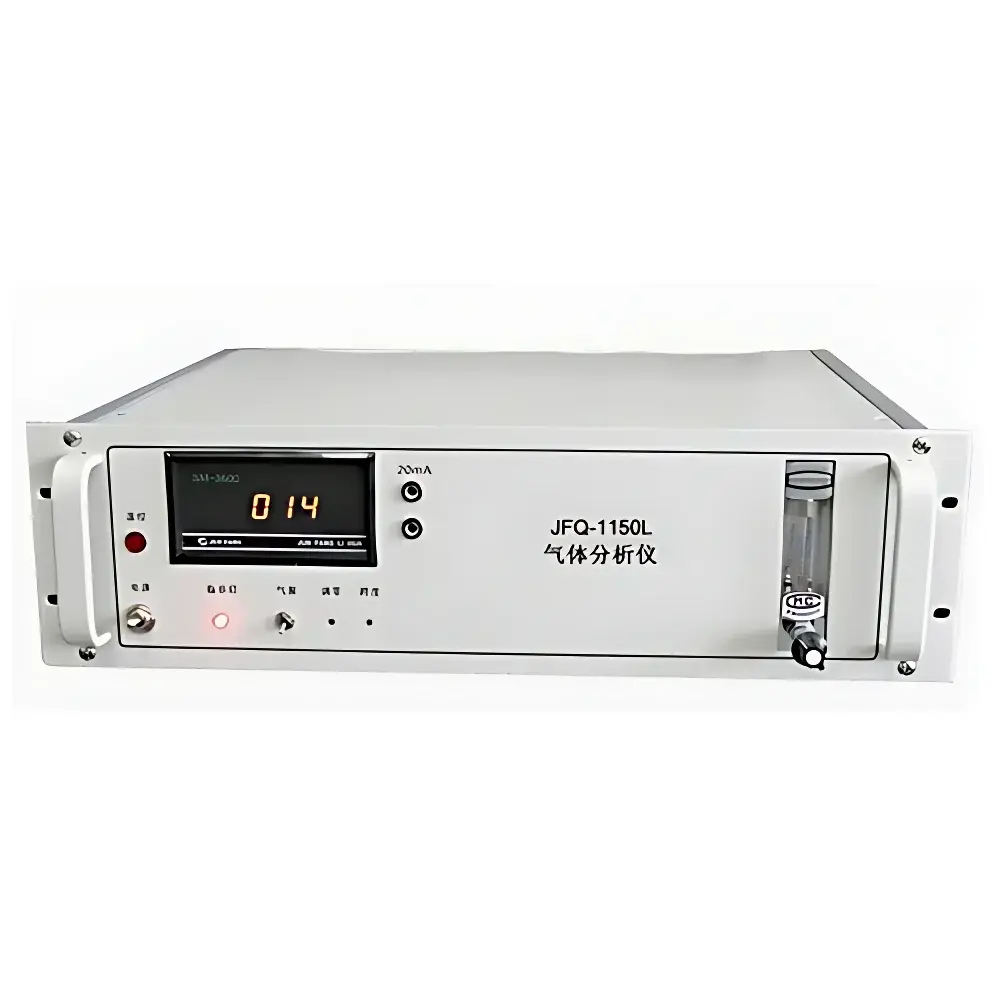
JFQ-1150L Online Non-Dispersive Infrared (NDIR) Gas Analyzer
| Brand | Junfang Lihua |
|---|---|
| Origin | Beijing, China |
| Model | JFQ-1150L |
| Measurement Principle | NDIR with optional thermal conductivity, electrochemical, or fluorescence detection modules |
| Gas Channels | Single-channel configurable |
| Measurable Gases | CH₄, C₃H₈, total hydrocarbons (HC), H₂, O₂, H₂S, SO₂, NH₃ (gas-specific module dependent) |
| Range | 0–100% vol (field-configurable) |
| Linearity Error | ≤ ±2% FS |
| Repeatability | ≤ ±1% FS |
| Zero Drift | ≤ ±1% FS / 48 h |
| Span Drift | ≤ ±1% FS / 48 h |
| Warm-up Time | ≤ 60 min |
| Response Time (T₉₀) | ≤ 60 s |
| Operating Humidity | ≤ 90% RH (non-condensing) |
| Power Supply | AC 220 V ±10%, 50 Hz ±5% |
| Output Signal | 4–20 mA analog |
| Enclosure | Rack-mountable embedded chassis with integrated sampling pump |
| Internal Temperature Control | Yes |
| Compliance | Designed to meet GB/T 16157, HJ 75–2017, HJ 76–2017, and ISO 12039 requirements for continuous emission monitoring systems (CEMS) |
Overview
The JFQ-1150L Online Non-Dispersive Infrared (NDIR) Gas Analyzer is an industrial-grade, rack-mounted process gas analyzer engineered for continuous, real-time measurement of gaseous species in demanding environmental and industrial applications. Its core detection principle relies on non-dispersive infrared absorption spectroscopy — a well-established, selective, and stable method for quantifying gases with characteristic IR absorption bands, including methane (CH₄), propane (C₃H₈), and total hydrocarbons (HC). The instrument supports modular sensor integration, allowing field-configurable expansion with complementary analytical technologies: thermal conductivity detection (TCD) for diatomic gases such as H₂ and O₂; electrochemical cells for toxic species including H₂S and SO₂; and fluorescence-based modules for NH₃. This hybrid architecture enables single-channel, multi-gas capability without cross-interference, making the JFQ-1150L suitable for stack emission monitoring, biogas composition analysis, refinery off-gas tracking, and landfill gas management.
Key Features
- Embedded rack-mount design with integrated sample draw pump and flow regulation circuitry — eliminates need for external vacuum sources or auxiliary flow controllers.
- Onboard temperature stabilization system maintains optical path and detector at constant setpoint, minimizing thermal drift and ensuring long-term baseline stability.
- Field-replaceable, gas-specific optical modules — each NDIR cell is calibrated against certified reference standards traceable to NIM (National Institute of Metrology, China) and complies with GB/T 18204.2–2014 for calibration validation.
- Real-time analog output (4–20 mA) with galvanically isolated signal conditioning, compatible with DCS, PLC, and SCADA systems per IEC 61000-6-2/6-4 EMC standards.
- Zero and span verification routines accessible via front-panel interface or remote command protocol — supports automated calibration scheduling aligned with HJ 75–2017 operational verification requirements.
- Robust internal diagnostics including lamp intensity monitoring, detector responsivity logging, and pressure-compensated concentration calculation — all data timestamped and stored in non-volatile memory.
Sample Compatibility & Compliance
The JFQ-1150L is designed for direct connection to hot, humid, and particulate-laden sample streams typical of flue gas, fermentation exhaust, and catalytic cracker vents. An optional heated sample line (up to 180 °C) and particulate filter (≤ 1 µm retention) are available to prevent condensation and fouling. All wetted materials comply with ASTM F2136 for chemical resistance in acidic gas environments. The analyzer meets the functional specifications outlined in China’s HJ 75–2017 (Technical Specification for Continuous Emission Monitoring of Flue Gas) and HJ 76–2017 (Verification Procedures for CEMS), including zero/span drift limits, response time, and linearity criteria. While not intrinsically safe certified, it may be deployed in Zone 2 classified areas when installed with appropriate barrier systems per GB 3836.4.
Software & Data Management
Local operation is managed through a 4.3-inch TFT LCD touchscreen with intuitive menu navigation supporting multi-language UI (English, Chinese). All configuration parameters — range scaling, alarm thresholds, analog output mapping, and calibration history — are stored with audit-trail timestamps. Raw sensor outputs, calculated concentrations, and diagnostic flags are logged internally at user-defined intervals (1 s to 1 h resolution) and exportable via USB 2.0 to CSV format. For networked deployment, optional RS-485 Modbus RTU or Ethernet TCP/IP interfaces enable integration into centralized data acquisition platforms. Data integrity conforms to GLP-aligned recordkeeping principles: no manual editing of historical logs, immutable timestamps, and password-protected administrative access levels.
Applications
- Continuous emission monitoring (CEM) of CH₄ and NMHC in municipal solid waste landfill gas collection systems.
- Real-time biogas quality control in anaerobic digesters — tracking CH₄/C₃H₈ ratio and detecting H₂S breakthrough before desulfurization units.
- Process safety monitoring in petrochemical plants: detection of H₂ accumulation in reformer purge streams or NH₃ slip in SCR reactor exhaust.
- Environmental compliance reporting for industrial boilers and kilns under China’s “Blue Sky Protection Campaign” regulatory framework.
- Research-grade gas composition profiling in laboratory-scale emission simulators and catalyst testing rigs.
FAQ
What gases can the JFQ-1150L measure simultaneously?
It measures one gas species per configured module. Multi-gas capability requires sequential module installation and reconfiguration — not simultaneous parallel detection.
Is the analyzer compliant with international standards such as ISO or EPA methods?
Its NDIR methodology aligns with ISO 12039 (stationary source emissions — determination of carbon monoxide, carbon dioxide and oxygen), and its performance envelope satisfies key parameters referenced in US EPA Method 10 and Method 21 — though formal EPA certification is not held.
Can the 4–20 mA output be assigned to multiple gas channels?
No — the analog output corresponds exclusively to the active measurement channel. Dual-output configurations require optional add-on signal splitters or DCS-side multiplexing.
What maintenance intervals are recommended for routine operation?
Optical window cleaning every 3 months; annual full calibration verification using certified span gases; lamp replacement every 24 months under continuous operation.
Does the unit support digital communication protocols beyond analog output?
Yes — RS-485 Modbus RTU is standard; Ethernet TCP/IP and Profibus DP are available as factory-installed options.
Related Products







