
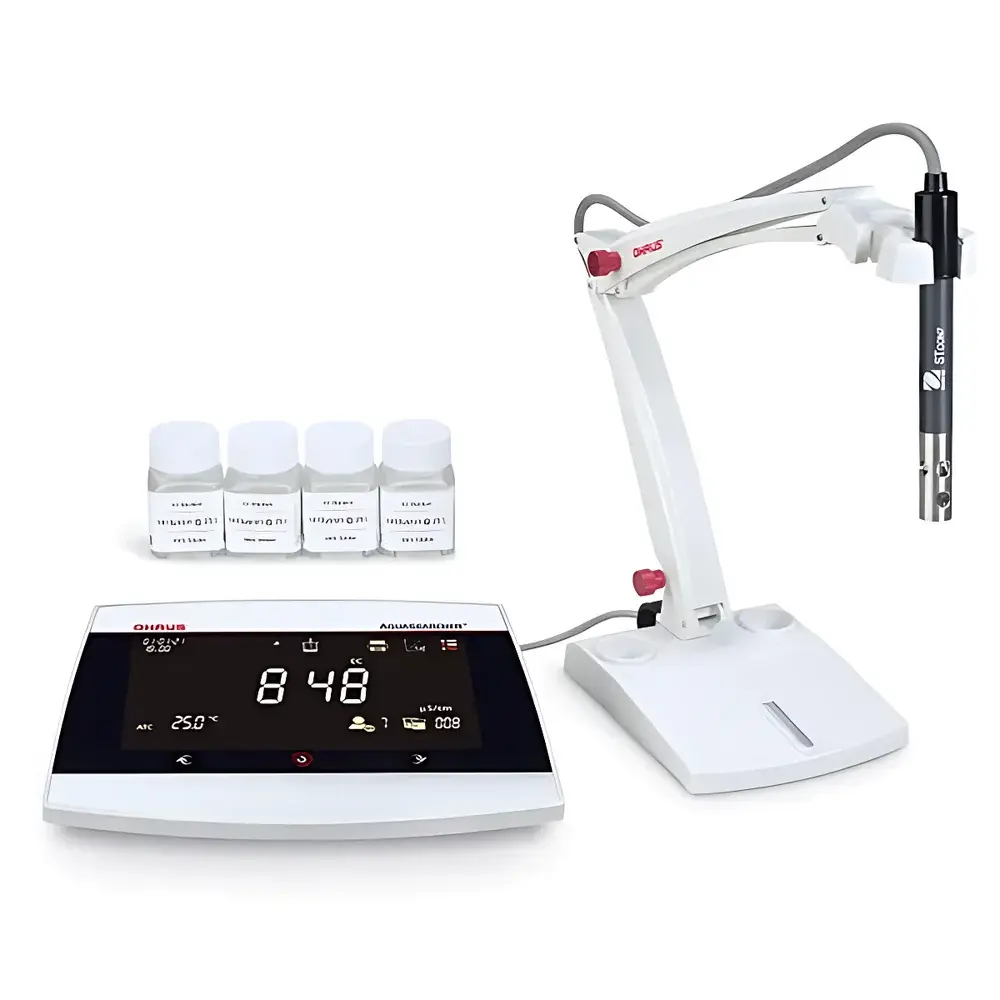
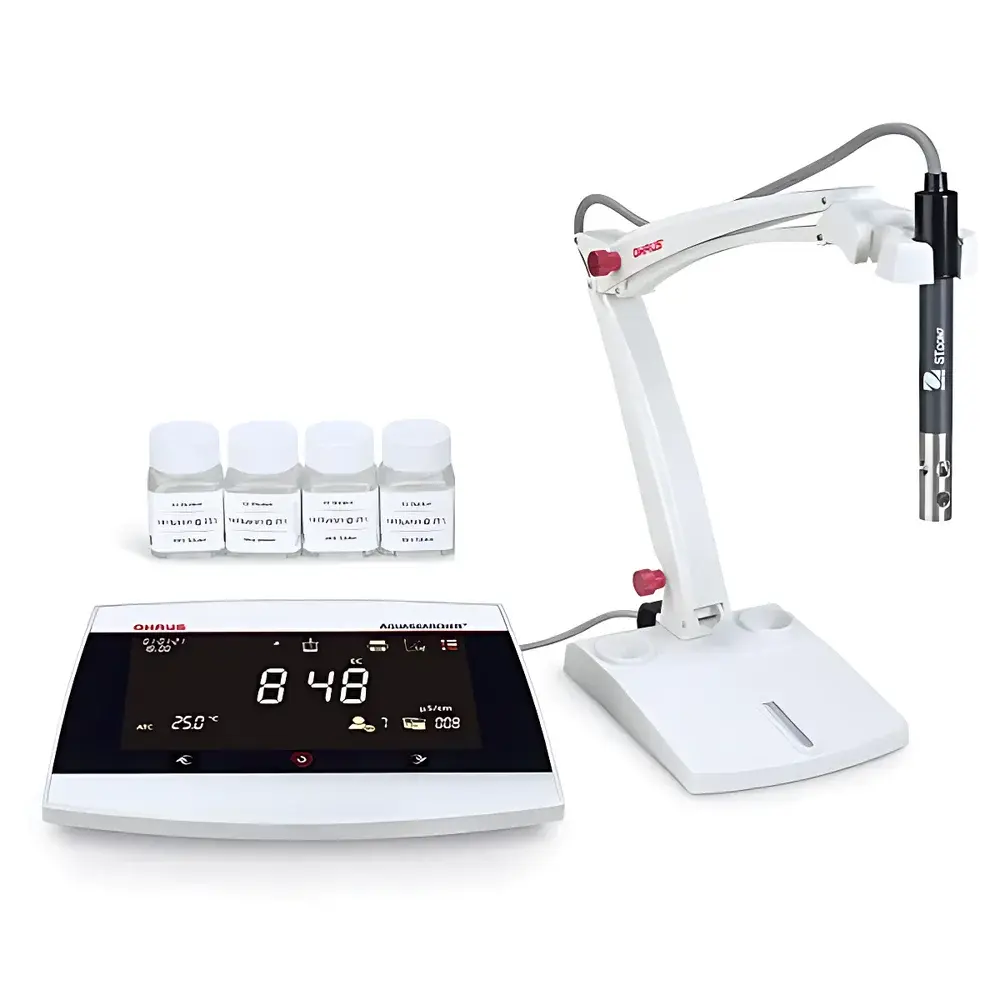
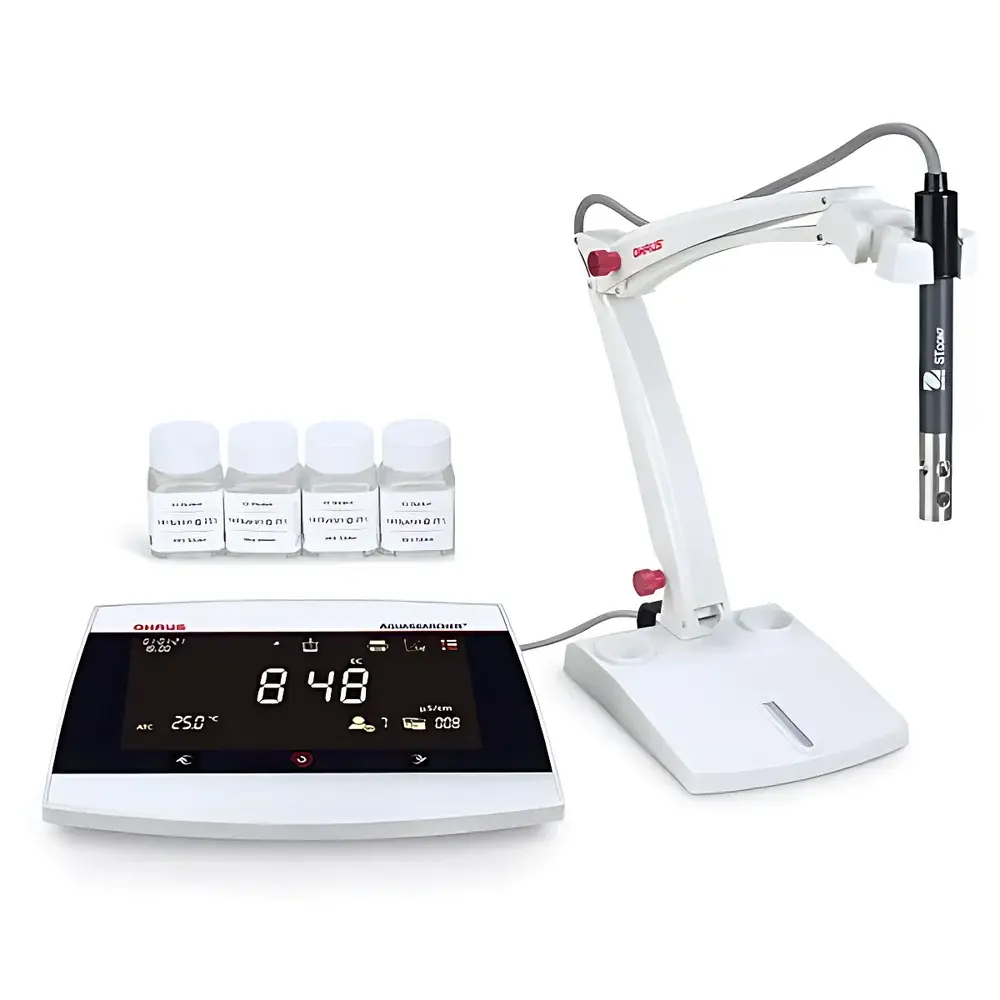
OHAUS AB33EC-F Benchtop Conductivity Meter
| Brand | OHAUS |
|---|---|
| Origin | USA |
| Model | AB33EC-F |
| Measurement Type | Single-parameter (Conductivity/Resistivity/Temperature) |
| Form Factor | Benchtop |
| Intended Use | Laboratory |
| Conductivity Range | 0.001 μS/cm – 1000 mS/cm |
| Resistivity Range | 1 Ω to 100 MΩ |
| Temperature Range | 5°C – 40°C |
| Accuracy | ±0.5 % of reading |
| Minimum Conductivity Resolution | 0.001 μS/cm |
| Resistivity Resolution | 0.01 Ω |
| Temperature Resolution | 0.3 °C |
| Display | Backlit LCD with single-line dot-matrix |
| Power Supply | AC adapter (included) |
| Dimensions (L×H×W) | 210 mm × 51 mm × 142 mm |
| Net Weight | 0.5 kg |
| Operating Environment | 5°C – 40°C, ≤80% RH (non-condensing) |
Overview
The OHAUS AB33EC-F is a precision benchtop conductivity meter engineered for reliable, repeatable measurement of electrical conductivity, resistivity, and temperature in laboratory environments. It operates on the fundamental principle of two-electrode conductometric measurement, where a known alternating current is applied across a standardized cell, and the resulting voltage drop is used to calculate solution conductance—corrected in real time for temperature using a built-in NTC thermistor sensor. Designed for routine quality control, water purity verification, and electrolyte characterization, the AB33EC-F delivers traceable performance across six decades of conductivity (0.001 μS/cm to 1000 mS/cm), supporting applications ranging from ultrapure water monitoring in pharmaceutical manufacturing to high-salinity brine analysis in environmental testing labs.
Key Features
- Benchtop form factor with compact footprint (210 × 51 × 142 mm) optimized for space-constrained lab benches and fume hood integration.
- Backlit single-line dot-matrix LCD display ensures legibility under variable ambient lighting conditions; all primary parameters—including conductivity, resistivity, and temperature—are displayed simultaneously without menu navigation.
- Integrated temperature compensation (ATC) with 0.3 °C resolution and automatic linear or non-linear (NaCl-based) correction algorithms per ASTM D1125 and ISO 7888 standards.
- Calibration support for 1-point or 2-point conductivity calibration using certified standard solutions (e.g., 84 μS/cm, 1413 μS/cm, 12.88 mS/cm); calibration data—including date, standard value, and slope—is stored internally and accessible via front-panel review.
- Rugged ABS housing with IP20-rated enclosure, compliant with IEC 61010-1 for laboratory electrical safety; CE marked and RoHS compliant.
- AC-powered operation with universal input (100–240 VAC, 50/60 Hz); no battery dependency ensures stable long-term operation during extended QC shifts or validation runs.
Sample Compatibility & Compliance
The AB33EC-F is compatible with standard DIN- or USP-compliant conductivity cells (e.g., K = 0.1, 1.0, or 10 cm−1 cells), enabling accurate measurement across low-conductivity deionized water (≤1 μS/cm), process water (10–1000 μS/cm), and concentrated electrolytes (up to 1000 mS/cm). Its ±0.5 % accuracy meets the performance criteria outlined in USP for purified and water-for-injection (WFI) testing when paired with a validated cell and proper SOPs. The instrument supports GLP-compliant workflows through manual calibration logging and timestamped measurement records (when interfaced externally via optional RS232 output). While the AB33EC-F itself does not include 21 CFR Part 11 audit trail functionality, its stable analog signal path and deterministic firmware architecture make it suitable for use in GMP-regulated environments where procedural controls govern data integrity.
Software & Data Management
The AB33EC-F operates as a standalone instrument with no embedded data storage or USB connectivity. All measurements are displayed in real time and intended for manual transcription or external capture. Optional RS232 serial interface (available via accessory cable) enables connection to PCs or LIMS systems for automated data logging—compatible with standard terminal emulation software (e.g., Tera Term, PuTTY) or custom LabVIEW/Python scripts. Output format is ASCII-based, including conductivity (μS/cm or mS/cm), resistivity (Ω·cm), temperature (°C), and unit identifiers—facilitating direct import into Excel or statistical process control (SPC) platforms. No proprietary drivers or cloud services are required, ensuring compatibility with air-gapped laboratory networks.
Applications
- Pharmaceutical water system validation (PW, WFI, and Purified Water per USP ).
- Environmental monitoring of surface water, wastewater effluent, and groundwater conductivity trends.
- Electroplating bath concentration control and rinse water purity assurance.
- Food & beverage production: monitoring cleaning-in-place (CIP) solution conductivity for detergent residue detection.
- Academic teaching labs for foundational electrochemistry experiments involving Kohlrausch’s law and ion mobility studies.
- Chemical manufacturing QA/QC for raw material verification (e.g., acid/base concentration, salt purity).
FAQ
Does the AB33EC-F support automatic temperature compensation (ATC)?
Yes—it features built-in ATC using a precision NTC temperature sensor with 0.3 °C resolution and selectable linear or NaCl-based compensation curves.
What conductivity cell constants are supported?
The meter accepts any two-electrode cell with a labeled cell constant (K = 0.1, 1.0, or 10 cm−1). Cell constant is entered manually prior to calibration.
Is the instrument suitable for measuring ultrapure water (<0.1 μS/cm)?
Yes, with a properly rinsed and calibrated K = 0.1 cm−1 cell and strict avoidance of atmospheric CO2 absorption during sampling.
Can calibration data be exported or reviewed on-device?
Calibration history—including date, standard value, measured value, and % slope deviation—is viewable directly on the LCD via the CAL HISTORY function.
Does the AB33EC-F meet ISO/IEC 17025 requirements for accredited testing?
When operated within its specified environmental limits, calibrated traceably to NIST-certified standards, and maintained per OHAUS recommendations, it satisfies the metrological requirements for conductivity measurement in ISO/IEC 17025 Clause 6.4.
Related Products




