
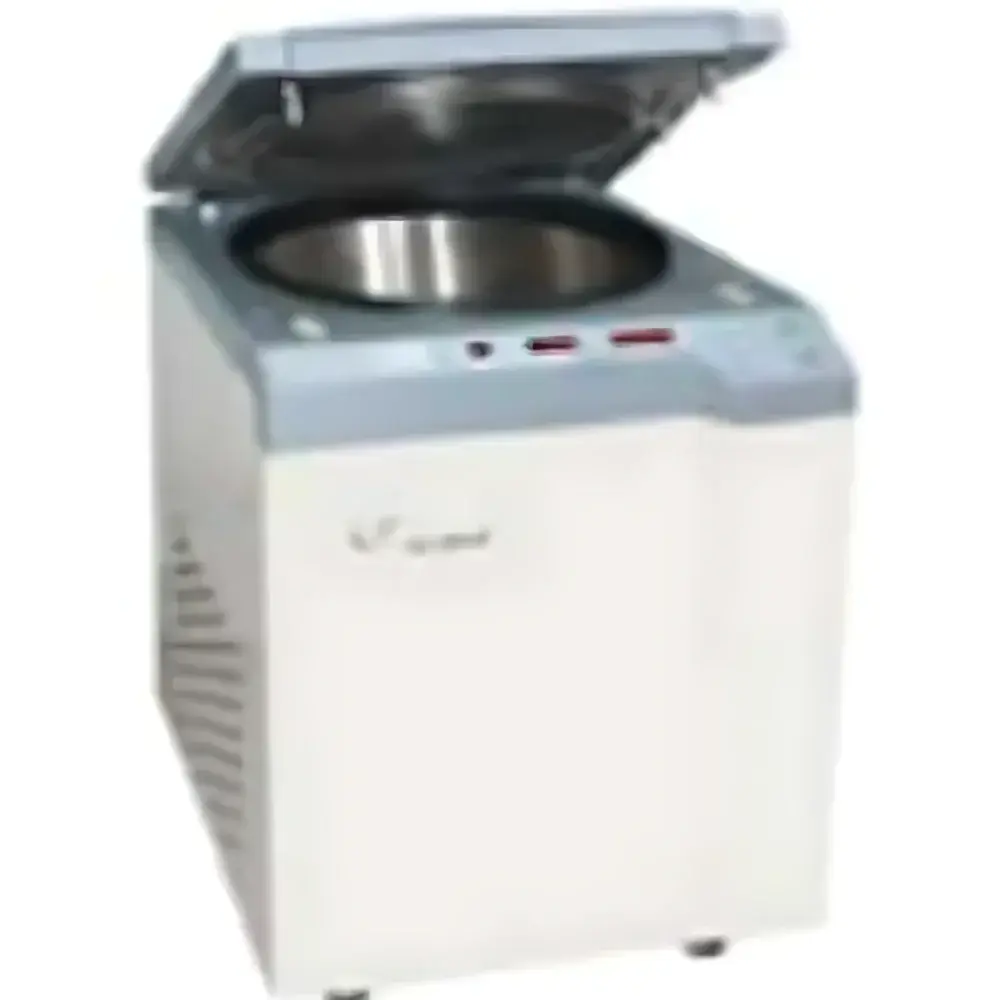
AnTing DL-5-B Low-Speed High-Capacity Multi-Tube Centrifuge
| Brand | AnTing |
|---|---|
| Origin | Shanghai, China |
| Model | DL-5-B |
| Instrument Type | Benchtop Centrifuge |
| Speed Range | Up to 5000 rpm |
| Max RCF | 5000 × g |
| Max Capacity | 250 mL × 4 |
| Timer Range | 0–99 min |
| Power Supply | 220 V, 50 Hz, 2.5 kW |
| Dimensions (L×W×H) | 590 mm × 460 mm × 675 mm |
| Weight | 83 kg |
| Rotor Configuration | Fixed-angle rotor |
| Construction | Reinforced polymer housing with structural steel frame |
| Safety | Electronic lid interlock system |
Overview
The AnTing DL-5-B is a benchtop low-speed high-capacity multi-tube centrifuge engineered for routine separation tasks in clinical laboratories, bioprocessing pilot lines, and academic research facilities. It operates on the principle of sedimentation-based separation under controlled gravitational force (RCF), where differential particle density and size drive phase stratification in heterogeneous liquid samples. Designed for robust daily use, the DL-5-B delivers stable rotational performance at speeds up to 5000 rpm—sufficient for pelleting mammalian cells, precipitating macromolecules, clarifying fermentation broths, and processing blood components without inducing shear-induced denaturation or aerosol generation typical of high-speed systems. Its fixed-angle rotor configuration ensures rapid sedimentation kinetics and reproducible pellet formation across all four positions, supporting standardized protocols compliant with CLSI GP15-A3 and ISO 15189 preanalytical requirements.
Key Features
- High-capacity sample handling: Accommodates four 250 mL conical tubes simultaneously—ideal for batch processing of serum, plasma, cell culture harvests, or environmental water samples.
- Stable low-speed operation: Precision-engineered brushless DC motor maintains ±10 rpm speed accuracy across full load conditions; minimal vibration (<2.5 mm/s RMS) ensures long-term bearing integrity and operator comfort.
- Reinforced polymer chassis: Structural housing combines impact-resistant thermoplastic composites with internal steel reinforcement—reducing overall mass while maintaining rigidity and acoustic dampening.
- Electronic lid interlock: Integrated safety circuit prevents rotor acceleration unless the lid is fully latched and sealed; automatic deceleration initiates upon lid opening during run.
- Digital timer control: Adjustable 0–99 minute countdown with audible end-of-run alert; non-volatile memory retains last-used parameters after power interruption.
- Thermal management: Passive ventilation design with optimized airflow channels prevents motor overheating during extended 90-minute continuous operation at maximum load.
Sample Compatibility & Compliance
The DL-5-B supports standard polypropylene and polycarbonate centrifuge tubes (15–250 mL), including conical-bottom formats commonly used in diagnostic and upstream biomanufacturing workflows. It complies with IEC 61010-1:2010 for laboratory electrical equipment safety and meets EN 61326-1:2013 electromagnetic compatibility standards. While not certified for Class II biosafety containment, its sealed rotor chamber and drip tray design minimize cross-contamination risk when used with capped tubes. The instrument satisfies general Good Laboratory Practice (GLP) documentation requirements for equipment qualification—User Requirement Specification (URS), Installation Qualification (IQ), and Operational Qualification (OQ) templates are available upon request for regulated environments.
Software & Data Management
The DL-5-B operates via an embedded microcontroller interface with no external software dependency. All operational parameters—including speed, time, and RCF—are displayed on a dual-line LED screen with backlighting for low-light lab conditions. Though it lacks network connectivity or electronic audit trail functionality, its mechanical timer and manual parameter entry support 21 CFR Part 11–aligned procedural controls when integrated into documented SOPs. For laboratories requiring traceability, optional external data loggers can record run timestamps, duration, and final rotor status via analog voltage output (0–5 V DC proportional to RPM). Calibration certificates per ISO/IEC 17025 are issued by authorized third-party metrology labs upon installation verification.
Applications
- Clinical diagnostics: Separation of whole blood into serum/plasma fractions prior to immunoassay or clinical chemistry analysis.
- Cell biology: Harvesting adherent and suspension mammalian cells at ≤5000 × g without compromising membrane integrity.
- Environmental testing: Clarification of wastewater or soil extract suspensions for subsequent TOC, heavy metal, or microbial analysis.
- Food & beverage QA/QC: Isolation of fat globules from milk homogenates or starch granules from cereal slurries.
- Veterinary laboratories: Processing large-volume animal blood samples for hematocrit determination or pathogen enrichment.
- Educational labs: Demonstrating sedimentation principles, density gradient fundamentals, and centrifugal force calculations in undergraduate physics and biochemistry curricula.
FAQ
What is the maximum tube volume supported per position?
Each rotor position accommodates one tube up to 250 mL; total capacity is 1000 mL across four positions.
Can this centrifuge be used with swing-bucket rotors?
No—the DL-5-B is configured exclusively for fixed-angle rotors and does not support swing-out or horizontal rotor interchangeability.
Is the unit suitable for GMP-regulated manufacturing environments?
Yes, provided it is included in equipment master validation plans and operated within defined process parameters; however, it lacks built-in electronic audit trails required for full Part 11 compliance.
Does the centrifuge include a refrigeration system?
No—this is a non-refrigerated model; ambient temperature operation only. Sample thermal stability must be maintained externally.
What maintenance intervals are recommended?
Visual inspection and cleaning every 3 months; rotor balancing check before each use; annual calibration of speed and timer accuracy by qualified service technician.



