
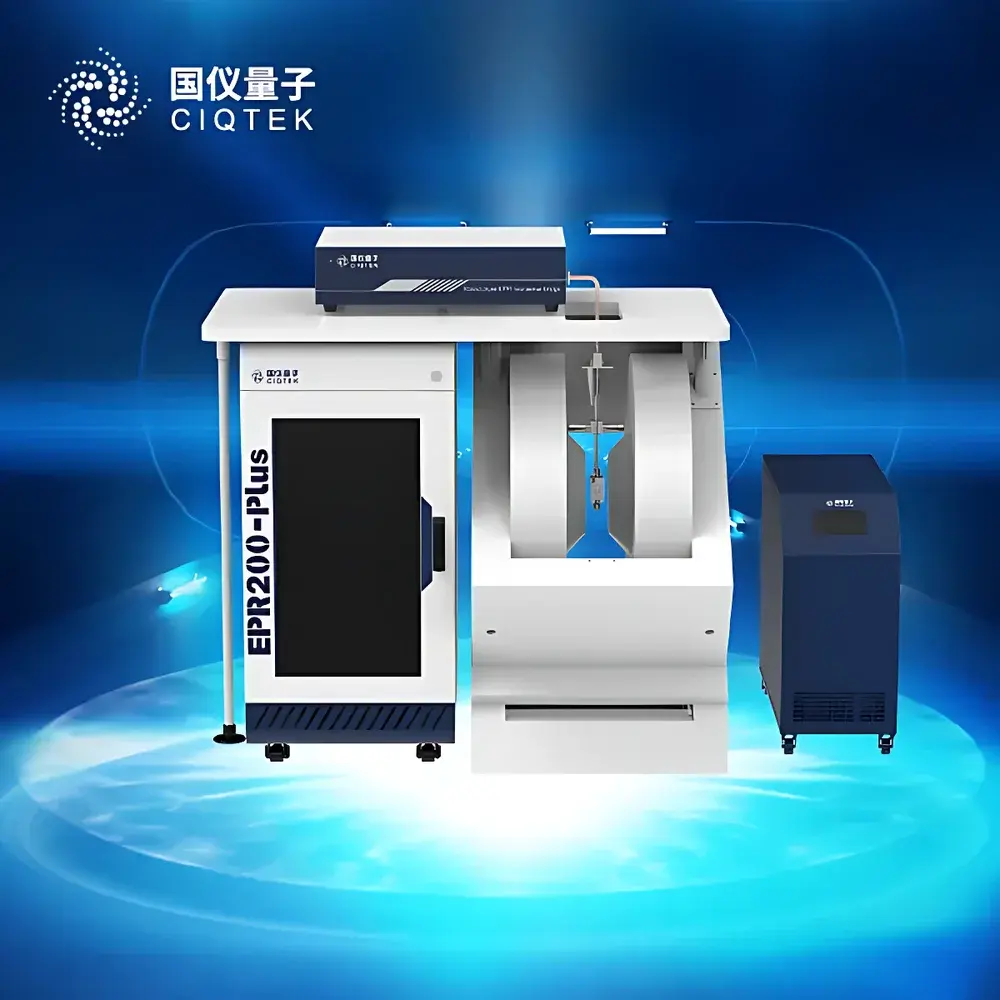
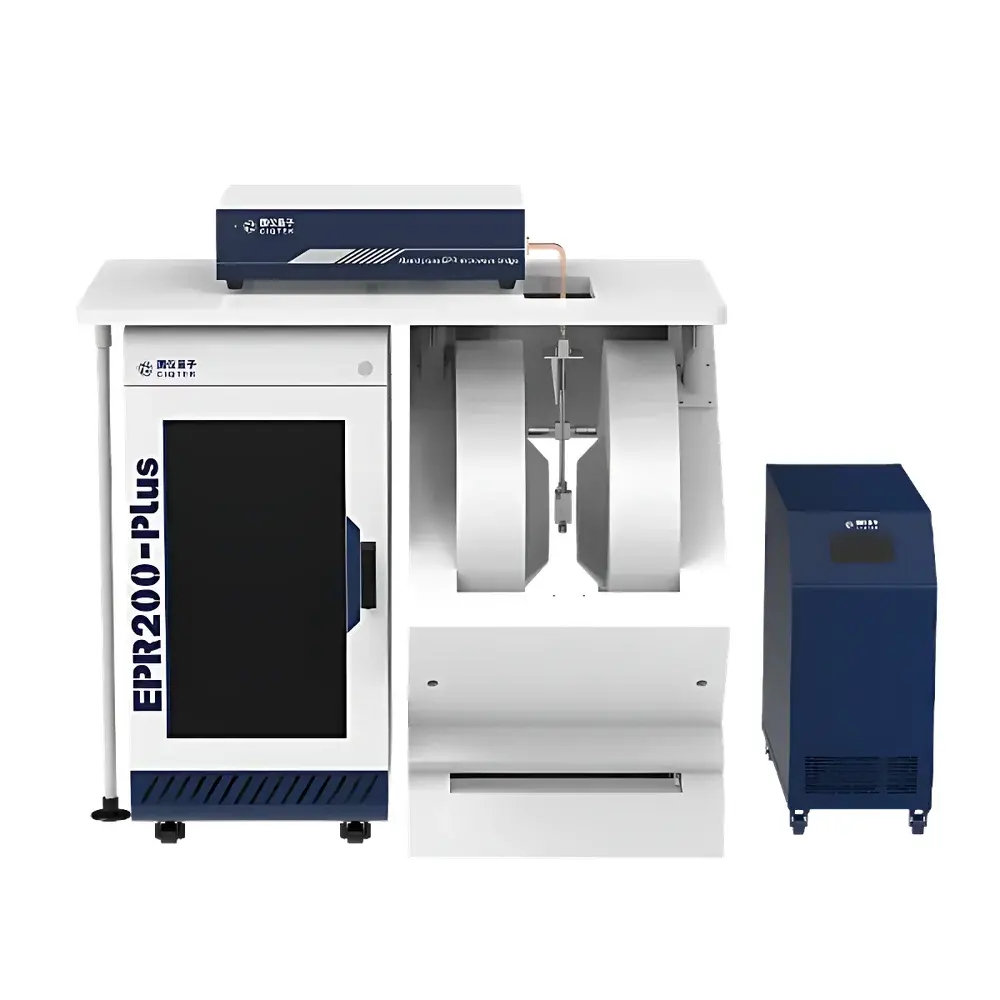
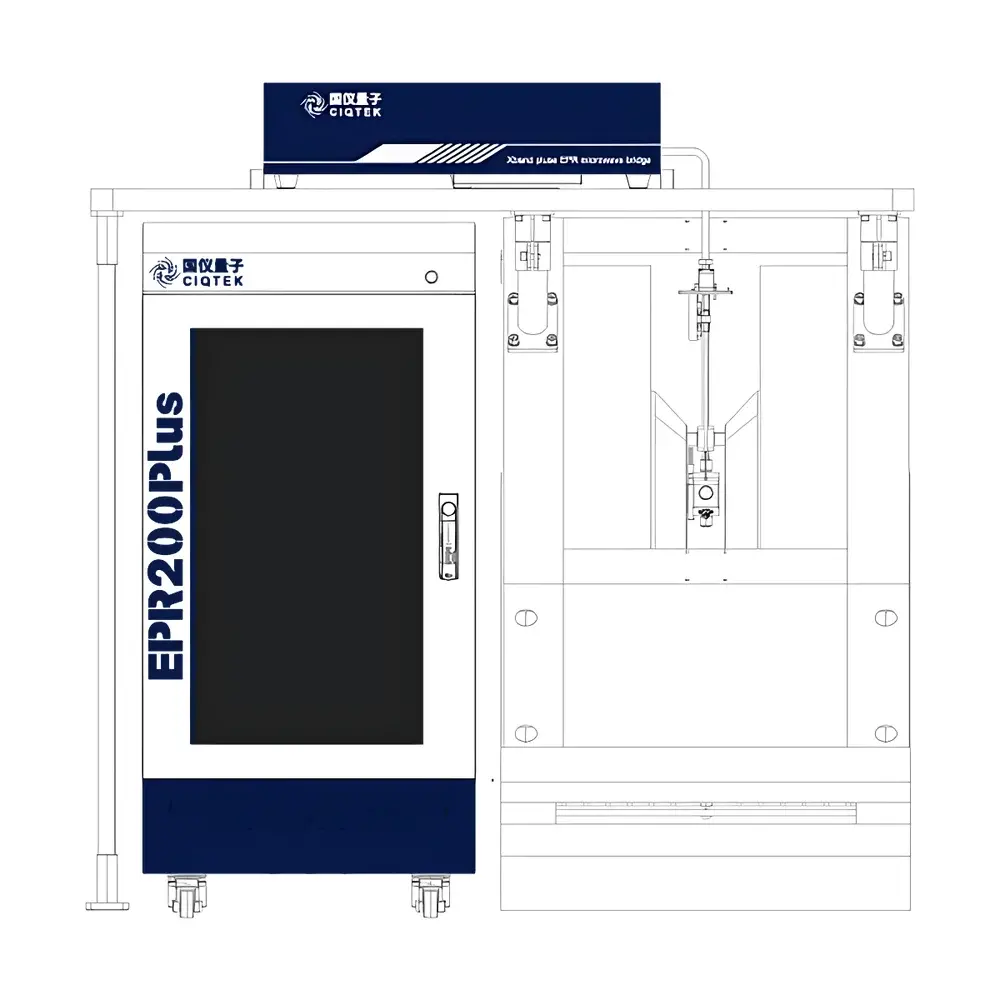
CIQTEK EPR200-Plus X-Band Continuous-Wave Electron Spin Resonance Spectrometer
| Brand | CIQTEK |
|---|---|
| Origin | Anhui, China |
| Manufacturer Type | Original Equipment Manufacturer (OEM) |
| Instrument Type | Continuous-Wave (CW) ESR/EPR Spectrometer |
| Model | EPR200-Plus |
| Microwave Frequency Band | X-band (~9.4 GHz) |
| Maximum Modulation Field Amplitude | 20 G |
| Microwave Bridge Output Power | 200 mW |
| Signal-to-Noise Ratio (SNR) | ≥3000:1 |
| Temperature Control Ranges | 4 K–300 K (dry cryogenic), 4.4 K–300 K (liquid helium), 100 K–600 K (liquid nitrogen), 300 K–800 K (high-temperature furnace) |
| Magnetic Field Homogeneity | ≤12 mG over 10 mm (Z) × 10 mm (X) × 22 mm (Y) volume |
| Modulation Frequency Range | 0.5–120 kHz |
| Scan Points | up to 256,000 |
| Sweep Speed | ≥1500 G/5 s |
| Receiver Gain | 0–106 dB |
| Power Stability | ≤1×10⁻⁶ |
| Spin Quantification | Absolute spin counting without reference standard |
| Field Zero-Crossing Scan Support | Yes |
Overview
The CIQTEK EPR200-Plus is a high-performance X-band continuous-wave electron paramagnetic resonance (EPR) spectrometer engineered for quantitative detection and structural characterization of paramagnetic species—including organic radicals, transition metal ions (e.g., Fe³⁺, Mn²⁺, Cu²⁺), rare-earth ions (e.g., Gd³⁺, Dy³⁺), and point defects such as oxygen vacancies—in solid, liquid, frozen solution, and biological matrices. Operating at a nominal microwave frequency of ~9.4 GHz, the system employs conventional CW-EPR methodology based on magnetic field modulation and phase-sensitive lock-in detection to resolve hyperfine splitting, g-anisotropy, zero-field splitting, and relaxation dynamics. Its modular architecture integrates a superconducting magnet (1.3 T or 1.5 T options), high-Q resonant cavity, low-noise microwave bridge, and digital signal processing unit—designed to meet the rigorous demands of academic research laboratories and industrial R&D centers in catalysis, energy materials, photoredox chemistry, and biophysics.
Key Features
- High-fidelity CW-EPR detection with SNR ≥3000:1 under standard aqueous sample conditions (e.g., TEMPO in water), enabling reliable quantification of spin concentrations down to sub-nanomolar levels.
- Ultra-stable magnetic field platform with homogeneity ≤12 mG over a 10×10×22 mm measurement volume—critical for high-resolution spectral acquisition and angular-dependent studies.
- Flexible modulation capability: adjustable modulation frequency (0.5–120 kHz) and amplitude (up to 20 G), supporting both high-sensitivity narrow-line detection and broad-line analysis of immobilized systems.
- Digital sweep control with up to 256,000 data points per scan and programmable sweep speeds ≥1500 G/5 s—facilitating rapid screening and kinetic profiling.
- Comprehensive temperature control ecosystem: interchangeable cryogenic and thermal modules covering 4 K (dry/dilution-compatible), 4.4 K (liquid He), 100–600 K (liquid N₂), and 300–800 K (resistive furnace) ranges—enabling thermally resolved EPR spectroscopy and Arrhenius analysis.
- Field-zero crossing scan function for precise determination of g = 2.0023 reference position and accurate calibration of anisotropic g-tensors.
- Receiver gain range spanning 0–106 dB with <1×10⁻⁶ power stability—ensuring long-term baseline integrity during extended acquisition protocols required for averaging or time-resolved experiments.
Sample Compatibility & Compliance
The EPR200-Plus accommodates diverse sample formats via a suite of application-optimized resonators: high-Q rectangular TE₁₀₂ cavities for general-purpose sensitivity; dual-mode cavities supporting both perpendicular and parallel excitation geometries—essential for integer-spin systems (S ≥ 1) and forbidden transitions in transition metal complexes; and specialized in situ cells including flat cells (for polar solvents and real-time reaction monitoring), electrochemical cells (for operando redox process tracking), flow/mixing cells (with integrated peristaltic pumps), and tissue-compatible holders for ex vivo biological specimens. All hardware and firmware comply with IEC 61000-4 electromagnetic compatibility standards. Data acquisition and processing workflows support audit-trail-enabled operation per GLP/GMP guidelines, with optional 21 CFR Part 11-compliant software modules available for regulated environments.
Software & Data Management
The instrument is controlled via CIQTEK’s proprietary EPR LabSuite software—a cross-platform (Windows/Linux) application built on Qt and Python-based scientific computing libraries. It provides real-time spectrum visualization, automated cavity tuning, multi-dimensional parameter sweeps (field, temperature, modulation, power), batch processing pipelines, and advanced spectral simulation using spin Hamiltonian modeling (including g, A, D, E tensors). Raw data are stored in HDF5 format with embedded metadata (instrument configuration, calibration history, environmental logs), ensuring FAIR (Findable, Accessible, Interoperable, Reusable) principles. Export options include ASCII, MATLAB .mat, and JCAMP-DX for third-party analysis (e.g., EasySpin, SimFonia, Mnova EPR). Remote access, script-driven automation (via Python API), and integration with laboratory information management systems (LIMS) are supported.
Applications
The EPR200-Plus serves as a core analytical tool across multiple disciplines: in heterogeneous catalysis, it identifies active-site oxidation states and monitors radical intermediates during CO₂ reduction or H₂ evolution; in photovoltaics and photocatalysis, it characterizes photoinduced charge separation, triplet excitons, and reactive oxygen species (•OH, O₂•⁻, ¹O₂); in battery research, it probes paramagnetic degradation products in cathode materials and SEI layer evolution; in bioinorganic chemistry, it resolves metal coordination geometry in metalloproteins (e.g., cytochrome c oxidase, superoxide dismutase); and in defect engineering of wide-bandgap semiconductors (e.g., TiO₂, ZnO, SiC), it quantifies vacancy-type defects and their charge-state transitions as a function of temperature and illumination. Published studies using this platform span journals including Nano Energy, Environmental Research, International Journal of Hydrogen Energy, and Biomaterials.
FAQ
What is the minimum detectable spin concentration for the EPR200-Plus under standard operating conditions?
Typical detection limits range from 10⁹ to 10¹⁰ spins under optimized settings (e.g., 100 µL aqueous TEMPO, 100 K, 1 G modulation, 100 kHz modulation frequency, 10⁵ averages). Absolute spin quantification is achievable without external standards using built-in cavity Q-factor calibration.
Does the system support time-resolved EPR (TR-EPR) measurements?
Yes—the EPR200-Plus can be upgraded with the optional TR-EPR module, comprising a synchronized nanosecond-pulsed laser (e.g., Nd:YAG, 355 nm or 532 nm), laser energy monitor, fast-gated digitizer, and dielectric resonator—enabling transient detection with sub-10 ns time resolution.
Can the instrument perform angle-resolved EPR on single crystals?
Yes—when equipped with the motorized 360° in situ rotator stage and appropriate dual-mode cavity, the system supports full angular dependence mapping of g- and A-tensors for crystallographic orientation analysis.
Is remote operation and automation supported?
Yes—EPR LabSuite includes a Python SDK and RESTful API interface, enabling integration into automated synthesis platforms, high-throughput screening workflows, and cloud-connected lab infrastructures.
Are service and calibration traceable to international standards?
All magnetic field calibrations are referenced to the NIST-traceable DPPH standard (g = 2.0036), and microwave frequency is verified using a calibrated wavemeter. Annual preventive maintenance and performance validation reports conform to ISO/IEC 17025 requirements for testing laboratories.
Related Products





