
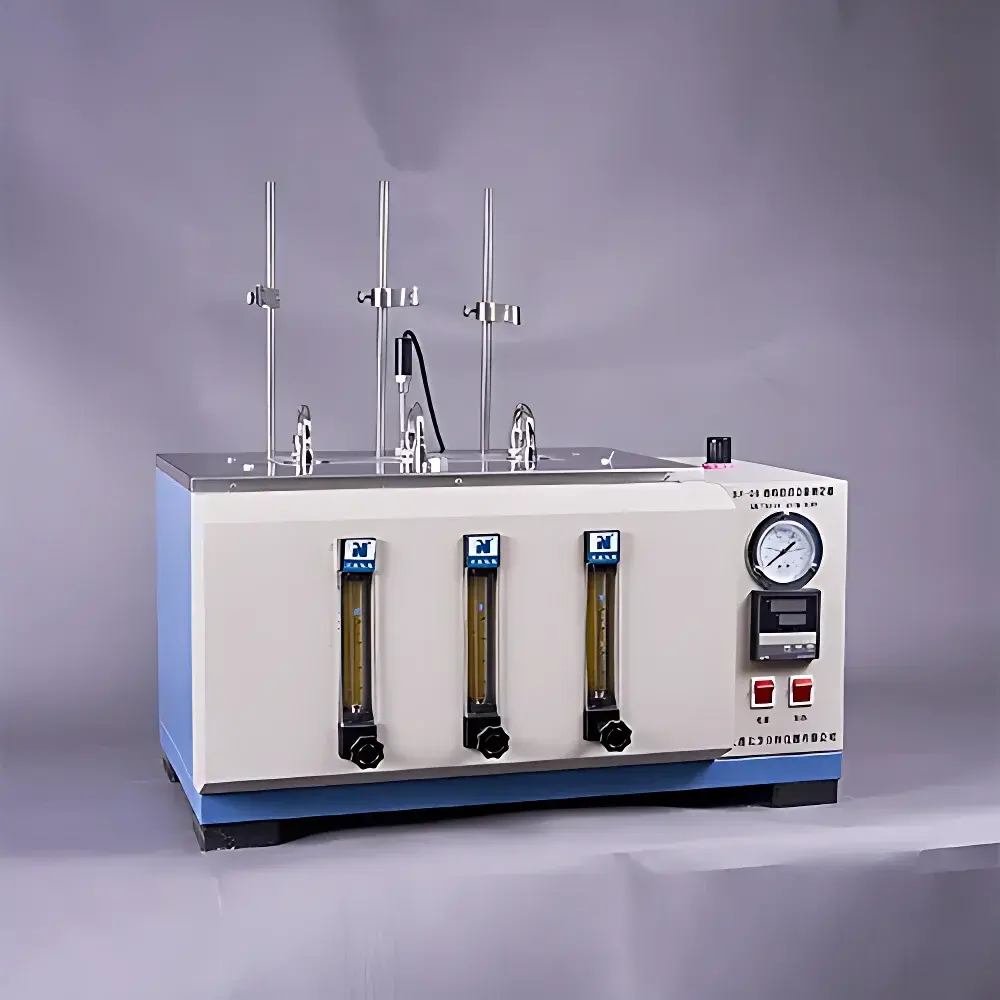
North BF-08 Fuel Gum Content Determinator
| Brand | North |
|---|---|
| Origin | Liaoning, China |
| Manufacturer Type | Authorized Distributor |
| Country of Manufacture | China |
| Model | BF-08 |
| Power Supply | AC 220 V ±10%, 50 Hz |
| Evaporation Bath Heating Power | 2000 W |
| Number of Test Positions | 3 |
| Air Flow Rate at Ambient Temperature | 600 mL/s ±90 mL/s |
| Outlet Air Velocity | 1000 mL/s ±150 mL/s |
| Bath Material | Anodized Aluminum |
| Temperature Control | Digital Intelligent PID Controller |
| Bath Geometry | Helical Air Path with Precision-Drilled Orifices |
| Temperature Monitoring | Dual-Sensor Configuration (Thermometer + RTD Sensor) |
| Compliance Standard | GB/T 8019–2008 |
Overview
The North BF-08 Fuel Gum Content Determinator is a precision-engineered laboratory instrument designed for the quantitative determination of gum content in aviation turbine fuels, motor gasoline, and other volatile distillate fractions—specifically those containing oxygenates (e.g., alcohols, ethers) and deposit-control additives. It operates in strict accordance with the methodology defined in GB/T 8019–2008, which aligns closely with ASTM D381 and IP 131 for gum measurement via evaporation under controlled airflow and thermal conditions. The core principle involves evaporating a standardized fuel sample (typically 50 mL) in a pre-weighed glass beaker placed within a thermostatically regulated aluminum evaporation bath. Compressed, purified air is delivered through a helical internal channel to ensure uniform, laminar flow across the sample surface at precisely defined velocity and temperature conditions. This process volatilizes all non-gum components while retaining adherent, insoluble gum residues for gravimetric quantification.
Key Features
- Triple-position anodized aluminum evaporation bath with integrated helical air distribution manifold—ensures consistent thermal mass and repeatable airflow geometry across all test positions.
- Digital intelligent PID temperature controller with ±0.5 °C stability over the operational range (typically 160–165 °C), verified by dual-sensor monitoring (calibrated mercury-in-glass thermometer + embedded RTD sensor).
- Adjustable compressed air delivery system featuring inline pressure gauge and calibrated rotameter, enabling precise regulation of inlet flow (600 mL/s ±90 mL/s at ambient) and validated outlet velocity (1000 mL/s ±150 mL/s) per ASTM D381 requirements.
- Ergonomic temperature probe holder with vertical translation and full 360° rotational capability—facilitates rapid, traceable calibration verification at each individual bath port.
- Robust 2000 W heating architecture delivering rapid thermal equilibration and minimal thermal gradient between adjacent test positions (<1.0 °C).
- Front-access service panel with dedicated ports for air purification unit integration, minimizing moisture and oil carryover into the evaporation stream.
Sample Compatibility & Compliance
The BF-08 supports a broad spectrum of hydrocarbon-based and oxygenated fuels—including Jet A-1, JP-8, unleaded gasoline (with MTBE, ethanol, or ETBE), and reformulated blends—provided volatility and initial boiling point fall within the scope of GB/T 8019–2008. All materials contacting air or sample vapor are chemically inert (anodized Al, borosilicate glass, stainless steel fittings), eliminating catalytic gum formation artifacts. Instrument design conforms to essential elements of ISO/IEC 17025:2017 for testing laboratory competence, and routine operation supports GLP documentation requirements. While GB/T 8019–2008 is the primary reference standard, method validation data demonstrate equivalence to ASTM D381–22 (Standard Test Method for Gum Content in Fuels by Jet Evaporation) when operated under identical thermal and airflow parameters.
Software & Data Management
The BF-08 is a standalone benchtop instrument with no embedded microprocessor or digital interface; it relies on manual procedural execution and external laboratory record-keeping. However, its deterministic mechanical and thermal architecture enables full traceability: each test position is individually verifiable via calibrated thermometer insertion, airflow is continuously monitored using analog rotameters with NIST-traceable calibration certificates, and bath temperature stability logs can be maintained manually or via external data loggers (e.g., Omega OM-DAQPRO-5300 series). For laboratories operating under FDA 21 CFR Part 11 or EU Annex 11 requirements, the BF-08 serves as a compliant hardware platform when paired with validated electronic lab notebooks (ELNs) supporting audit trails, user authentication, and electronic signatures for test records.
Applications
- Quality control of finished gasoline and aviation turbine fuels prior to distribution.
- Stability assessment of fuel formulations containing antioxidants, metal deactivators, and detergent packages.
- Research and development of low-gum biofuel blends (e.g., ethanol-gasoline, Fischer–Tropsch synthetic fuels).
- Investigation of storage-induced oxidation products in intermediate refinery streams.
- Third-party certification testing for compliance with national fuel specifications (e.g., GB 17930, GB 6537).
FAQ
Does the BF-08 comply with international standards beyond GB/T 8019–2008?
Yes—the thermal profile, airflow geometry, and sample handling protocol are functionally equivalent to ASTM D381 and IP 131, allowing cross-standard validation with documented correlation studies.
Is compressed air purification mandatory?
Yes. The instrument requires oil-free, desiccated air (dew point ≤ –40 °C) to prevent condensation artifacts and catalytic residue formation. A certified compressed air purification unit must be installed upstream.
Can the BF-08 accommodate non-standard sample volumes?
No. Per GB/T 8019–2008, only 50 mL samples in specified 50-mL low-form glass beakers are permitted to ensure reproducible evaporation dynamics and gum deposition morphology.
What maintenance intervals are recommended for long-term accuracy?
Annual verification of temperature uniformity across all three ports and biannual recalibration of the rotameter against a primary flow standard (e.g., Brooks 5850E) are advised per ISO/IEC 17025 guidance.
Is the aluminum bath susceptible to corrosion from acidic fuel residues?
No—the anodized surface provides Class AA corrosion resistance per MIL-A-8625F, validated for repeated exposure to sulfur-containing and organic acid-bearing fuel fractions.






