
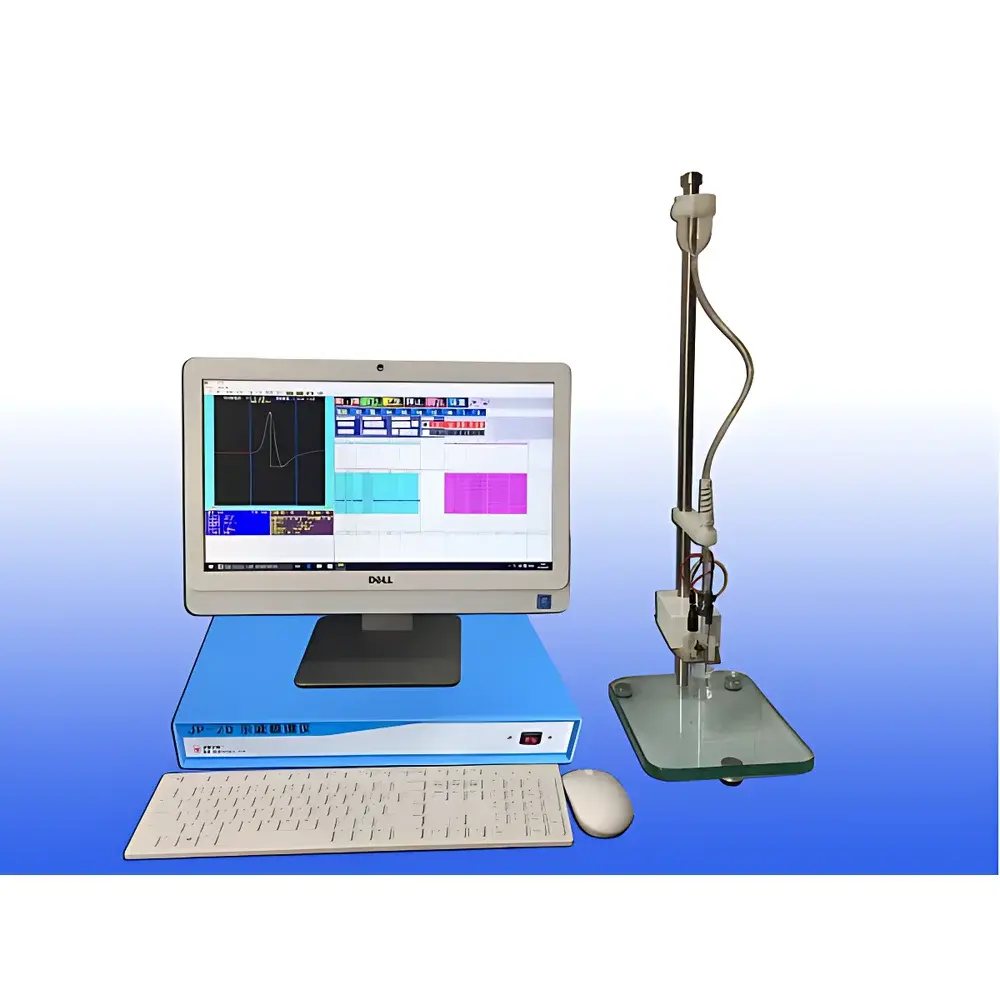
JP-2D Oscilloscopic Polarograph
| Brand | — |
|---|---|
| Origin | Beijing, China |
| Manufacturer Type | Authorized Distributor |
| Region of Manufacture | Domestic (China) |
| Model | JP-2D |
| Price | Upon Request |
Overview
The JP-2D Oscilloscopic Polarograph is a microprocessor-controlled, computer-integrated voltammetric analyzer engineered for high-fidelity electrochemical detection in laboratory and quality control environments. Based on classical DC polarography and derivative (first- and second-order) polarographic techniques, the instrument employs dropping mercury electrode (DME) or solid electrodes to measure current–voltage (i–E) responses under controlled potential sweeps. Its core measurement principle relies on capacitive current compensation, background subtraction, and digital signal processing of faradaic currents generated during electroreduction or electrooxidation of analytes in solution. Designed for trace-level quantitative analysis, the JP-2D delivers sub-nanomolar detection sensitivity—validated at <5 × 10⁻⁸ mol/L for Cd2+ using linear-scan polarography—and supports standardized electroanalytical workflows aligned with ISO 8655 (volumetric calibration), ASTM D3224 (electrochemical sensor validation), and general GLP-compliant data integrity practices.
Key Features
- Integrated 19.5-inch all-in-one industrial PC with Windows-compatible embedded software (32-/64-bit support), enabling full instrument control without external computing hardware
- ARM-based real-time embedded architecture ensuring deterministic response timing and system stability during extended acquisition cycles
- 18-bit analog-to-digital and digital-to-analog conversion (ADC/DAC), delivering enhanced dynamic range and reproducibility over legacy 12-bit systems
- Programmable polarization potential range from +3904 mV to –3904 mV (32 mV resolution), compatible with both anodic and cathodic scans
- Adjustable scan rate (50–1000 mV/s) and amplitude (50–1000 mV), supporting optimized waveform definition for diverse redox couples
- Automatic capacitive and residual current compensation, minimizing baseline distortion and improving peak resolution (≤32 mV)
- 23-step programmable current range (15 nA to 400 µA full-scale), with ≤0.3% range-switching error and ≤0.3% repeatability error
- Dual-element sequential measurement mode: simultaneous parameter sets for two analytes with widely separated peak potentials, executed without electrolyte replacement
- Automated peak detection, calibration, and numbering; built-in statistical engine for regression analysis (linear and quadratic), coefficient of variation (CV), and correlation coefficient (R²)
Sample Compatibility & Compliance
The JP-2D accommodates standard three-electrode configurations (working, reference, counter) and is routinely deployed with mercury-based electrodes (DME, HMDE) or carbon-based alternatives (glassy carbon, screen-printed electrodes). It supports aqueous and mixed-solvent electrolytes across pH 1–12, with compatibility verified for common supporting electrolytes including KCl, HClO4, and acetate buffers. While not certified to IEC 61010-1 for hazardous location use, the instrument meets CE marking requirements for electromagnetic compatibility (EN 61326-1) and low-voltage safety (EN 61010-1). Data handling adheres to foundational ALCOA+ principles—attributable, legible, contemporaneous, original, accurate—with audit-trail-capable software logging all method parameters, raw i–E curves, and post-processing steps. Though not FDA 21 CFR Part 11–validated out-of-the-box, its structured data export (CSV, Excel-ready) facilitates integration into validated LIMS or ELN platforms.
Software & Data Management
The proprietary JP-2D Control Suite provides a unified interface for instrument configuration, real-time waveform visualization, and post-acquisition analysis. All measurement protocols—including standard addition, calibration curve (single/multi-point), and comparative methods—are predefined and editable. Raw polarograms are stored with metadata (date/time, electrode ID, solution batch, operator ID) and can be recalled, overlaid, or averaged. Batch processing enables automated sequence execution: blank subtraction, peak identification, concentration calculation, and Excel report generation—including regression plots, equations, R² values, and CV statistics. Export formats include .csv (for third-party statistical packages), .xlsx (with embedded charts), and printer-ready PDF reports featuring customizable headers, Chinese/English bilingual labeling, and user-defined footnotes. Software updates are distributed free-of-charge via secure download portal, maintaining backward compatibility with legacy method files.
Applications
The JP-2D serves as a versatile tool in academic teaching laboratories for demonstrating fundamental electrochemical concepts—including diffusion-controlled kinetics, Nernstian behavior, and scan-rate dependence of peak current. In applied settings, it supports trace metal analysis in environmental water (Pb, Cd, Zn, Cu), pharmaceutical impurity profiling (e.g., heavy metal catalyst residues per ICH Q2(R2)), food safety testing (As, Hg in seafood), and geological sample digestion analysis (ore leachates, soil extracts). Its dual-parameter capability is particularly effective for simultaneous quantification of metals with large peak separation (e.g., Pb2+ at –0.42 V vs. Ag/AgCl and Tl+ at –0.27 V), reducing assay time by up to 40% compared to sequential single-analyte runs. The instrument is also used in method development for pharmacopeial assays (USP , EP 2.2.43) where polarographic endpoints supplement chromatographic results.
FAQ
Is the JP-2D compliant with FDA 21 CFR Part 11 for electronic records?
The base software does not include electronic signature, role-based access control, or audit-trail archiving required for Part 11 compliance; however, raw data exports (.csv/.xlsx) may be imported into validated enterprise systems meeting these criteria.
Can the instrument operate without the integrated computer?
Yes—the USB interface allows connection to any Windows PC (Win7/8/10, 32- or 64-bit); the bundled software installs independently and retains full functionality.
What electrode types are supported?
Standard configurations include dropping mercury electrode (DME), hanging mercury drop electrode (HMDE), and solid electrodes such as glassy carbon, platinum, or gold; electrode-specific parameters (drop time, purge gas flow) are user-configurable.
How is background current compensated?
The system applies digital subtraction of pre-scan baseline segments and adaptive capacitive current modeling during voltage ramping, minimizing non-faradaic contributions without requiring manual baseline correction.
Does the software support multi-language interfaces?
The GUI defaults to English and Chinese; language selection is configurable within system settings, with all report templates and dialog boxes fully localized.
Related Products






