
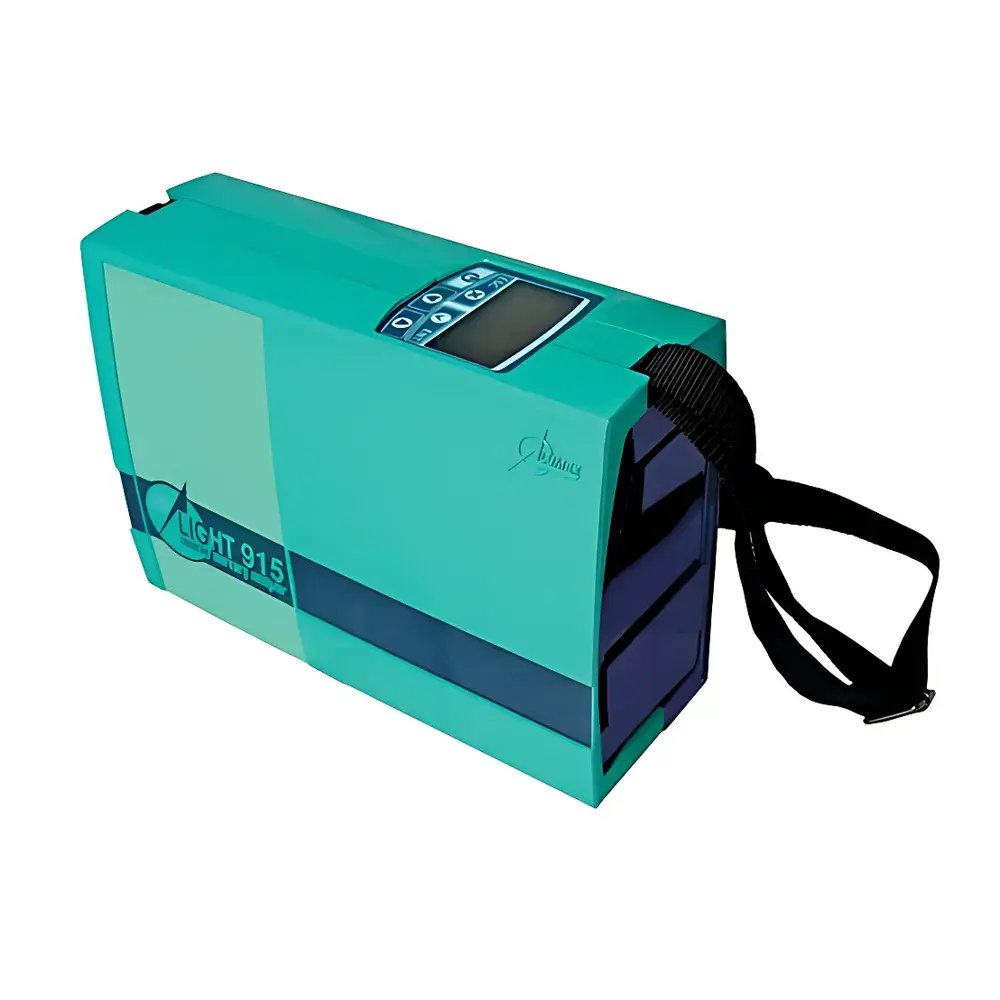
Light 915 Ultra-Portable Ambient Air Mercury Analyzer
| Brand | — |
|---|---|
| Origin | Beijing, China |
| Manufacturer Type | Authorized Distributor |
| Region of Manufacture | Domestic (China) |
| Model | Light 915 |
| Instrument Type | Portable |
| Detection Principle | Zeeman Atomic Absorption Spectroscopy with High-Frequency Modulated Polarized Light (ZAAS-HFM) |
| Wavelength | 254 nm |
| Detection Limit | <0.1 µg/m³ |
| Operating Duration | Up to 12 h on rechargeable battery |
| Dynamic Range | 5 orders of magnitude |
| Data Storage | Internal memory with USB and Bluetooth export |
| Regulatory Status | Listed on U.S. EPA Emergency Response Equipment List |
| Compliance | Designed for compliance with OSHA PEL, ACGIH TLV, and ISO 6879 for elemental mercury vapor monitoring |
Overview
The Light 915 Ultra-Portable Ambient Air Mercury Analyzer is a field-deployable, direct-reading instrument engineered for real-time quantification of elemental mercury vapor (Hg⁰) in ambient air and confined gas streams. It employs Zeeman Atomic Absorption Spectroscopy with High-Frequency Modulated Polarized Light (ZAAS-HFM), a physics-based optical detection method that exploits the characteristic absorption of mercury atoms at the 254 nm resonance line. Unlike conventional gold-amalgam preconcentration systems, the Light 915 performs direct, continuous measurement without chemical reagents, carrier gases, or sample trapping—enabling immediate response to dynamic concentration changes. Its compact form factor (weight < 2.5 kg), integrated lithium-ion power system, and ruggedized enclosure make it suitable for deployment across diverse operational environments—from industrial hygiene surveys and emergency spill response to mobile atmospheric profiling aboard vehicles, helicopters, or marine vessels.
Key Features
- Direct Hg⁰ measurement via ZAAS-HFM principle—no gold trap, no consumables, no external gas supply required
- Sub-part-per-trillion (pptv) equivalent detection capability, with verified lower limit of quantification (LLOQ) ≤ 0.1 µg/m³ (≈ 8 ng/m³ or 40 pptv at 25°C/1 atm)
- Real-time output with 1-second data resolution and configurable averaging intervals (1–60 s)
- Onboard performance verification module including automatic zero-check and internal reference calibration source
- Integrated rechargeable battery supporting ≥12 hours of continuous operation under typical sampling conditions
- Wide dynamic range spanning five decades (0.1–100,000 µg/m³), enabling trace-level surveillance and high-concentration incident assessment within a single instrument
- Rugged IP54-rated housing with shock-absorbing casing, designed for field durability and transport resilience
- Dual-mode data interface: USB 2.0 for bulk transfer and Bluetooth 4.2 for wireless telemetry and remote configuration
Sample Compatibility & Compliance
The Light 915 is optimized for gaseous samples containing elemental mercury vapor in air, nitrogen, argon, or other non-reactive carrier matrices. It is not intended for oxidized mercury species (e.g., Hg²⁺), particulate-bound mercury, or organic mercury compounds without prior thermal or catalytic reduction. The analyzer meets functional requirements outlined in U.S. EPA Method IO-3.2 (Mercury Vapor Monitoring Using Zeeman Atomic Absorption) and aligns with ISO 6879:2021 (Air quality — Determination of mercury in ambient air — Direct reading instruments using atomic absorption). Its inclusion on the U.S. Environmental Protection Agency’s Emergency Response Equipment List validates its suitability for rapid deployment during accidental releases. For occupational health applications, it supports exposure assessment against OSHA Permissible Exposure Limits (PEL: 0.1 mg/m³ ceiling) and ACGIH Threshold Limit Values (TLV-TWA: 0.025 mg/m³), with built-in logging compliant with GLP data integrity expectations.
Software & Data Management
The Light 915 operates with embedded firmware supporting time-stamped data acquisition, user-defined site metadata tagging, and automated event flagging (e.g., alarm thresholds, battery low warnings). Raw and averaged concentration values are stored in non-volatile memory (≥16,000 records) with UTC synchronization. The companion PC software (Windows/macOS compatible) enables spectral review, calibration history tracking, and export to CSV or PDF report formats. Audit trail functionality logs all configuration changes, zero checks, and manual interventions—supporting documentation needs for internal QA reviews and regulatory inspections. While not certified for FDA 21 CFR Part 11 compliance out-of-the-box, the system architecture permits integration into validated laboratory information management systems (LIMS) via standardized serial or Bluetooth protocols.
Applications
- Rapid identification and spatial mapping of mercury vapor plumes during accidental spills or equipment failures
- Post-remediation verification of decontamination efficacy in laboratories, dental clinics, or chlor-alkali facilities
- Occupational exposure monitoring in workplaces handling mercury-containing devices (e.g., fluorescent lamp recycling, thermometers, switches)
- Process gas stream monitoring in mercury-cell chlorine production or coal-fired flue gas treatment systems
- Field-based ecological studies assessing atmospheric mercury deposition gradients near contaminated sites
- Mobile ambient air screening during environmental justice assessments or community health investigations
FAQ
Does the Light 915 require routine calibration with mercury vapor standards?
Yes—while the internal verification unit ensures short-term stability, NIST-traceable calibration checks using permeation tubes or dynamic dilution systems are recommended before each critical deployment and at least daily during extended field use.
Can the instrument measure mercury in soil gas or stack emissions?
It is validated for ambient air and inert gas matrices; for soil gas or flue gas, users must ensure temperature, moisture, and particulate content remain within specified operating limits (≤90% RH, <5 µm particulates, 5–40°C) and apply appropriate filtration and conditioning.
Is the data output compatible with third-party environmental monitoring platforms?
Yes—the ASCII-formatted serial output and Bluetooth HID profile support integration with SCADA systems, cloud-based dashboards, and GIS-enabled mapping tools via standard middleware configurations.
What maintenance is required between field deployments?
Routine inspection of the optical window cleanliness, battery health verification, and filter replacement (if installed upstream) constitute the primary preventive maintenance protocol; no optical alignment or lamp replacement is needed during normal service life.






