
CHL-5Z Portable Chlorophyll-a Fluorometer
| Brand | — |
|---|---|
| Origin | Beijing, China |
| Manufacturer Type | Authorized Distributor |
| Country of Manufacture | China |
| Model | CHL-5Z |
| Price | Upon Request |
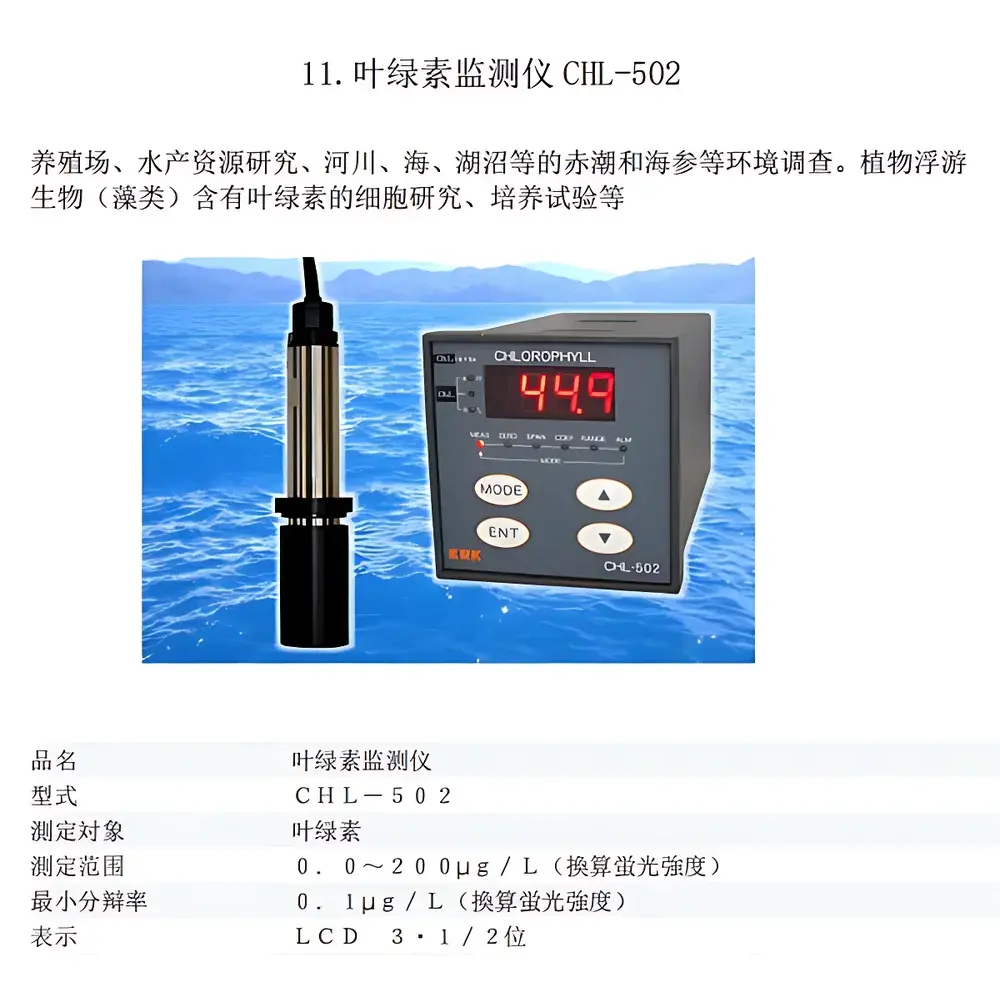
| Measurement Range | 0.0–200 µg/L (fluorescence-intensity calibrated) |
| Resolution | 0.1 µg/L |
| Display | 3.5-digit LCD |
| Excitation Wavelength | 400–470 nm |
| Emission Wavelength | 600–700 nm |
| Repeatability | ±2% (under controlled conditions) |
| Operating Temperature | 5–35 °C (non-freezing, shielded from direct sunlight) |
| Protection Rating | IP63-equivalent |
| Power Supply | DC 4.5 V (3 × AAA/LR03 batteries) |
| Auto Power-Off | After 30 minutes of inactivity |
| Dimensions | 75 mm (W) × 38 mm (H) × 180 mm (D) |
| Weight | ~300 g |
| Standard Accessories | Instrument body, alkaline batteries, instruction manual, warranty card, carrying case |
Overview
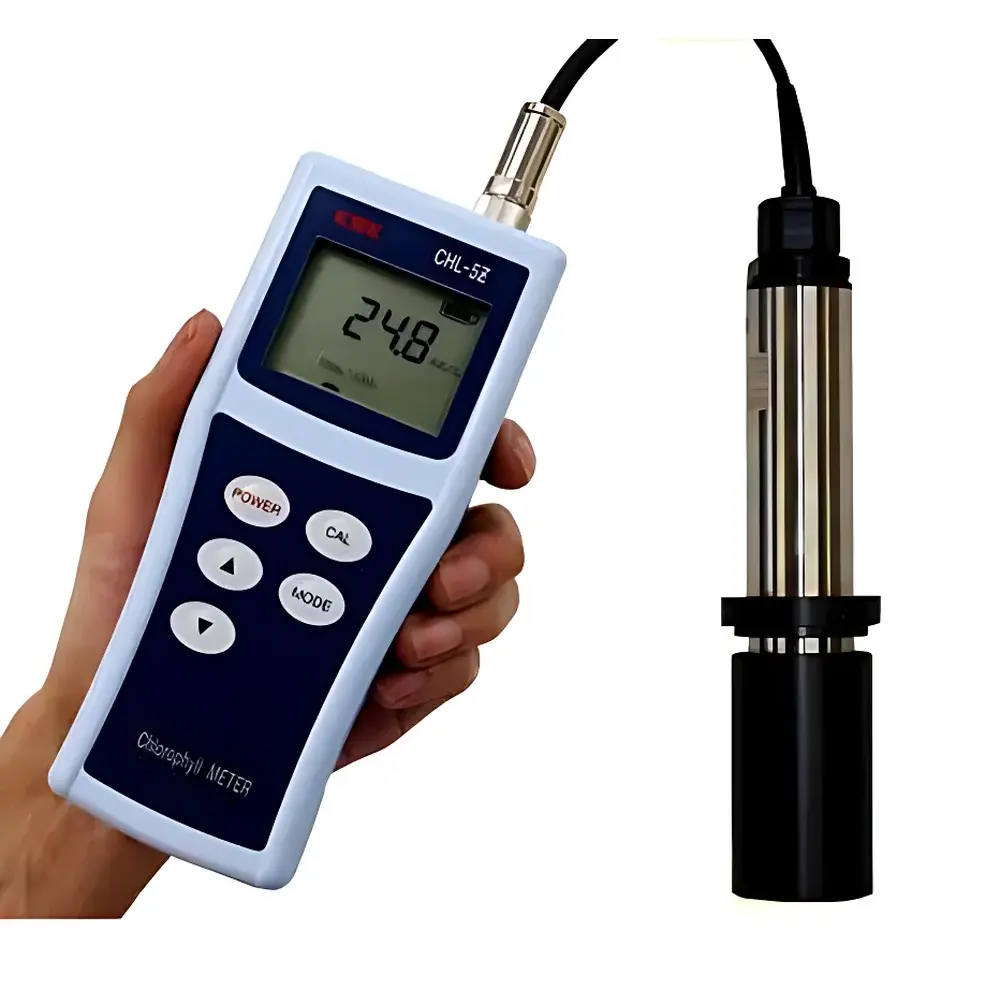
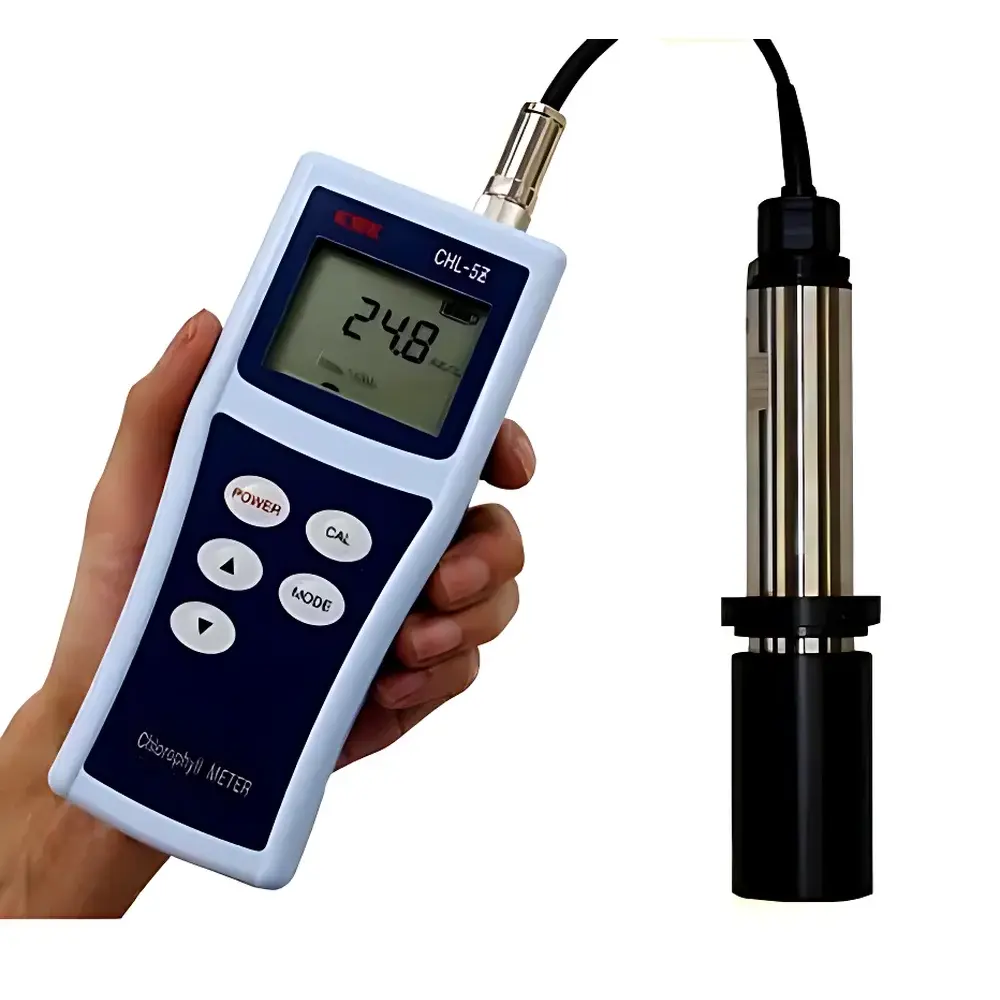
The CHL-5Z Portable Chlorophyll-a Fluorometer is a field-deployable optical sensor engineered for rapid, in-situ quantification of chlorophyll-a concentration in natural and managed aquatic systems. It operates on the principle of in vivo fluorescence spectroscopy: living phytoplankton cells contain chlorophyll-a molecules that absorb blue light (400–470 nm) and re-emit energy as red fluorescence (600–700 nm). The CHL-5Z integrates a compact excitation LED source and a matched photodiode detector within a probe-style housing, enabling direct immersion measurements without sample extraction or chemical processing. This real-time, non-destructive methodology supports high-temporal-resolution profiling—particularly valuable for vertical water column surveys, bloom onset detection, and short-term incubation experiments. Unlike laboratory-based acetone-extraction protocols (e.g., ASTM D3977-18), the CHL-5Z delivers immediate fluorescence intensity values calibrated to µg/L chlorophyll-a equivalents, with traceability established via empirical correlation to reference spectrophotometric methods.
Key Features
- Probe-style design optimized for handheld deployment and vertical profiling in rivers, lakes, estuaries, and coastal waters
- Dual-wavelength optical architecture: narrowband blue excitation (400–470 nm) paired with red-emission bandpass detection (600–700 nm) to maximize signal specificity for chlorophyll-a
- IP63-rated enclosure ensuring dust resistance and protection against water spray during field operation
- Low-power electronics powered by three standard AAA batteries, supporting >100 hours of continuous use and automatic shutdown after 30 minutes of idle time
- High-resolution 3.5-digit LCD display with intuitive status indicators (BAT, CAL, S, ERR, and out-of-range alerts)
- Calibration-compatible interface—supports user-defined correlation factors to align fluorescence output with local phytoplankton community composition or lab-derived acetone-extraction data
Sample Compatibility & Compliance
The CHL-5Z is validated for use in freshwater, brackish, and marine matrices exhibiting turbidity ≤50 NTU and suspended solids ≤100 mg/L. Its fluorescence response is sensitive to physiological state (e.g., nutrient stress, photoacclimation) and taxonomic composition; therefore, site-specific calibration against solvent-extraction HPLC or spectrophotometric reference methods (per ISO 10260:2021 or APHA 10200H) is recommended for quantitative environmental reporting. While not certified for regulatory compliance under EPA Method 445.0 or USP , the instrument meets functional requirements for screening-level monitoring aligned with GLP-guided field studies and preliminary assessment protocols. Data outputs are suitable for integration into QA/QC workflows requiring documented calibration history and operator verification logs.
Software & Data Management
The CHL-5Z operates as a standalone field instrument with no embedded memory or digital interface. All measurement records must be manually logged or transcribed into external databases. For traceability, users are advised to maintain parallel logbooks containing date/time, location (GPS coordinates), depth, temperature, instrument serial number, calibration factor applied, and observer ID. When used in regulated environments (e.g., aquaculture facility monitoring per FAO Technical Paper No. 582), this manual documentation satisfies minimum ALCOA+ principles (Attributable, Legible, Contemporaneous, Original, Accurate, Complete, Consistent, Enduring, Available) for field-collected environmental data.
Applications
- Rapid assessment of phytoplankton biomass during algal bloom surveillance (e.g., cyanobacterial scum in eutrophic reservoirs or dinoflagellate blooms in coastal zones)
- Vertical chlorophyll-a profiling in limnological and oceanographic campaigns using simple winch-deployed probe handling
- Short-term culture experiments tracking photosynthetic activity under controlled light/nutrient gradients
- Pre-screening tool prior to full-speciation analysis (e.g., microscopy or flow cytometry) in ecological monitoring programs
- Education and outreach activities where portability, safety (no solvents), and instant feedback enhance experiential learning
FAQ
How does the CHL-5Z differ from laboratory-based chlorophyll-a analysis methods?
It provides real-time, in-situ fluorescence readings without sample preservation, extraction, or centrifugation—enabling immediate decision-making but requiring correlation to reference methods for absolute quantification.
Can the CHL-5Z distinguish between chlorophyll-a and phycocyanin or other pigments?
No. Its optical bandpass overlaps partially with accessory pigments; elevated phycocyanin (e.g., in Microcystis blooms) may cause positive interference unless corrected via dual-pigment calibration.
Is temperature compensation built into the instrument?
No. Measurements must be conducted within 5–35 °C, and users should record concurrent water temperature to assess potential thermal quenching effects on fluorescence yield.
What maintenance is required for long-term field reliability?
Regular cleaning of the optical window with deionized water and soft lint-free cloth; periodic verification of battery contact integrity and LED output stability using a reference standard solution (e.g., diluted rhodamine WT).







