
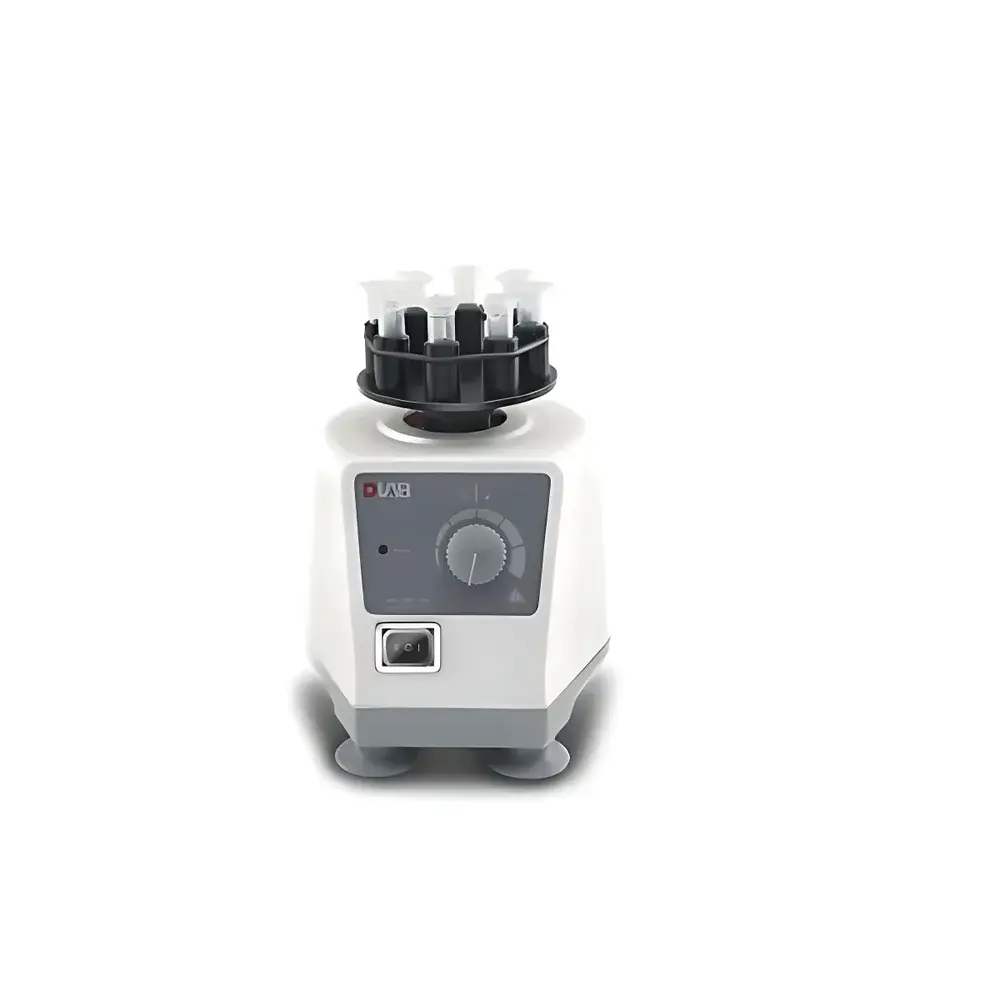
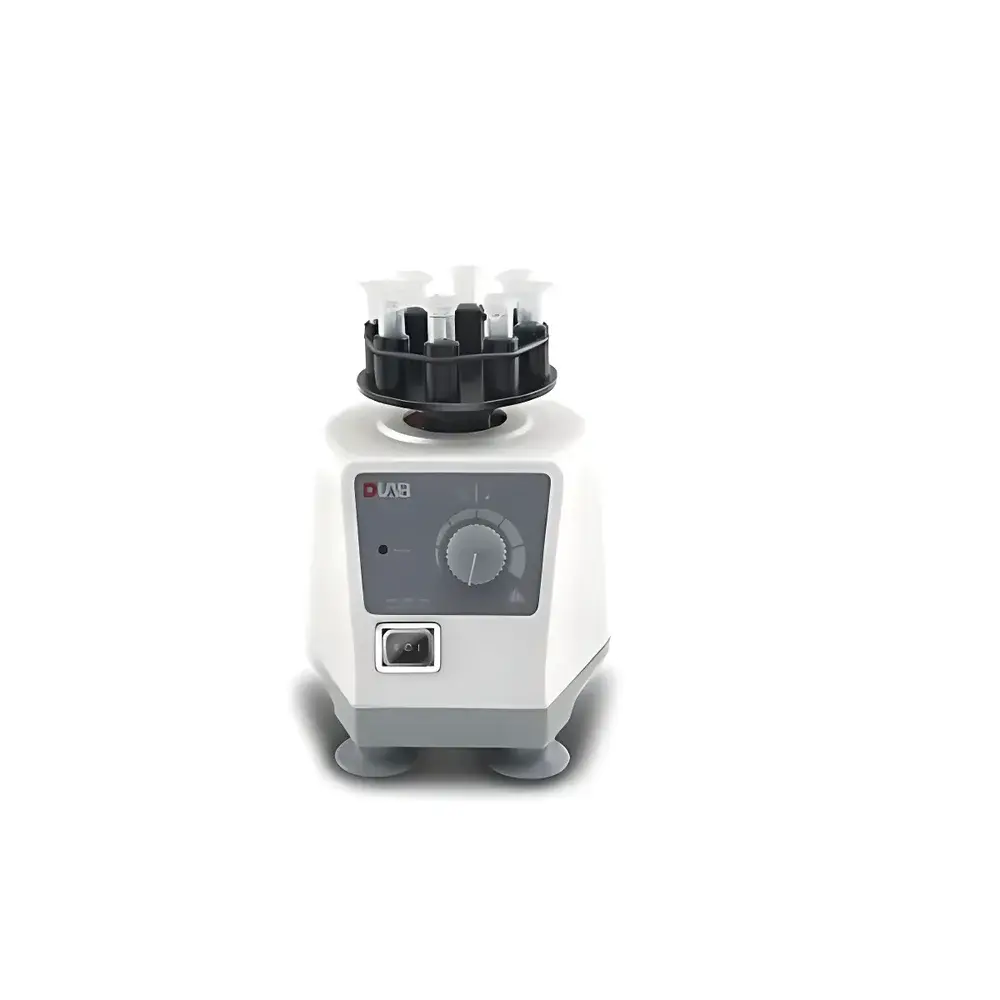
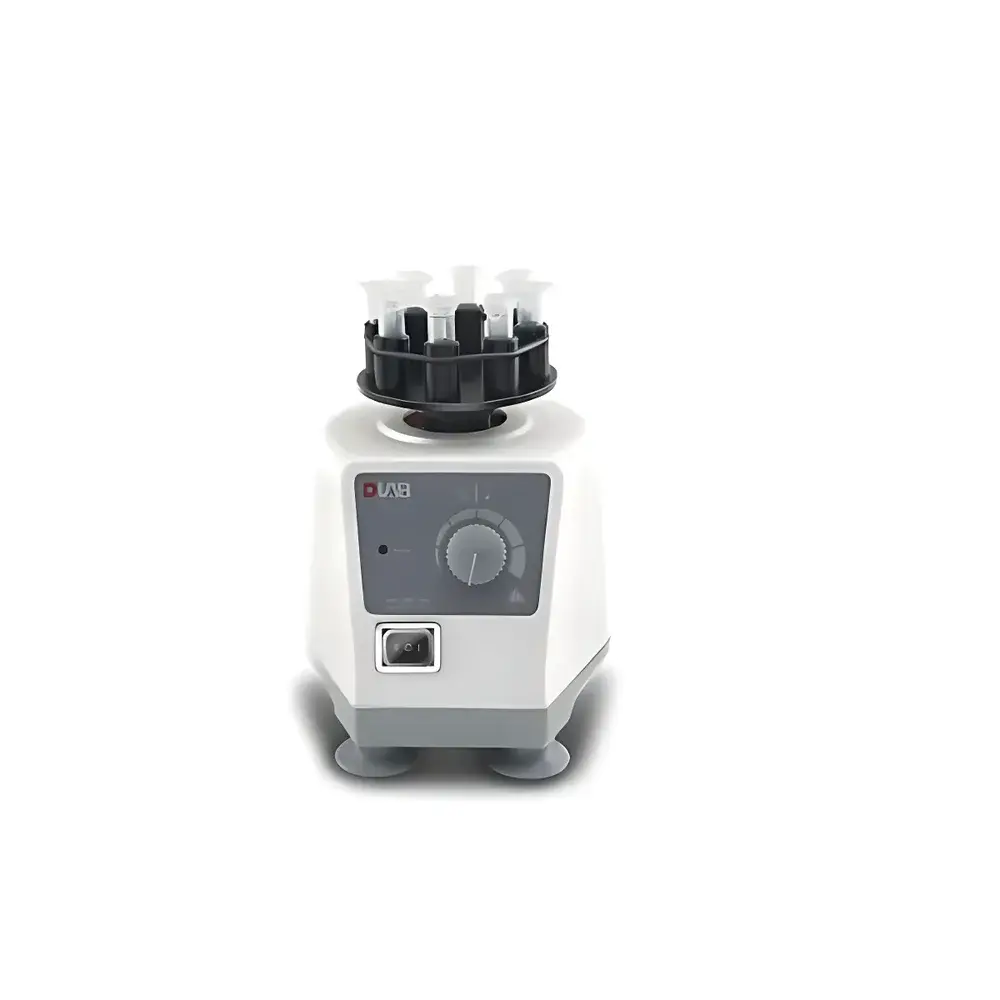
DLAB MX-C High-Throughput Cell Disruptor with Ultrasonic and Vortex Lysis Capabilities
| Brand | DLAB |
|---|---|
| Origin | Beijing, China |
| Model | MX-C |
| Temperature Range | 0–60 °C |
| Operating Frequency | 20–25 kHz |
| Ultrasonic Power Output | 0–300 W |
| Sample Volume per Tube | 0.5–50 mL |
| Throughput | 8 samples (max. 2 mL/tube) |
| Vortex Motion | Orbital shaking with 4 mm orbit diameter |
| Speed Range | 0–3000 rpm (adjustable) |
| Power Input | 60 W |
| Voltage | 100–120 V / 200–240 V, 50/60 Hz |
| Dimensions (L×W×H) | 127 × 130 × 160 mm |
| Weight | 2.0 kg |
Overview
The DLAB MX-C High-Throughput Cell Disruptor is an integrated benchtop lysis platform engineered for reproducible, non-contact mechanical disruption of biological cells in research-grade life science laboratories. It combines two complementary physical lysis modalities—focused high-frequency ultrasonication (20–25 kHz) and controlled orbital vortex agitation—to achieve efficient, scalable, and thermally managed sample preparation. Unlike handheld sonicators or single-tube homogenizers, the MX-C employs a fixed-position transducer array coupled with an 8-position microtube carrier, eliminating operator variability and enabling simultaneous processing under identical acoustic and mechanical parameters. The system’s temperature-controlled chamber (0–60 °C) ensures thermal stability during extended lysis cycles—critical for preserving nucleic acid integrity, minimizing protein denaturation, and maintaining native complex stoichiometry in downstream applications such as chromatin immunoprecipitation (ChIP), RNA-seq library prep, or recombinant protein extraction.
Key Features
- Parallel processing of up to eight samples (0.5–50 mL volume range) using a precision-machined aluminum sample block with integrated cooling channels
- Dual-mode lysis architecture: adjustable ultrasonic power (0–300 W) synchronized with orbital shaking (0–3000 rpm, 4 mm orbit diameter) for synergistic shear stress delivery
- Programmable temperature regulation via Peltier-based control system, with real-time monitoring and ±0.5 °C stability over 30-minute runs
- Microprocessor-driven timing and duty-cycle management (ultrasonic burst mode configurable from 0.1–10 s ON/OFF intervals)
- Low-vibration, brushless DC motor drive and sealed transducer housing for long-term operational reliability and minimal cross-contamination risk
- Compliance-ready design: CE-marked, RoHS-compliant, and compatible with standard biosafety cabinets (Class II A2)
Sample Compatibility & Compliance
The MX-C accommodates standard 0.5–2.0 mL microcentrifuge tubes (including PCR-grade and low-binding variants), 15 mL conical tubes (with optional adapter), and custom tube formats up to 50 mL volume. It supports diverse biological matrices—including bacterial cultures (E. coli, Bacillus spp.), yeast (S. cerevisiae), mammalian cell lines (HEK293, CHO), plant tissues (leaf homogenates), and frozen lysates—without requiring enzymatic pretreatment. All wetted surfaces are chemically inert (anodized aluminum, PTFE-sealed transducers), ensuring compatibility with common lysis buffers (RIPA, NP-40, Tris-EDTA), chaotropic agents (guanidine HCl), and cryoprotectants (glycerol, DMSO). The instrument meets ISO 13485-aligned manufacturing protocols and includes factory calibration documentation traceable to NIST standards. Its operating parameters support GLP-compliant workflows when paired with audit-trail-enabled software (see Software & Data Management section).
Software & Data Management
The MX-C operates via front-panel digital interface with tactile rotary encoder and LED status indicators—no PC dependency required for routine operation. For advanced protocol management and regulatory compliance, optional DLAB LysisControl™ v2.1 software (Windows 10/11 compatible) provides full remote control, method storage (up to 99 user-defined profiles), electronic signature support, and 21 CFR Part 11–compliant audit trail generation. All run logs—including timestamp, power setting, temperature setpoint, rpm, duration, and error codes—are exportable as CSV or PDF for integration into ELN systems (e.g., LabArchives, Benchling). Firmware updates are delivered via USB flash drive with cryptographic signature verification.
Applications
- Nucleic acid isolation: Efficient release of genomic DNA and total RNA from Gram-positive bacteria and tough-walled fungi without enzymatic digestion
- Proteome extraction: High-yield solubilization of membrane proteins and inclusion bodies while retaining native folding states
- Subcellular fractionation: Gentle organelle isolation (mitochondria, nuclei) with minimized cytosolic contamination
- Vaccine development: Consistent antigen release from whole-cell bacterial vaccines (e.g., pertussis, typhoid)
- CRISPR-Cas9 RNP delivery optimization: Controlled lysis for assessing ribonucleoprotein complex stability post-extraction
- Quality control in biomanufacturing: Batch-to-batch consistency testing of microbial lysate turbidity and viscosity prior to chromatography
FAQ
Does the MX-C require water bath coupling or external cooling units?
No—the integrated Peltier thermoelectric module maintains precise temperature control without auxiliary chillers or recirculating baths.
Can the MX-C process viscous or particulate-laden samples (e.g., soil extracts or tissue homogenates)?
Yes; its dual-mode agitation prevents sedimentation and improves energy transfer efficiency in heterogeneous suspensions.
Is rotor or probe replacement needed for routine maintenance?
No moving probes or consumable rotors are used; the transducer is solid-state and rated for >10,000 hours of continuous operation.
How is acoustic energy calibrated across the 8-sample block?
Each position undergoes individual acoustic intensity mapping during factory calibration (IEC 61000-4-3 compliant), with deviation <±3% across the array.
What safety certifications does the MX-C hold?
It carries CE marking (EMC Directive 2014/30/EU, LVD Directive 2014/35/EU), UL 61010-1 recognition, and conforms to IEC 61000-6-2/6-3 immunity/emission standards.






