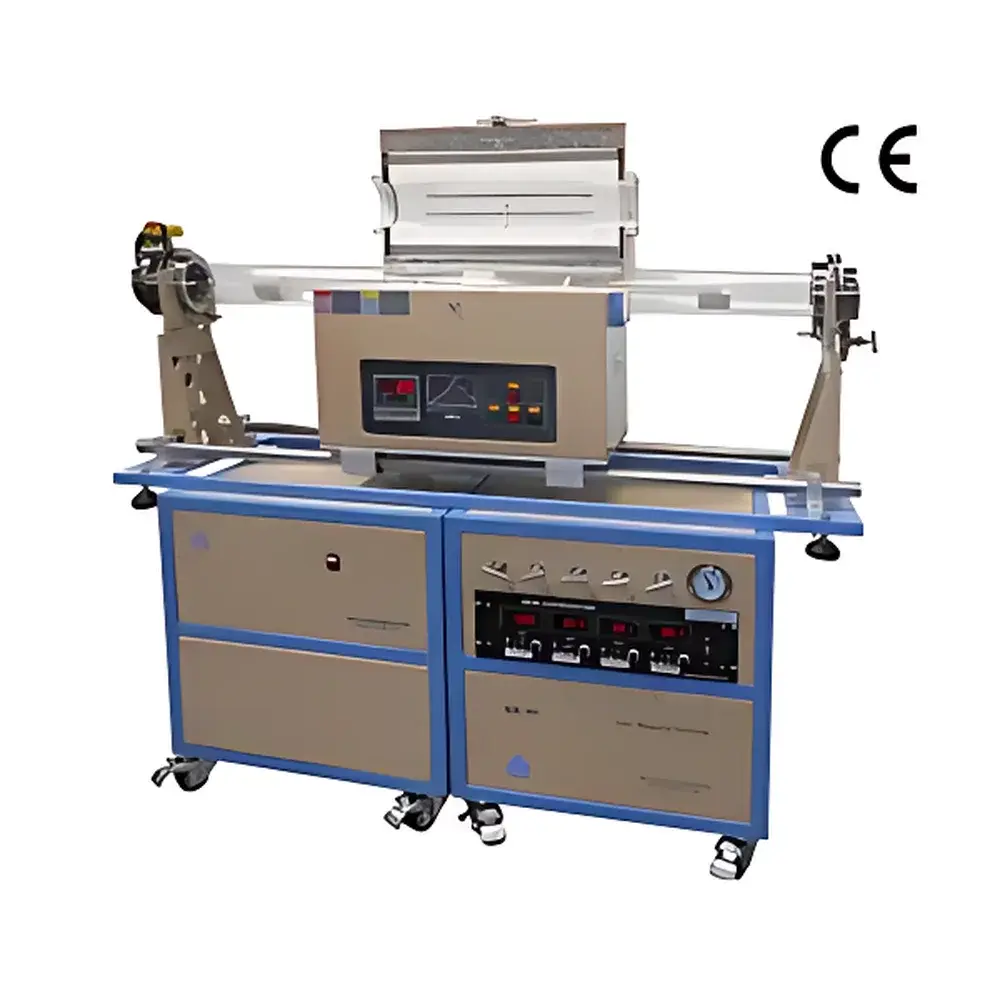
KEJING OTF-1200X-4-C4LVS Dual-Tube Sliding Four-Channel CVD System for Graphene and Thin-Film Growth on Metallic Foils
| Brand | KEJING |
|---|---|
| Model | OTF-1200X-4-C4LVS |
| Max Operating Temperature | 1100 °C (continuous at 1000 °C) |
| Heating Zone Length | 440 mm |
| Uniform Temperature Zone | 120 mm (±1 °C, 400–1100 °C) |
| Quartz Tube Dimensions | Outer Tube Ø100 × ID96 × 1400 mm |
| Gas Channels | 4 independent MFC-controlled lines (0–100 / 0–200 / 0–200 / 0–500 sccm) |
| Vacuum Level | 10⁻² Torr (mechanical pump) |
| Power Supply | 208–240 VAC, 50/60 Hz, single-phase, 2.5 kW |
| Cooling Method | Forced-air + sliding furnace displacement |
| Compliance | ASTM F2623 (CVD process validation), ISO 9001-certified manufacturing |
| Weight | 136 kg (300 lb) |
| Warranty | 12 months (excludes consumables: quartz tubes, O-rings, heating elements) |
Overview
The KEJING OTF-1200X-4-C4LVS is a purpose-engineered dual-tube sliding-configuration chemical vapor deposition (CVD) system designed specifically for scalable, high-reproducibility thin-film synthesis—particularly graphene and transition metal dichalcogenides (TMDs)—on flexible metallic foils such as Cu, Ni, and stainless steel substrates. Unlike conventional single-zone tube furnaces, this system employs a concentric dual-quartz architecture: the sample-carrying inner tube (Ø80 mm) is suspended within a larger outer tube (Ø100 mm), creating a 10 mm annular gap that serves as the primary reaction zone for precursor gas mixing and pyrolysis. The furnace body slides laterally along precision-ground rails, enabling rapid thermal transients—critical for nucleation control, layer uniformity, and minimizing interfacial diffusion in foil-based growth. Its maximum operating temperature of 1100 °C (with continuous stability up to 1000 °C) supports both low-pressure and atmospheric-pressure CVD protocols, while the Al₂O₃ fiber insulation and imported high-emissivity alumina coating ensure ±1 °C temperature uniformity across a 120 mm hot zone—verified per ASTM E220 calibration standards.
Key Features
- Dual-tube concentric design with independently sealed inner and outer quartz tubes, enabling simultaneous gas injection into the annulus (reaction zone) and direct cooling gas flow through the inner tube bore.
- Manually actuated lateral sliding mechanism (600 mm travel range) for controlled thermal ramping: preheat furnace displacement enables 15 °C/s cooling rates near 800 °C.
- Four-channel digital mass flow controller (MFC) system with calibrated ranges (0–100, 0–200, 0–200, 0–500 sccm), 0.2% full-scale accuracy, and individual stainless-steel needle valves for fine-grained stoichiometric tuning of CH₄/H₂/Ar/NH₃ or other multi-precursor chemistries.
- KF25 vacuum interface with double O-ring (Viton® HT70, rated to 200 °C) stainless-steel flanges; base pressure ≤10⁻² Torr with integrated 2.5 m³/h scroll pump; optional turbo-molecular pumping achieves ≤10⁻⁵ Torr for ultra-high-purity monolayer growth.
- 30-segment programmable PID temperature controller with over-temperature cutoff, real-time data logging, and GLP-compliant audit trail export (CSV/Excel) via RS485/USB interface.
- High-integrity thermal architecture: high-purity Al₂O₃ insulation (99.7% purity), reinforced alumina-coated furnace chamber, and bottom-mounted axial cooling fans to maintain structural integrity during repeated thermal cycling.
Sample Compatibility & Compliance
The system accommodates standard metallic foils (Cu, Ni, Fe, SS316L) up to 150 mm wide × 150 m long, wound directly onto the outer surface of the inner quartz tube. This geometry ensures uniform radial heat flux and minimizes substrate warping under thermal stress. All wetted components—including gas manifolds, MFC housings, and vacuum flanges—are constructed from electropolished 304 stainless steel compliant with ASTM A276 and ISO 8502-3 cleanliness requirements. The system meets mechanical safety standards per IEC 61000-6-2 (EMC immunity) and thermal safety per UL 61010-1. Optional documentation packages support FDA 21 CFR Part 11 compliance for regulated R&D environments requiring electronic record integrity and user access control.
Software & Data Management
The embedded temperature controller provides local touchscreen operation and remote monitoring via Modbus RTU or TCP/IP. Process recipes—including ramp/soak profiles, gas sequencing logic, and vacuum hold steps—can be saved, versioned, and recalled with timestamped metadata. Exported log files include temperature setpoint/actual, MFC flow readings, vacuum pressure, and alarm events—structured for integration into LIMS or ELN platforms (e.g., LabArchives, Benchling). Audit trails record operator ID, parameter changes, and system state transitions, satisfying GLP/GMP traceability requirements for materials qualification workflows.
Applications
- Scalable graphene synthesis on Cu foil for transparent conductive electrodes and flexible electronics.
- Growth of MoS₂, WS₂, and h-BN heterostructures on catalytic metal foils for 2D device prototyping.
- Carbon nanotube array fabrication via alcohol-CVD on patterned Ni/Cu templates.
- Thermal ALD precursor decomposition studies requiring precise thermal zoning and gas residence time control.
- Post-deposition annealing and reduction of oxide films (e.g., NiO, Co₃O₄) under controlled reducing atmospheres.
FAQ
What is the recommended procedure for achieving optimal graphene domain size uniformity?
Pre-anneal the Cu foil at 1050 °C under 100 sccm H₂ for 30 min to remove native oxides and induce grain coarsening; then initiate CH₄ introduction only after stable temperature and base pressure (<5×10⁻² Torr) are confirmed.
Can the system operate under dynamic vacuum conditions during gas switching?
Yes—the KF25 vacuum manifold and fast-response MFCs allow sequential gas purging with pressure stabilization <30 s between steps, validated per ASTM F2623 Annex B for process repeatability.
Is the inner quartz tube replaceable without disassembling the furnace core?
Yes—inner and outer tubes are independently mounted via spring-loaded flange clamps; replacement requires only loosening four M6 bolts per end flange and sliding the tube axially.
Does the sliding mechanism require periodic lubrication or recalibration?
No—the hardened steel rails and PTFE-coated sliders are maintenance-free for ≥10,000 cycles; position repeatability is mechanically constrained to ±0.3 mm without encoder feedback.
What documentation is provided for IQ/OQ validation?
Factory-assembled DQ/IQ protocol templates, calibration certificates for MFCs and thermocouples (NIST-traceable), and temperature uniformity mapping reports per ASTM E220 are included with shipment.