
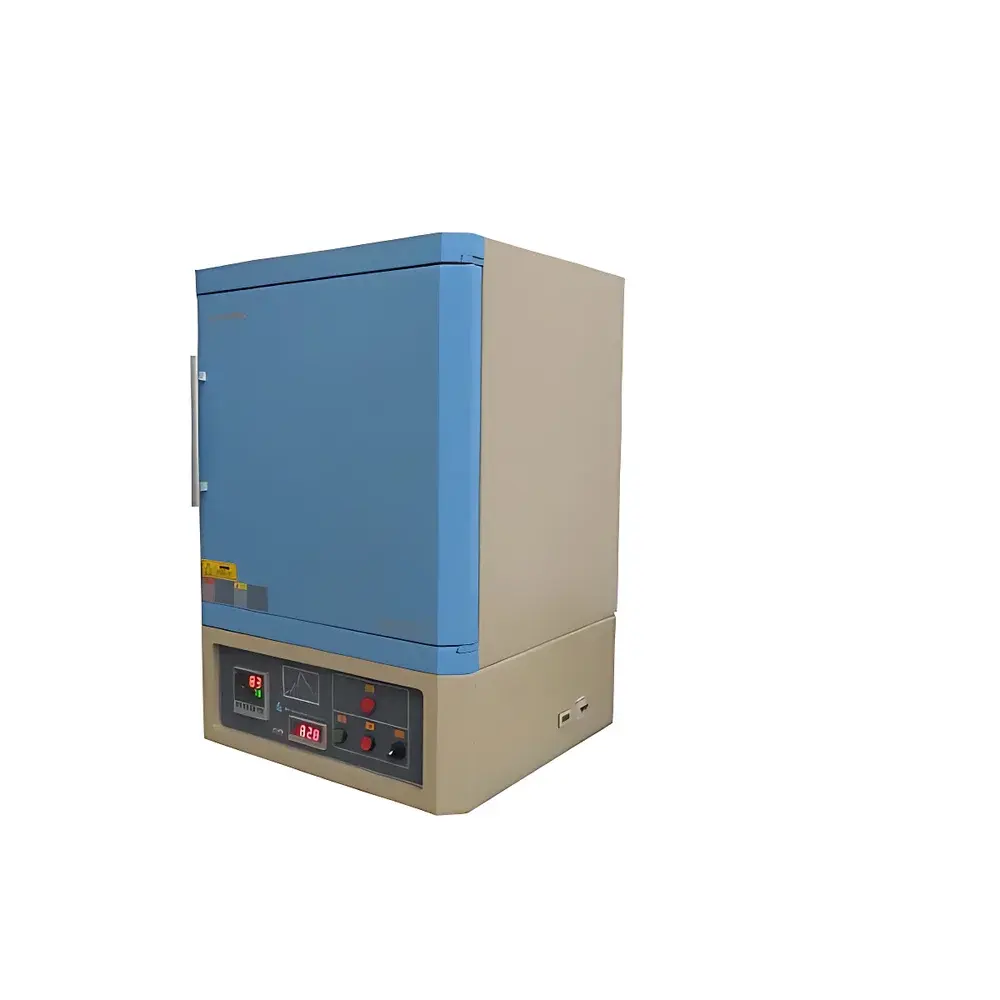
English Product Name
| Brand | Hefei Kejing |
|---|---|
| Origin | Anhui, China |
| Model | KSL-1200X-5L-UL |
| Maximum Temperature | 1200°C |
| Temperature Uniformity | ±5°C (within 250 × 250 × 250 mm at 1000°C, 3-h hold) |
| Control Accuracy | ±1°C |
| Heating Rate | 20°C/min (to max temp) |
| Internal Chamber Dimensions | 400 × 400 × 400 mm |
| Chamber Volume | 64 L |
| Rated Power | 8.8 kW |
| Voltage | AC 208–240 V, single-phase, 50/60 Hz |
| Heating Element Material | Molybdenum-doped Fe-Cr-Al alloy |
| Chamber Lining | High-purity alumina fiber with US-imported high-temperature alumina coating |
| Floor Load Capacity | 100 kg (supported by embedded SiC plate) |
| Cooling | Dual-layer housing with forced-air cooling (outer surface <60°C) |
| Safety | Dual K-type super-thermocouples (OMEGA), independent control & alarm circuits, UL/MET/CSA certified components (>24 V), CE compliant |
Overview
The Hefei Kejing KSL-1200X-5L-UL is a precision-engineered five-sided heating box furnace designed for applications demanding exceptional thermal uniformity and process repeatability in materials science and metallurgical research. Unlike conventional top- or bottom-heated furnaces, this model integrates heating elements on the left, right, front, rear, and floor surfaces—enabling symmetrical heat flux distribution across the entire working zone. This architecture minimizes axial and radial thermal gradients, making it especially suitable for annealing high-performance alloys, sintering advanced ceramics, and conducting controlled oxidation/reduction studies where localized overheating or cold spots could compromise microstructural homogeneity. The furnace operates continuously at 100–1100°C and supports short-duration excursions up to 1200°C (≤1 h), complying with ASTM E220 and ISO 8573-1 standards for thermal calibration traceability when used with NIST-traceable thermocouples.
Key Features
- Five-sided heating configuration (left, right, front, rear, and floor) ensures superior temperature uniformity of ±5°C within a 250 × 250 × 250 mm measurement volume at 1000°C after 3-hour stabilization.
- Reinforced silicon carbide (SiC) hearth plate embedded directly above the floor heating element supports loads up to 100 kg, maintaining structural integrity and thermal conductivity during high-mass sample processing.
- Dual independent OMEGA K-type super-thermocouples—one for PID-controlled temperature regulation, the other for redundant over-temperature alarm—trigger automatic main power cutoff if differential exceeds preset thresholds, satisfying IEC 61508 SIL-2 functional safety requirements.
- High-purity alumina fiber insulation (99.8% Al₂O₃) coated with US-sourced high-emissivity/low-contamination alumina enhances radiant efficiency, reduces energy consumption by ~12% compared to standard ceramic fiber linings, and extends service life under cyclic thermal stress.
- Forced-air-cooled dual-shell enclosure maintains external surface temperature below 60°C even at maximum operating temperature, eliminating operator burn hazards and reducing ambient heat load in shared lab environments.
- Integrated exhaust port on the top lid enables continuous venting of corrosive vapors (e.g., Cl₂, SO₂, H₂O) generated during reactive annealing or precursor decomposition, protecting heating elements and extending maintenance intervals.
Sample Compatibility & Compliance
The KSL-1200X-5L-UL accommodates diverse sample geometries—including crucibles (Al₂O₃, SiC, graphite), metal ingots, powder compacts, and multi-layer thin-film substrates—within its 64 L chamber. Its inert atmosphere compatibility (via optional rear-mounted gas inlet/outlet ports) supports N₂, Ar, or forming gas purging per ASTM F1355 guidelines for oxide-sensitive processes. All electrical components rated above 24 V carry UL, MET, and CSA certifications; the system bears CE marking per EU Machinery Directive 2006/42/EC and Low Voltage Directive 2014/35/EU. Upon customer request and at additional cost, individual units can be submitted for TÜV Rheinland or CSA Group certification to meet site-specific regulatory or GMP audit requirements.
Software & Data Management
The furnace features an RS485 serial interface for integration into centralized lab automation systems. Optional MTS-02 control module enables PC-based programming of up to 30-segment ramp-soak-cool profiles via proprietary Kejing LabControl software. Real-time temperature logging (0.1 s resolution), curve export in CSV/Excel format, and digital signature-enabled audit trails comply with FDA 21 CFR Part 11 requirements for electronic records and signatures when configured with time-stamped user authentication. Raw thermocouple data is timestamped and buffered locally during network interruptions, ensuring zero data loss during extended thermal cycles.
Applications
- Metallurgical annealing of Ni-based superalloys, Ti-6Al-4V, and shape-memory alloys requiring uniform recrystallization kinetics.
- Sintering of ZrO₂, Si₃N₄, and WC-Co composites where density gradients correlate directly with temperature non-uniformity.
- Thermal treatment of battery cathode precursors (e.g., LiCoO₂, NMC) under controlled atmospheres to optimize crystallinity and cation ordering.
- Calibration reference furnace validation per ISO/IEC 17025-accredited laboratories performing thermocouple calibration services.
- Accelerated aging tests for aerospace-grade adhesives and polymer matrix composites per ASTM D3045 protocols.
FAQ
What is the recommended maintenance schedule for the heating elements?
Heating elements should be visually inspected every 200 operational hours; replacement is advised after 1,500–2,000 cumulative hours at ≥1100°C or upon visible oxidation cracking.
Can the furnace be operated under vacuum?
No—this model is not vacuum-rated. For vacuum-compatible alternatives, consider the KSL-1200X-V series with flanged quartz tube chambers and diffusion pump interfaces.
Is GLP-compliant data archiving supported out of the box?
Yes—when paired with the MTS-02 module and LabControl v3.2+, full electronic record retention, user access logs, and change history tracking meet GLP Annex 11 and ISO/IEC 17025 clause 7.5.2 requirements.
Does the SiC hearth plate require periodic replacement?
Under normal use (≤1100°C, non-corrosive atmospheres), the SiC plate exhibits >5-year service life; replacement is only necessary if chipped, cracked, or contaminated with low-melting eutectics (e.g., NaCl, PbO).
How is temperature uniformity verified during commissioning?
Kejing provides a factory-issued temperature mapping report (per ASTM E220 Annex A2) using nine calibrated thermocouples positioned in a 3×3×3 grid within the specified 250 mm cube volume, recorded during three consecutive 3-hour holds at 1000°C.
Related Products



