
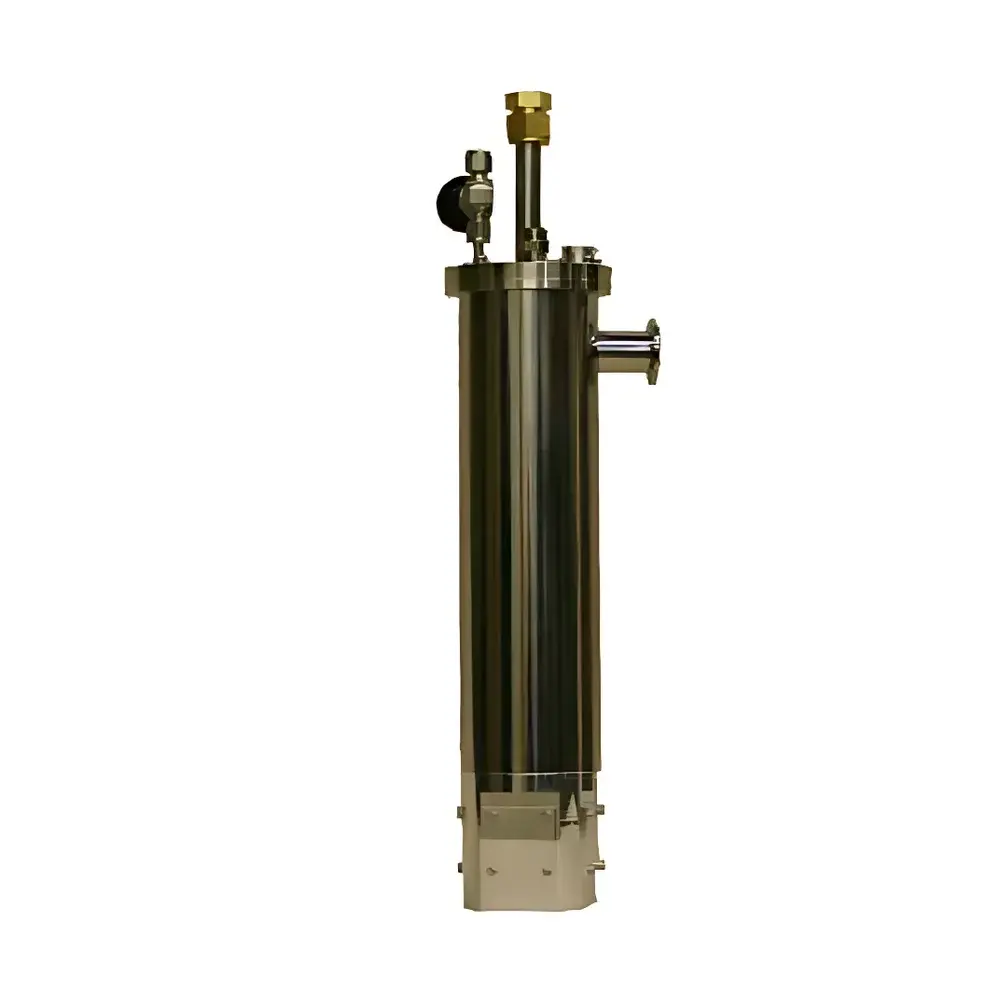
ARS LN-400 Liquid Nitrogen Cryogenic Thermostat
| Brand | ARS |
|---|---|
| Origin | USA |
| Model | LN-400 |
| Temperature Range | 77 K to 500 K (upgradable to 800 K) |
| Liquid Nitrogen Capacity | 0.4 L |
| Optical Window Diameter | 1.25 in (31.75 mm), High-Purity Fused Silica |
| Numerical Aperture Equivalent | f/1.4 |
| Temperature Sensor | Calibrated Silicon Diode (±0.5 K accuracy, dual placement: bath & sample stage) |
| Heating Element | 36 Ω Flat-Foil Heater |
| Electrical Interface | Hermetic 10-pin Feedthrough |
| Sample Stage | Removable Flat Plate Mount |
| Controller | Integrated PID Temperature Controller with RS-232/USB Interface |
Overview
The ARS LN-400 Liquid Nitrogen Cryogenic Thermostat is a continuous-flow, cryogenically cooled temperature control platform engineered for precision low-temperature experimentation across optical, electrical, magnetic, and spectroscopic disciplines. Operating on liquid nitrogen (LN₂) as the primary coolant, the LN-400 achieves stable thermal setpoints from 77 K—representing the boiling point of liquid nitrogen at ambient pressure—to 500 K, with an optional high-temperature upgrade extending operational range to 800 K via integrated resistive heating. Its design follows fundamental principles of cryostat thermodynamics: heat exchange occurs through controlled conduction and radiation shielding, while thermal stability is maintained by closed-loop feedback between a calibrated silicon diode sensor mounted directly on the sample stage and a proportional-integral-derivative (PID) controller driving a flat-foil heater. Unlike closed-cycle refrigerators, the LN-400 avoids mechanical vibration and electromagnetic interference—critical for sensitive optical alignment, quantum transport measurements, and time-resolved spectroscopy. The system’s modular architecture supports integration into vacuum chambers, optical tables, and probe stations, making it suitable for both benchtop research and production-grade characterization workflows.
Key Features
- Stable temperature operation from 77 K to 500 K (standard); upgradable to 800 K with high-temperature stage
- 0.4 L liquid nitrogen reservoir enabling >4 hours of continuous operation at 77 K without refill under typical load conditions
- Two high-purity fused silica optical windows (1.25″ diameter) providing broadband transmission from UV (190 nm) to mid-IR (5 µm)
- Optimized optical geometry with f/1.4 effective numerical aperture for high-throughput light collection in Raman, PL, EL, FTIR, and magneto-optic experiments
- Dual-sensor configuration: one silicon diode embedded in the cold stage for bath temperature monitoring; second sensor with 4-ft low-noise lead wire mounted directly adjacent to the sample for localized thermal feedback
- Hermetically sealed 10-pin electrical feedthrough supporting simultaneous DC and low-frequency AC measurements (e.g., Hall effect, resistivity, DLTS)
- Modular flat-plate sample holder designed for rapid exchange and compatibility with standard sample holders, diamond anvil cells (DAC), and matrix-isolation substrates
- Integrated PID temperature controller with programmable ramp rates, hold functions, and digital communication via RS-232 or USB for automated test sequencing
Sample Compatibility & Compliance
The LN-400 accommodates a broad spectrum of sample geometries and experimental configurations—including thin films, bulk crystals, nanowires, suspended membranes, and liquid-phase samples contained in capillaries or cuvettes. Its open-access design permits direct mounting of commercial probe cards, fiber-optic couplers, and microwave waveguides. All materials in contact with the cold stage comply with ASTM F2733 (cryogenic material compatibility) and are non-magnetic (per ASTM A342) to ensure integrity during magnetooptic and SQUID-compatible measurements. The system meets general laboratory safety requirements per ANSI Z21.1 and UL 61010-1 for electrical equipment used in measurement, control, and laboratory applications. While not inherently 21 CFR Part 11 compliant, the controller’s digital logging interface supports third-party audit-trail software for GLP/GMP-aligned environments when deployed with validated data acquisition systems.
Software & Data Management
The LN-400 operates with ARS’s proprietary CryoControl™ software (Windows-based), which provides real-time temperature monitoring, multi-zone PID tuning, script-driven thermal profiling, and synchronized data export in CSV and HDF5 formats. The software supports time-stamped metadata tagging—including sensor IDs, calibration coefficients, and environmental conditions—for traceability in ISO/IEC 17025-accredited laboratories. Exported datasets are fully compatible with MATLAB, Python (via NumPy/Pandas), and Igor Pro for post-processing. Optional LabVIEW drivers and TCP/IP API enable integration into custom test automation frameworks. All temperature logs include checksum-verified timestamps and support user-defined alarm thresholds with email/SNMP notification triggers.
Applications
- Optical Spectroscopy: Photoluminescence (PL), electroluminescence (EL), Raman scattering, UV-Vis-NIR absorption, FTIR, and magneto-optic Kerr effect (MOKE) studies
- Electrical Transport: Resistivity, Hall coefficient, carrier mobility, deep-level transient spectroscopy (DLTS), and high-frequency impedance analysis
- Magnetic Characterization: Temperature-dependent magnetic susceptibility, muon spin rotation (µSR), Mössbauer spectroscopy, and spin-crossover phenomena
- High-Pressure Physics: Integration with diamond anvil cells (DAC) for cryogenic pressure–temperature phase mapping
- Cryogenic Chemistry: Matrix isolation spectroscopy, reaction kinetics at sub-100 K, and quantum tunneling investigations
- Device Testing: Low-temperature validation of photodetectors, superconducting qubits, MEMS resonators, and IR focal plane arrays
FAQ
What is the base temperature achievable with the LN-400, and how is it maintained?
The LN-400 achieves a base temperature of 77 K using liquid nitrogen boil-off cooling. Thermal stability of ±0.1 K over 1 hour is attainable under static conditions, with active regulation via the integrated 36 Ω heater and dual silicon diode sensors.
Can the LN-400 be used under vacuum or in a controlled atmosphere?
Yes—the main body is vacuum-rated to 1×10⁻⁶ Torr. Optional O-ring-sealed flanges and purge ports support operation in inert gas (N₂, Ar) or high-vacuum environments.
Is the system compatible with external magnetic fields?
The LN-400 uses non-ferromagnetic structural alloys (6061-T6 Al, OFHC Cu) and contains no permanent magnets. It is routinely deployed in fields up to 12 T when paired with split-pair or superconducting magnets.
How is temperature calibration performed, and what standards are referenced?
Each unit ships with NIST-traceable calibration certificates for both stage and sample-mounted diodes, referenced to ITS-90 fixed points (e.g., oxygen triple point at 54.3584 K). Users may perform field recalibration using certified reference thermometers per ISO/IEC 17025 procedures.
What maintenance is required for long-term reliability?
Routine maintenance includes periodic inspection of O-rings, cleaning of optical windows with spectroscopic-grade solvents, and verification of LN₂ fill line integrity. No scheduled lubrication or consumable replacement is required beyond standard cryogenic handling practices.



