
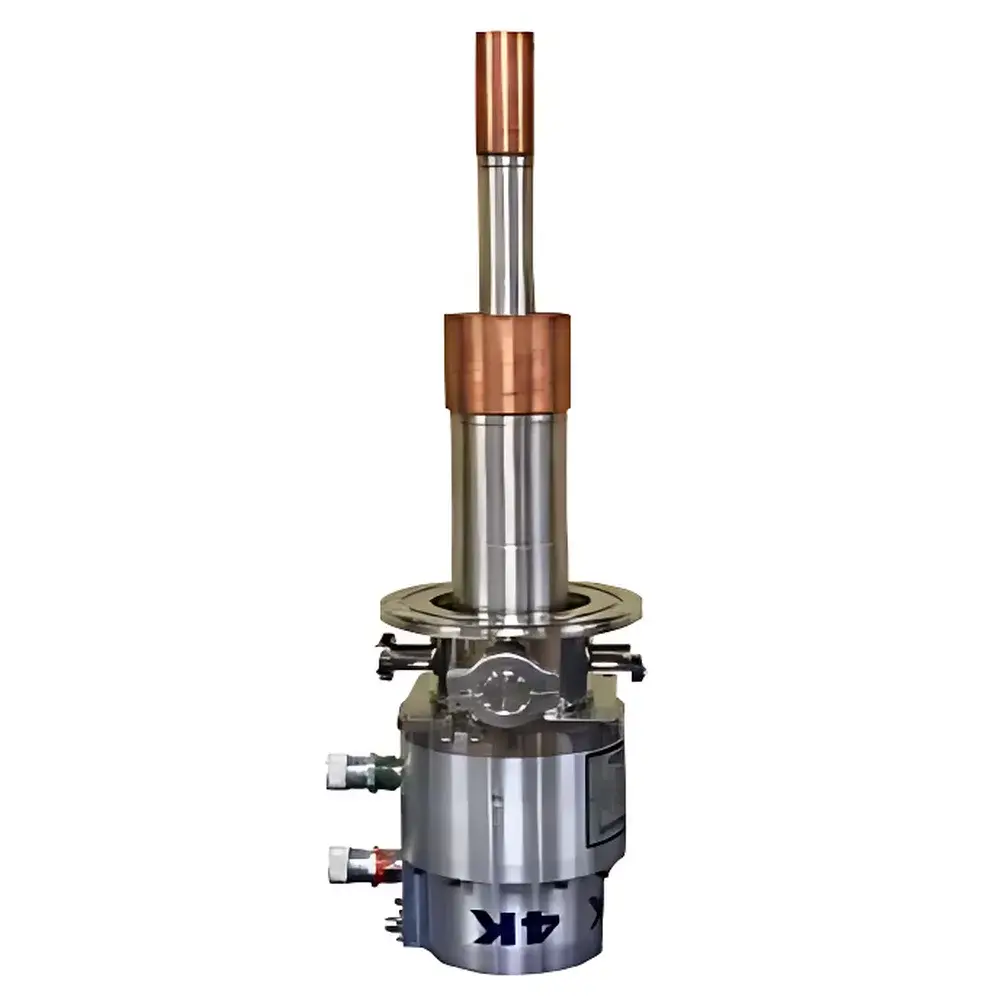
ARS DE-215 4K Cryocooler System
| Brand | ARS |
|---|---|
| Origin | USA |
| Model | DE-215 |
| Cooling Capacity | 1.5 W at 4.2 K |
| Cold Head Type | Two-Stage Gifford-McMahon Cryocooler |
| Operating Environment | Closed-Cycle, Helium-Gas-Driven |
| Flange Options | MRI Universal Flange, ISO-KF Flange |
| Standard Configuration | DE-215S Cold Head + ARS-10HW Compressor + Two Flexible High-Pressure Helium Transfer Lines |
| Vibration Level | < 5 µm peak-to-peak (at cold tip, 4.2 K) |
| Acoustic Noise | < 65 dB(A) at 1 m |
| Maintenance Interval | ≥ 15,000 hours compressor runtime |
| Compliance | CE-marked, RoHS-compliant, UL-listed components |
Overview
The ARS DE-215 is a high-capacity, closed-cycle 4 K cryocooler system engineered for demanding low-temperature research and industrial applications requiring stable, helium-free operation below 4.2 K. Based on a two-stage Gifford-McMahon thermodynamic cycle, the DE-215 delivers 1.5 W of cooling power at 4.2 K—ARS’s highest nominal refrigeration capacity in its standard commercial cryocooler lineup. Unlike liquid-helium-dependent systems, the DE-215 eliminates the logistical, safety, and cost constraints associated with cryogen replenishment, enabling continuous, unattended operation over extended periods. Its robust mechanical architecture minimizes thermal drift and mechanical vibration transmission to the cold stage, making it particularly suitable for ultra-sensitive experiments including scanning probe microscopy (SPM), quantum transport measurements, superconducting device characterization, and RF/microwave testing under cryogenic conditions.
Key Features
- Helium-free operation: Fully closed-cycle design eliminates dependence on liquid helium, reducing operational overhead and enhancing experimental continuity.
- Low-vibration cold head (DE-215S): Engineered with optimized pulse tube dynamics and passive damping, delivering < 5 µm peak-to-peak mechanical displacement at the 4.2 K stage—critical for atomic-resolution imaging and nanoscale metrology.
- High-reliability compressor (ARS-10HW): Air-cooled, oil-lubricated unit rated for ≥15,000 hours MTBF; includes integrated pressure regulation, helium gas monitoring, and thermal overload protection.
- Flexible integration: Supplied with two armored, low-thermal-conductance helium transfer lines (standard length: 3 m), enabling spatial decoupling between compressor and cold head to minimize acoustic and thermal coupling.
- Quiet operation: Acoustic emission < 65 dB(A) at 1 meter distance—compliant with ISO 7779 and suitable for shared laboratory environments.
- Modular flange configurations: Available with MRI universal flange (for compatibility with high-field vector magnets) or ISO-KF 100/160 standards, supporting rapid integration into custom cryostats, vacuum chambers, or magnet systems.
Sample Compatibility & Compliance
The DE-215 supports a wide range of sample environments—from compact insert probes to large-bore superconducting magnet systems. Its standard configuration accommodates cryostats with up to 6 ft vertical extension lengths and full 360° rotational capability within a 10-inch clear aperture—enabling angular-dependent measurements in magnetic fields. All electrical feedthroughs (including RF-grade SMA and triaxial connectors) and fluid/gas hoses are pre-bent and strain-relieved to maintain integrity during rotation. The system conforms to international safety and electromagnetic compatibility standards: CE marking per Directive 2014/30/EU (EMC) and 2014/35/EU (LVD); RoHS 2011/65/EU compliance for hazardous substances; UL recognition for compressor control electronics. It is routinely deployed in GLP-compliant laboratories and supports audit-ready documentation for ISO/IEC 17025 accreditation.
Software & Data Management
While the DE-215 operates as a stand-alone hardware platform, ARS provides optional LabVIEW-based control software (CoolSoft v3.x) for remote monitoring and programmable temperature ramping. The system features RS-232 and Ethernet (TCP/IP) interfaces for integration into facility-wide SCADA or experiment orchestration frameworks. All compressor parameters—including helium pressure (high/low side), motor current, oil temperature, and cooldown status—are logged with timestamped metadata. Optional 21 CFR Part 11-compliant audit trail modules are available for regulated environments requiring electronic record integrity, user access controls, and electronic signatures.
Applications
- Quantum computing hardware testing: Qubit characterization, coherence time mapping, and microwave resonator tuning at milliKelvin-equivalent base temperatures.
- Superconducting magnet integration: Cryogenic interfacing for vector magnets (up to 12 T), including XYZ piezo stage actuation and multi-channel RF excitation.
- Materials science: In-situ resistivity, Hall effect, and specific heat measurements across phase transitions (e.g., superconducting, magnetic, charge-density-wave).
- Nanoscale spectroscopy: Low-temperature Raman, photoluminescence, and STM/AFM platforms requiring sub-5 µm vibration stability.
- Industrial QA/QC: Cryogenic sensor calibration, infrared detector testing, and satellite component thermal cycling validation.
FAQ
What is the minimum base temperature achievable with the DE-215 cold head?
The DE-215 achieves a typical no-load base temperature of ≤3.8 K in high-vacuum conditions (<1×10⁻⁶ Torr), with 4.2 K sustained under full 1.5 W thermal load.
Can the DE-215 be retrofitted into an existing cryostat?
Yes—provided mechanical, thermal, and vacuum interface specifications align; ARS offers flange adapters, custom-length transfer lines, and integration engineering support.
Is helium gas refilling required during operation?
No—the system is fully sealed and uses a fixed helium charge; no periodic gas replenishment is needed over its service lifetime.
Does the DE-215 support automatic temperature setpoint programming?
When paired with CoolSoft software and optional temperature controller (e.g., Lakeshore 336), it supports ramp-soak profiles, PID optimization, and real-time thermal derivative feedback.
What maintenance is recommended for long-term reliability?
Annual inspection of compressor oil level and filter integrity; helium circuit integrity verification every 5 years via pressure decay test—no cold head servicing required under normal operating conditions.



