
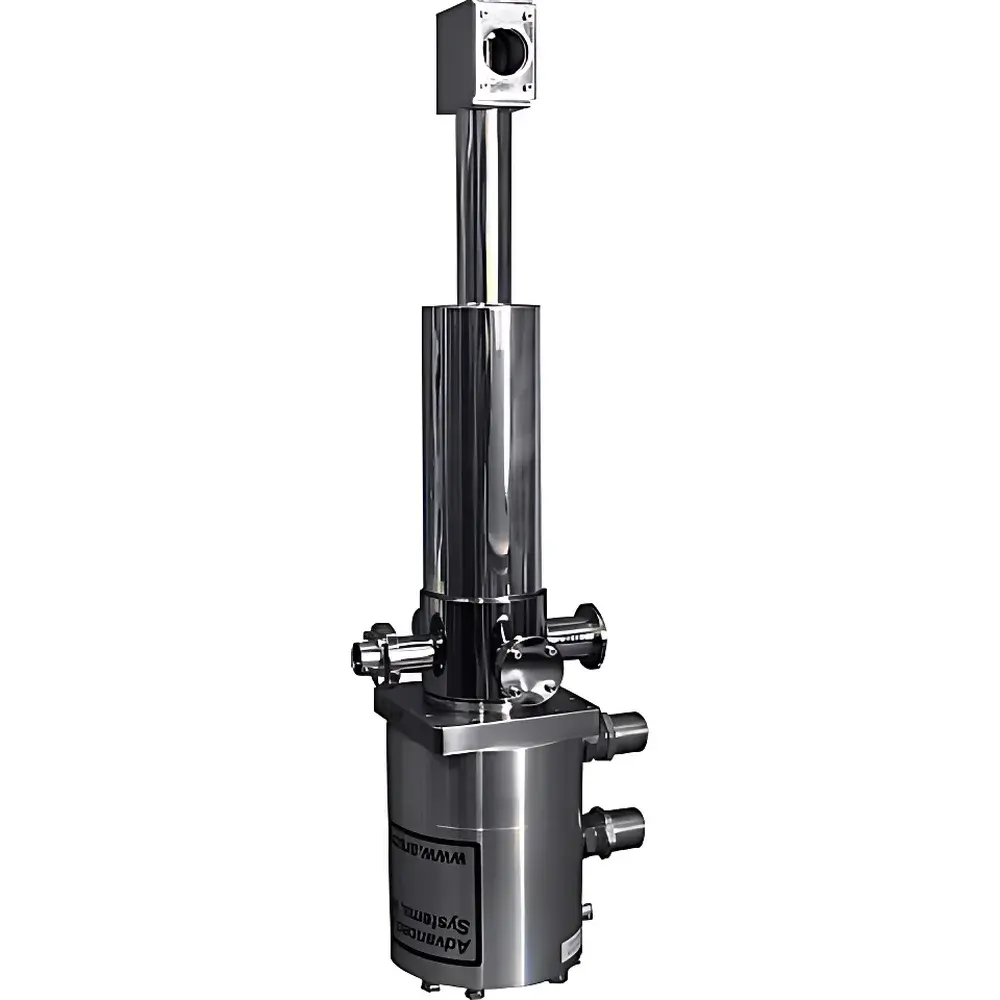
ARS X-12 Narrow-Aperture Closed-Cycle Cryogenic Thermostat
| Brand | ARS |
|---|---|
| Origin | USA |
| Model | X-12 |
| Cooling Capacity Options | 4 K, 5.5 K, or 10 K (with DE-202/DE-204 cold head) |
| Vacuum Enclosure Material | Non-magnetic anodized aluminum |
| Radiation Shield | Polished oxygen-free copper (OFHC), non-magnetic |
| Optical Aperture | DMX-12 (1.62 in) or DMX-12B (1.37 in) |
| Standard Optical Window | 1-inch fused silica |
| Temperature Sensing | Calibrated silicon diode (±12 mK accuracy, 4-ft lead) + control-grade silicon diode (±0.5 K) |
| Electrical Feedthrough | 10-pin hermetic connector |
| Sample Stage | Customizable non-magnetic mount for Hall/magneto-optical measurements |
| Compressor | ARS-2HW |
| Helium Transfer Lines | Two flexible cryogenic lines |
| Compliance | Designed for operation inside narrow-gap electromagnets and superconducting magnets (e.g., split-pair, vertical-field, or horizontal-field configurations) |
Overview
The ARS X-12 Narrow-Aperture Closed-Cycle Cryogenic Thermostat is an engineered solution for low-temperature physical property characterization under high magnetic fields. Based on a two-stage Gifford-McMahon (GM) cryocooler architecture—typically integrated with DE-202 or DE-204 cold heads—the X-12 achieves base temperatures of 4 K, 5.5 K, or 10 K without liquid cryogens. Its defining feature is the lateral narrow-aperture vacuum shroud, optimized to insert directly into the confined gap (<50 mm) of resistive or superconducting magnets while maintaining full thermal and electromagnetic isolation. Unlike conventional cryostats requiring extended cold fingers—which introduce thermal load, mechanical instability, and field distortion—the X-12 positions the sample stage at the magnet center via side-mounted optical access, eliminating cold finger extension and preserving minimum attainable temperature. The system operates under high vacuum (≤1×10⁻⁶ Torr typical) and supports simultaneous electrical, optical, and magnetic measurements across the 1.5–400 K range with active temperature stabilization.
Key Features
- Narrow-aperture aluminum vacuum shroud (non-magnetic, anodized) enabling insertion into magnet gaps as narrow as 35 mm
- Side-mounted optical access with standard DMX-12 (1.62″) or DMX-12B (1.37″) window flanges—compatible with F/1 optical collection geometry
- 1-inch diameter fused silica optical windows (AR-coated optional) for broadband transmission from UV to mid-IR
- Polished oxygen-free copper (OFHC) radiation shield, non-magnetic and thermally decoupled from structural components
- No cold finger extension required: sample stage located coaxially with magnet centerline for uniform field exposure
- Hermetic 10-pin electrical feedthrough with four internal Cu wires for low-noise DC/resistance/Hall measurements
- Dual temperature sensing: control-grade silicon diode (±0.5 K) and NIST-traceable calibrated diode (±12 mK, 4-ft lead)
- Integrated 36 Ω surface-mount heater for precise PID-controlled ramping and isothermal hold
Sample Compatibility & Compliance
The X-12 accommodates samples up to 25 mm in diameter and 10 mm in height on a custom-machined, non-magnetic OFHC or titanium sample holder. Its construction complies with electromagnetic compatibility requirements for operation inside ±9 T superconducting magnets and ±2 T electromagnets. All structural materials—including vacuum shroud, radiation shield, and wiring—meet ASTM F2630-22 standards for non-magnetic instrumentation used in high-field physics labs. The system supports GLP-aligned experimental workflows: temperature logs are timestamped and exportable via RS-232/USB; optional firmware enables audit-trail-enabled temperature setpoint history per FDA 21 CFR Part 11 requirements when paired with validated third-party controllers. Vacuum integrity conforms to ISO 2859-1 sampling plans for leak-rate verification (<1×10⁻⁹ atm·cc/s He).
Software & Data Management
The X-12 operates independently of proprietary software but integrates seamlessly with industry-standard platforms including Lake Shore Cryotronics’s CryoSoft, Keysight PathWave, and National Instruments LabVIEW via analog voltage (0–10 V) and digital TTL I/O interfaces. Temperature setpoints, ramp rates, and hold durations are programmable through ASCII command protocol over RS-232. Real-time sensor data (temperature, compressor status, pressure interlock) is output at 10 Hz resolution. Optional Ethernet-enabled temperature controller modules provide HTTP API access, JSON-formatted telemetry streaming, and TLS-secured remote monitoring—supporting centralized lab asset management systems compliant with IEEE 1451.2 transducer electronic data sheet (TEDS) conventions.
Applications
- Hall effect & transport measurements: Van der Pauw geometry testing at 1.8–300 K under fields up to 9 T; optimized electrode routing minimizes thermoelectric offsets
- Magneto-optical spectroscopy: Faraday rotation, MOKE, and magneto-photoluminescence with <10 µrad angular stability at 4 K
- Low-T dielectric & capacitance spectroscopy: Impedance analysis down to 1 mHz using guarded triaxial cabling routed through the 10-pin feedthrough
- Quantum device characterization: Gate-dependent conductance mapping of 2DEGs, topological insulators, and Josephson junctions
- Cryogenic photodetector calibration: Spectral responsivity validation from 200 nm to 12 µm using integrated shutter and reference detector ports
FAQ
Can the X-12 be operated inside a vertical-field superconducting magnet with a 40 mm bore gap?
Yes—the narrow-aperture shroud (32 mm nominal width) and absence of protruding cold finger allow direct insertion into gaps ≥35 mm. Alignment fiducials and adjustable leveling feet ensure repeatable positioning.
Is the system compatible with ultra-high vacuum (UHV) environments?
The standard configuration uses Viton O-rings rated for 1×10⁻⁷ Torr base pressure. For UHV (≤1×10⁻¹⁰ Torr), optional metal-sealed CF flanges, baked stainless steel shields, and NEG pump integration are available.
What electrical noise performance can be expected during simultaneous optical and transport measurements?
With proper grounding topology and twisted-pair internal wiring, RMS voltage noise remains below 5 nV/√Hz at 10 Hz when using the 10-pin feedthrough with external low-noise preamplifiers.
Does ARS provide application-specific sample holders for Hall bar or van der Pauw geometries?
Yes—custom OFHC, phosphor bronze, or Macor® holders with lithographically defined contact pads and thermal anchoring features are designed per user-specified layout files and fabricated in-house.
How is temperature calibration traceability maintained across operating ranges?
Each calibrated silicon diode is supplied with a NIST-traceable certificate (ISO/IEC 17025 accredited lab), including individual polynomial coefficients and uncertainty budget per IEC 60751:2022 Annex D.



