
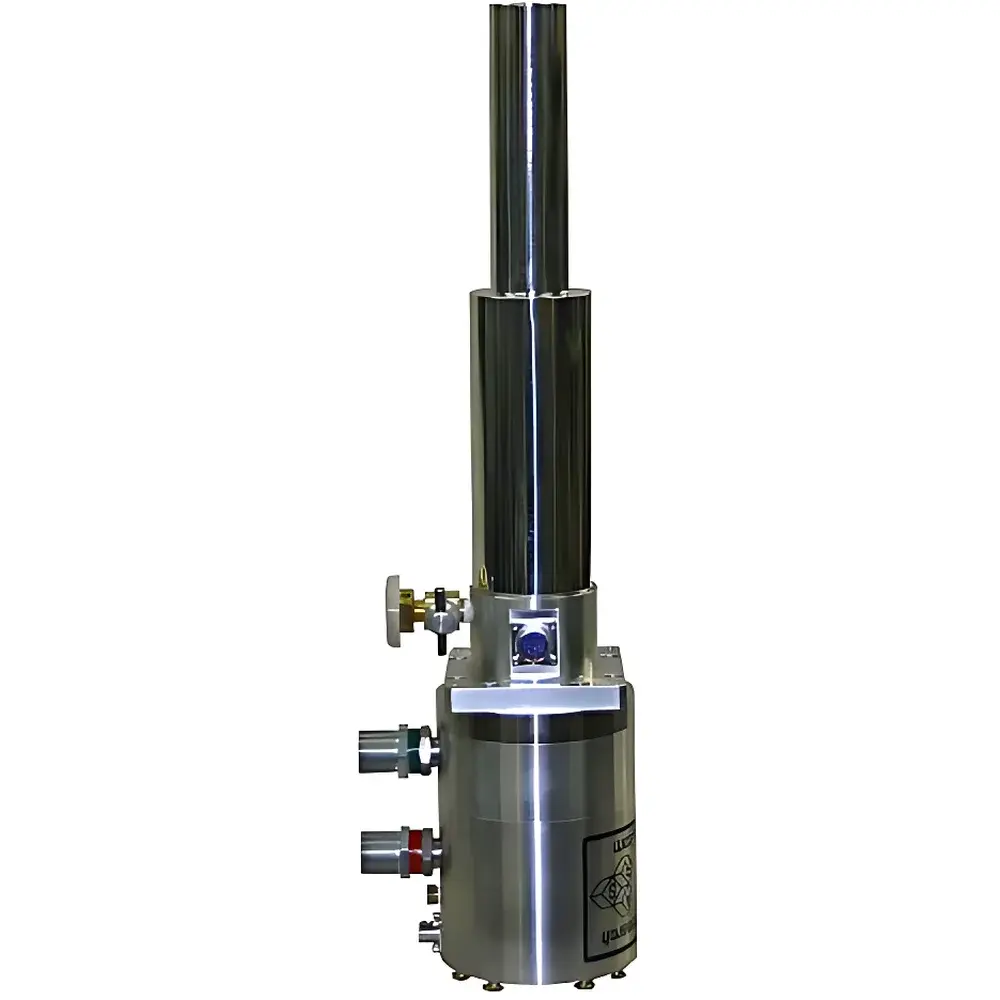
American Research Systems (ARS) X-3 Tubular Closed-Cycle Cryogenic Thermostat
| Brand | ARS |
|---|---|
| Origin | USA |
| Model | X-3 |
| Cooling Capacity Options | 4 K (0.1 W @ 4.2 K), 5.5 K (1 W @ 10 K), or 10 K |
| Cold Head Compatibility | DE-202, DE-204, DE-210 series |
| Construction Material | Aluminum (standard), Stainless Steel (customizable) |
| Vacuum Enclosure | Aluminum or stainless steel DMX-3 vacuum shroud optimized for electrical transport measurements |
| Radiation Shield | Aluminum thermal radiation shield |
| Temperature Sensing | ±0.5 K calibrated silicon diode (control), ±12 mK calibrated silicon diode with 4-ft lead (sample-stage metrology) |
| Electrical Interface | 10-pin hermetic feedthrough, four dedicated low-noise measurement leads, electrically isolated sample stage |
| Optional Upgrades | 450 K / 800 K high-temperature insert, custom thermometer mounting, custom wiring harness, custom sample holder geometry |
Overview
The American Research Systems (ARS) X-3 Tubular Closed-Cycle Cryogenic Thermostat is an engineered solution for low-temperature physical property characterization in constrained magnetic environments. Designed around a compact tubular geometry, the X-3 eliminates optical viewports to minimize radiative heat load and accelerate cooldown—enabling stable base temperatures of 4.2 K, 5.5 K, or 10 K depending on cold head selection (DE-202, DE-204, or DE-210). Its slender profile allows direct insertion into narrow-bore superconducting magnets (e.g., 50 mm–70 mm bore diameters) and electromagnets, making it especially suited for magnetotransport experiments including Hall effect, AC/DC resistivity, and magnetic susceptibility under field. Unlike bath-cooled systems, the X-3 operates without liquid cryogens, relying on a closed-cycle helium refrigeration loop driven by a dedicated ARS compressor and flexible helium transfer lines. The system’s vacuum-tight aluminum or stainless steel outer shroud (DMX-3 configuration) provides electromagnetic shielding and mechanical rigidity while supporting low-vibration, low-noise electrical transport measurements.
Key Features
- Tubular form factor with no optical windows—reduces radiative loading and improves thermal efficiency during cooldown and hold.
- Modular cold head integration: compatible with DE-202 (4.2 K), DE-204 (5.5 K), and DE-210 (10 K) cryocoolers—each selected based on required base temperature and cooling power at target operating point.
- Customizable structural materials: standard aluminum construction for cost-effective thermal mass and machinability; optional 304/316 stainless steel for enhanced UHV compatibility, higher strength, or magnetic cleanliness.
- Dual-stage temperature metrology: a ±0.5 K accuracy silicon diode for primary feedback control, plus a traceable ±12 mK calibrated sensor with 4-foot twisted-pair cabling for high-fidelity sample-stage thermometry.
- Electrical transport–optimized interface: hermetically sealed 10-pin feedthrough, four individually shielded low-noise coaxial measurement lines, and an electrically isolated copper sample stage with integrated 36 Ω foil heater.
- Integrated thermal architecture: multi-layer aluminum radiation shield, vacuum-jacketed helium lines, and compressor-mounted vibration isolation to ensure microvolt-level measurement stability.
Sample Compatibility & Compliance
The X-3 accommodates samples up to 25 mm in diameter and 15 mm in height within its central bore—configurable with user-defined sample holders (e.g., van der Pauw, Corbino, or SQUID-compatible geometries). All metallic components comply with ASTM F899-22 (Standard Specification for Stainless Steels for Surgical Instruments) where applicable, and vacuum surfaces meet ISO 10110-7 surface finish specifications for UHV-readiness. The system supports GLP-compliant operation through hardware-enforced temperature logging (via ARS TC-200 or third-party PID controllers), with optional audit-trail-capable software interfaces compliant with FDA 21 CFR Part 11 requirements when paired with validated data acquisition platforms. No proprietary consumables are required; helium charge is sealed for lifetime operation with scheduled compressor maintenance per ARS Service Bulletin SB-2023-04.
Software & Data Management
While the X-3 operates as a hardware platform independent of vendor-specific software, it integrates seamlessly with industry-standard instrumentation ecosystems. Analog temperature outputs (0–10 V) and digital RS-232/RS-485 interfaces enable bidirectional communication with LabVIEW, Python (PyVISA), MATLAB, or KEITHLEY TestScript environments. Temperature setpoints, ramp rates, and heater power are programmable via ASCII command protocol. For long-term stability monitoring, the calibrated ±12 mK sensor output can be logged at ≥10 Hz resolution using IEEE-488 GPIB or USB-TMC interfaces. All firmware revisions adhere to IEC 61508 SIL-2 functional safety guidelines for thermal runaway prevention, and controller logs retain timestamps, sensor IDs, and calibration coefficients for full traceability.
Applications
- Low-field and high-field Hall effect and longitudinal resistivity mapping (0–16 T compatible with appropriate magnet pairing)
- Deep Level Transient Spectroscopy (DLTS) requiring sub-10 K thermal stability over 24+ hour acquisition windows
- AC magnetic susceptibility (χ’/χ’’) measurements using lock-in techniques at frequencies from 1 Hz to 10 kHz
- Specific heat (Cp) via relaxation calorimetry with <10 mK temperature step resolution
- Thermoelectric characterization—including Seebeck coefficient (S) and thermal conductivity (κ) via differential steady-state methods
- Quantum transport in 2D electron gases, topological insulators, and correlated oxide heterostructures
FAQ
Does the X-3 require liquid nitrogen or liquid helium for operation?
No—the X-3 is a fully self-contained closed-cycle system. It uses gaseous helium circulated between the cold head and compressor; no cryogen refills are needed.
Can the X-3 be used inside a superconducting magnet with a 50 mm warm bore?
Yes—the tubular design (outer diameter ≤48 mm) enables direct insertion into standard 50 mm and 60 mm bore magnets; custom-length variants are available upon request.
Is vacuum integrity verified prior to shipment?
Yes—each unit undergoes helium leak testing to ≤1×10⁻⁹ mbar·L/s and bake-out validation at 120 °C for 8 hours before final QC.
What is the typical cooldown time from 300 K to 4.2 K?
Approximately 2.5–3.5 hours, depending on cold head model, ambient conditions, and thermal anchoring of internal components.
Can I integrate my own temperature controller or DAQ system?
Yes—all analog and digital I/O signals conform to IEEE Std 488.2 and SCPI standards; pinout schematics and command reference manuals are provided under NDA.



