
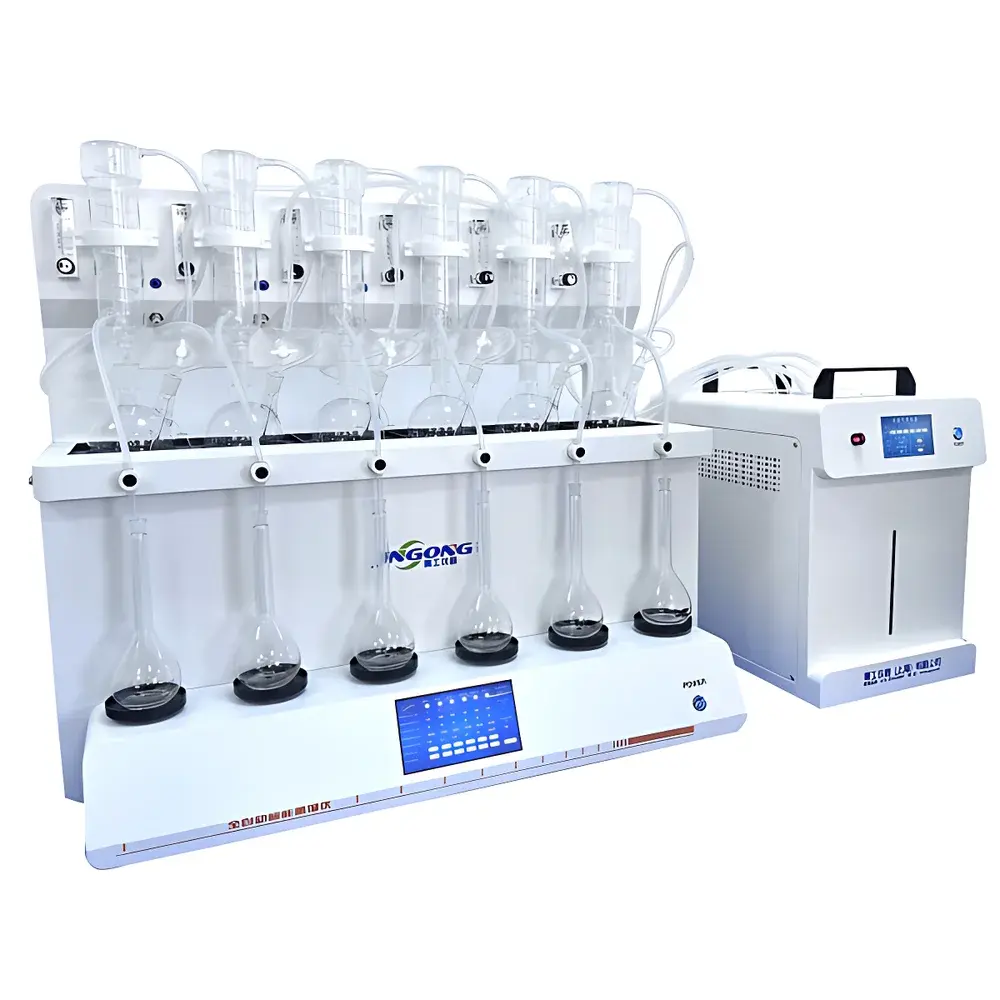
Jinggong JZ-3100 Fully Automated Steam Distillation System
| Brand | Jinggong (JNGON) |
|---|---|
| Origin | Shanghai, China |
| Model | JZ-3100 |
| Heating Units | 6 independent positions |
| Touchscreen Display | 7-inch color LCD (main unit), 5-inch color LCD (steam generator) |
| Steam Generator Power | 3000 W (adjustable) |
| Individual Heating Power | 0–600 W per position |
| Distillation Rate | 2–12 mL/min |
| Steam Flow Control | Electromagnetic + pinch valve with atmospheric venting |
| Automatic Endpoint Detection | Dual-mode (pressure-weight sensing + timer), range: 1–500 g (mL) |
| Nitrogen Purge | Optional, 0–2 L/min per port, individually controllable |
| Cooling System | Closed-loop compressor chiller, temperature range: ambient to 35 °C, outlet coolant ≤15 °C |
| Anti-suckback Protection | Pressure-responsive solenoid valve + automatic steam-line venting |
| Flask Compatibility | 250 mL or 500 mL round-bottom flasks ×6 (customizable) |
| Total Power Consumption | 3600 W (adjustable) |
| Dimensions (Main Unit) | 930 × 450 × 720 mm (L×W×H) |
| Dimensions (Steam Generator) | 350 × 500 × 540 mm (L×W×H) |
| Water Reservoir Capacity | 16 L with level indicator and auto-refill alert |
| Compliance Standards | GB 5009.34–2022 (SO₂, ion chromatography method), GB 5009.120–2016 (sodium/calcium propionate), GB 5009.277–2016 (sodium diacetate) |
Overview
The Jinggong JZ-3100 Fully Automated Steam Distillation System is an integrated laboratory platform engineered for precise, reproducible, and compliant steam distillation in food safety, quality control, and environmental analysis laboratories. It operates on the principle of steam distillation—introducing saturated steam into a sample matrix to volatilize target analytes (e.g., SO₂, volatile basic nitrogen, propionic acid, sodium diacetate) under controlled thermal conditions, followed by condensation and quantitative collection. Unlike conventional open-loop setups, the JZ-3100 integrates steam generation, temperature-regulated heating, real-time endpoint detection, nitrogen blanketing, and closed-loop refrigeration into a single coordinated architecture. Its design aligns with standardized methodologies requiring strict adherence to distillation kinetics, vapor-phase integrity, and analyte recovery fidelity—particularly critical for regulatory submissions under Chinese national standards (GB series) and harmonized laboratory practices.
Key Features
- Modular Dual-Mode Heating: Independent far-infrared ceramic heating elements (0–600 W per position) support both conventional distillation and steam-assisted distillation. Each position features micro-boil/full-boil mode selection to suppress bumping and ensure stable vapor generation.
- Intelligent Endpoint Control: Combines high-resolution pressure-weight transduction with programmable time limits to terminate distillation at user-defined mass/volume thresholds (1–500 g/mL). The system automatically deactivates both main heater and steam generator upon endpoint confirmation.
- Integrated Steam Generation & Safety Logic: Dedicated 6-position steam generator (3000 W, adjustable) incorporates electromagnetic and pinch-valve actuation to isolate the steam line post-distillation. This prevents backflow into distillation flasks and absorption vessels—critical for volatile, low-boiling, or pH-sensitive analytes.
- Nitrogen Blanketing Capability: Optional per-port nitrogen purge (0–2 L/min, independently adjustable) maintains inert atmosphere during distillation and condensation, minimizing oxidation of labile compounds such as sulfites and short-chain fatty acids.
- Closed-Loop Chilled Condensation: External compressor-based cooling system delivers consistent coolant at ≤15 °C across all six channels, enabling uninterrupted batch processing without reliance on municipal water supply or risk of thermal drift.
- Self-Cleaning & Maintenance Support: One-touch reverse-air flush function cleans condenser tubing after each run; all glass joints use standardized ground-glass interfaces (ISO K8/10 or equivalent) for leak-tight assembly and rapid disassembly.
Sample Compatibility & Compliance
The JZ-3100 accommodates heterogeneous matrices across food, agricultural, and environmental testing workflows. Solid samples include dried seasonings, starch-based snacks, nut products, vegetable preserves, and fermented soy pastes. Liquid applications span alcoholic beverages (beer, wine, rice wine), soft drinks, and dairy-based emulsions. Semi-solid formats—such as sauces, fruit pulps, and canned vegetables—are compatible via optimized steam flow modulation and anti-foaming protocols. The system meets methodological requirements of GB 5009.34–2022 (determination of sulfur dioxide by ion chromatography), GB 5009.120–2016 (propionate quantification), and GB 5009.277–2016 (sodium diacetate analysis). While not certified to ISO/IEC 17025 or FDA 21 CFR Part 11 out-of-the-box, its deterministic endpoint logic, audit-ready parameter logging (via touchscreen history export), and hardware-level fail-safes (dry-run protection, overpressure release, auto-drain alerts) support GLP-compliant documentation when deployed within validated SOP frameworks.
Software & Data Management
Operation is managed through a 7-inch capacitive touchscreen interface with intuitive icon-driven navigation. All critical parameters—including setpoint temperatures, steam-on duration, nitrogen flow rates, endpoint mass targets, and cooling setpoints—are stored per method profile with timestamped execution logs. Data export is supported via USB flash drive in CSV format, preserving raw sensor readings (weight change vs. time, steam pressure, coolant temperature). No cloud connectivity or remote access is implemented; data residency remains local to ensure alignment with institutional IT security policies and data sovereignty requirements. Firmware updates are performed manually via offline firmware packages, maintaining traceability and version control in regulated environments.
Applications
- Quantitative determination of sulfur dioxide in dried fruits, wines, and preserved seafood per GB 5009.34–2022 Method III.
- Extraction and isolation of volatile basic nitrogen (VBN) from meat, fish, and dairy products for spoilage assessment.
- Recovery of propionic acid, sodium propionate, and calcium propionate from bakery preservatives and feed additives.
- Distillation of sodium diacetate from antimicrobial-treated grains and processed meats.
- Soil cation exchange capacity (CEC) analysis via ammonium acetate displacement and steam-assisted ammonia recovery.
- Preparative isolation of essential oils and flavor volatiles from botanical matrices where thermal sensitivity precludes direct solvent extraction.
FAQ
Does the JZ-3100 comply with international standards such as AOAC or ISO?
The instrument is designed to execute methods aligned with Chinese national standards (GB series). While it does not carry formal AOAC Official Method or ISO certification, its operational parameters—especially endpoint precision, steam purity, and condensate containment—meet technical prerequisites for method adaptation under ISO 5555 or AOAC 990.11 frameworks when validated in-house.
Can the system be used for non-food matrices such as wastewater or soil?
Yes—its steam generation stability, corrosion-resistant fluid paths (stainless steel + borosilicate glass), and configurable endpoint logic make it suitable for environmental samples including sludge, sediment, and aqueous effluents, provided digestion or pretreatment steps precede distillation.
Is method validation support available from the manufacturer?
Jinggong provides baseline operating procedures and calibration guidelines. Full method validation (including accuracy, precision, LOD/LOQ, and robustness studies) must be conducted by the end user’s QA/QC team per ISO/IEC 17025 requirements.
What maintenance intervals are recommended for long-term reliability?
Daily: Empty and rinse water reservoir; inspect ground-glass joints for residue. Weekly: Descale steam generator using 5% citric acid solution; verify solenoid valve response. Annually: Replace coolant fluid; recalibrate weight sensors using NIST-traceable masses.
Is third-party software integration (e.g., LIMS) supported?
No native API or Ethernet interface is provided. Data transfer occurs exclusively via manual USB export. Integration with LIMS requires custom middleware scripting at the client site.




