
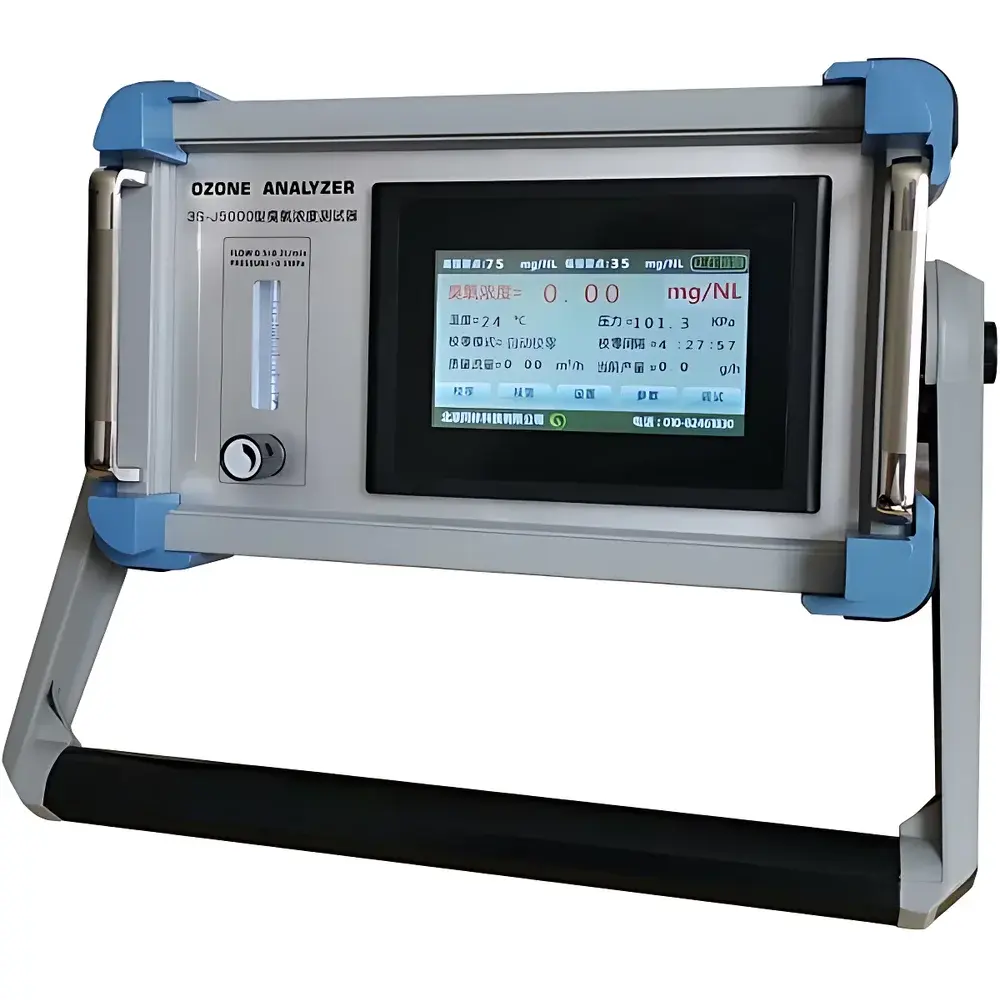
LH-3S Portable Ozone Analyzer by Canadian OEM
| Origin | Canada |
|---|---|
| Manufacturer Type | Authorized Distributor |
| Origin Category | Imported |
| Model | LH-3S |
| Instrument Type | Portable |
| Measurement Ranges | 0–100 mg/L and 0–200 mg/L (user-selectable) |
| Limit of Detection | 0.1 mg/L |
| Response Time | ≤1 s |
| Zero Drift | ±0.1 mg/L (24 h) |
| Resolution | 0.1 mg/L |
| Principle | Dual-Wavelength UV Absorption (254 nm & 365 nm) |
| Dimensions | 120 × 260 × 206 mm |
Overview
The LH-3S Portable Ozone Analyzer is an industrial-grade, field-deployable instrument engineered for real-time, high-stability quantification of aqueous ozone concentration in ozone generation systems, water treatment facilities, and disinfection process validation environments. It employs dual-wavelength ultraviolet absorption spectroscopy — measuring absorbance at 254 nm (primary ozone absorption peak) and 365 nm (reference wavelength for compensating turbidity and organic interference) — to deliver selective, matrix-resistant ozone measurement in liquid phase. Unlike single-beam or electrochemical sensors, the dual-UV optical path design eliminates baseline drift from lamp aging, quartz cell fouling, or variable sample clarity, ensuring long-term calibration integrity without frequent re-zeroing. The analyzer is optimized for direct inline or grab-sample measurement of ozone in water streams ranging from deionized process water to moderately turbid secondary effluent, with no chemical reagents or consumables required.
Key Features
- Dual-wavelength UV photometric detection (254 nm + 365 nm) for intrinsic compensation of spectral interferences and optical path degradation
- Two user-switchable measurement ranges: 0–100 mg/L and 0–200 mg/L — selected via front-panel interface or remote command
- Sub-second response time (≤1 s T90) enabling dynamic monitoring of ozone generator ramp-up, shutdown, and transient dose events
- Stable zero point maintained at ±0.1 mg/L over 24 hours, verified per ASTM D6169-22 for ozone analyzer drift assessment
- High-resolution digital output: 0.1 mg/L display and analog/digital data reporting
- Rugged portable enclosure (IP65-rated) with integrated rechargeable Li-ion battery (≥8 h continuous operation)
- Optical flow cell with fused silica windows and self-cleaning geometry to minimize biofilm accumulation and maintenance frequency
Sample Compatibility & Compliance
The LH-3S is validated for use with aqueous matrices including ozonated drinking water, cooling tower water, pharmaceutical process water (PW/WFI), and municipal wastewater effluent. It complies with ISO 14644-1 cleanroom monitoring prerequisites for ozone residual verification and supports GLP-compliant documentation when paired with optional audit-trail-enabled data logging firmware. While not certified to USP <643> or EPA Method 4500-O₃ B as a standalone device, its dual-UV methodology aligns with the optical principles specified in those standards. Calibration traceability is maintained to NIST-traceable ozone-in-water reference standards (certified by Canadian National Research Council accredited labs). The instrument meets IEC 61326-1 (industrial EMC) and IEC 61010-1 (safety) requirements for portable analytical instrumentation.
Software & Data Management
Data acquisition and configuration are managed via the LH-Link PC software (Windows 10/11 compatible), supporting real-time graphing, multi-point calibration curve generation, and export to CSV or PDF report formats. Firmware v2.3+ enables timestamped data logging with embedded metadata (operator ID, location tag, calibration history), satisfying FDA 21 CFR Part 11 requirements for electronic records when deployed with user authentication and audit trail activation. Optional Bluetooth 5.0 or RS-485 Modbus RTU interfaces allow integration into SCADA or PLC-based control systems for automated dose feedback loops. All calibration parameters and measurement logs are stored in non-volatile memory with cyclic overwrite protection.
Applications
- Real-time verification of ozone generator output concentration at point-of-use in bottled water production lines
- Validation of CT (concentration × time) values during ozone disinfection of pharmaceutical water systems per EU GMP Annex 1
- Monitoring ozone decay kinetics in pilot-scale advanced oxidation process (AOP) studies
- Field verification of residual ozone prior to activated carbon contactors in municipal water treatment plants
- Commissioning support for UV/O₃ hybrid disinfection units requiring synchronized ozone dosing control
- Academic research on ozone solubility, mass transfer efficiency, and radical yield under varying pH/temperature conditions
FAQ
What sample volume is required for accurate measurement?
The integrated flow cell operates continuously with a minimum flow rate of 100 mL/min; no discrete sample volume is needed — it measures in-line with minimal hold-up volume (<1.2 mL).
Can the LH-3S be used for gas-phase ozone measurement?
No — this instrument is specifically designed for aqueous ozone analysis. Gas-phase ozone requires a dedicated UV photometer with temperature/pressure-compensated dry-gas sampling and different path-length optimization.
How often does the instrument require calibration?
Factory calibration is valid for 6 months under normal operating conditions; field verification using a certified ozone standard solution is recommended before each critical batch or daily in GMP-regulated environments.
Is the optical cell resistant to chlorine or hydrogen peroxide interference?
Yes — the 365 nm reference channel effectively corrects for overlapping absorbance from free chlorine and low-concentration H₂O₂; however, concentrations >5 mg/L Cl₂ or >10 mg/L H₂O₂ may necessitate pre-treatment or method validation.
Does the device support automatic temperature compensation?
Yes — an integrated Pt1000 sensor measures sample temperature in real time and applies ISO 7393-3–derived correction coefficients to ozone absorbance calculations.
Related Products







