
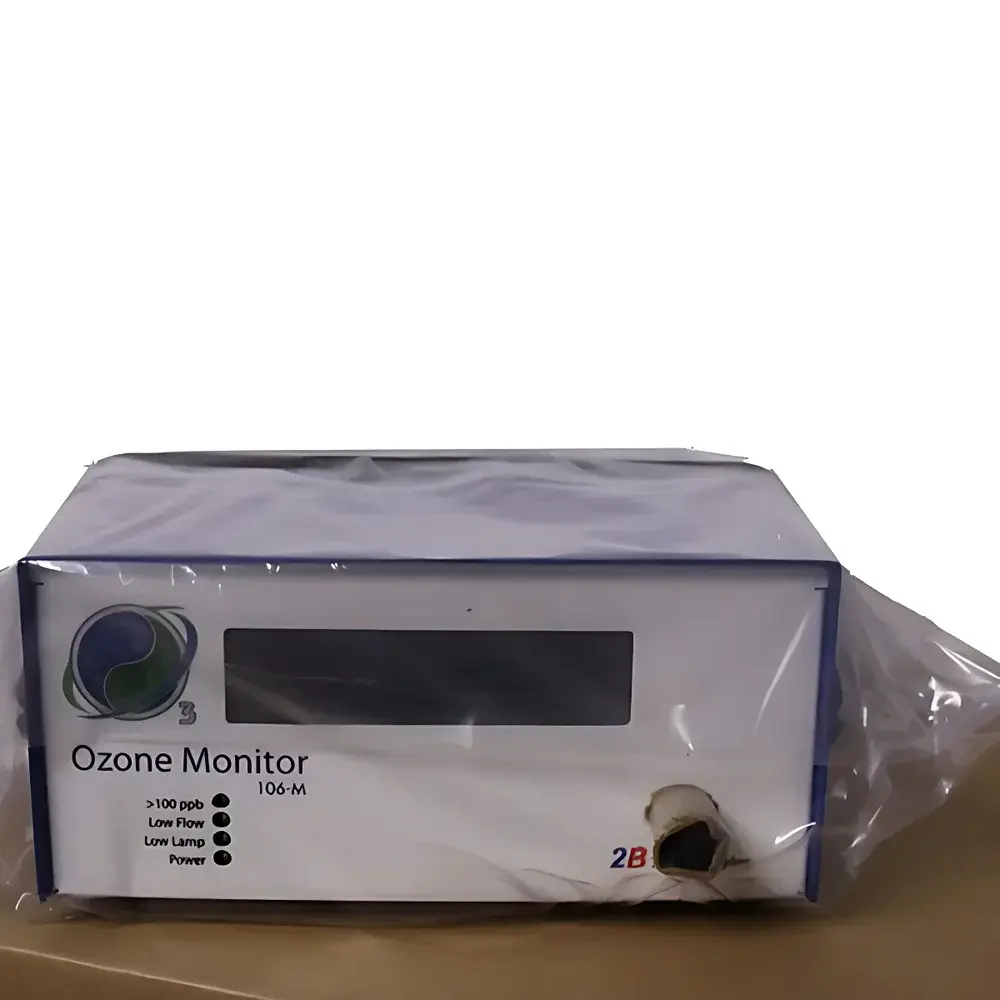
2B Technologies Model 106M Ozone Analyzer
| Brand | 2B Technologies |
|---|---|
| Model | 106M |
| Measurement Principle | UV Absorption at 254 nm |
| Range | 0–1000 ppmv |
| Resolution | 0.01 ppmv |
| Accuracy | ±(0.01 ppmv or 2% of reading) |
| Detection Limit | 1.5 ppbv |
| Sampling Flow Rate | ~1 L/min |
| Data Storage Capacity | 12,288 points |
| Averaging Intervals | 10 s, 1 min, 5 min, 1 hr |
| Output Interfaces | USB, RS-232, 0–2.5 V analog, 4–20 mA |
| Power Supply | 12 V DC or 120/240 V AC (4.2 W) |
| Dimensions | 9.5 × 21.0 × 21.6 cm |
| Weight | 2.1 kg |
| Compliance | NIST-traceable calibration support, compatible with EPA reference method requirements for ozone monitoring |
Overview
The 2B Technologies Model 106M Ozone Analyzer is a compact, field-deployable ultraviolet (UV) absorption-based instrument engineered for precise, continuous measurement of ambient and process-level ozone (O₃) concentrations. It operates on the well-established principle of Beer–Lambert absorption spectroscopy at 254 nm—the strong Hartley band absorption peak of ozone—enabling high selectivity and minimal interference from other atmospheric constituents. Designed for robustness in diverse operational environments, the Model 106M delivers stable, NIST-traceable performance across a wide dynamic range (0–1000 ppmv), with a lower detection limit of 1.5 ppbv and resolution of 0.01 ppmv. Its low power consumption (4.2 W nominal), lightweight chassis (2.1 kg), and modular I/O architecture make it suitable for unattended long-term deployments—including remote atmospheric monitoring stations, indoor air quality networks, and industrial process control loops—where reliability, energy efficiency, and regulatory-compliant data integrity are critical.
Key Features
- UV photometric detection at 254 nm with temperature-stabilized mercury vapor lamp and dual-beam optical path for drift compensation
- Integrated DewLine™ Nafion® dry tube for real-time water vapor management—eliminates humidity-induced spectral interference without consumables
- Onboard data logging with 12,288-point memory buffer; configurable averaging intervals (10 s to 1 hr) support flexible temporal resolution for compliance reporting or research analysis
- Multiple output options: isolated 4–20 mA and 0–2.5 V analog signals (user-selectable full-scale ranges), plus USB and RS-232 digital interfaces for direct PC integration or SCADA system interfacing
- Programmable relay outputs with user-defined high/low alarm thresholds (0.000–100.000 ppmv), supporting automated ventilation control or safety interlocks
- Self-diagnostics including lamp status, flow rate verification, filter life estimation, and calibration due-date alerts—designed for GLP/GMP-aligned operational transparency
Sample Compatibility & Compliance
The Model 106M accepts gaseous samples at ambient pressure and temperature, with optional inlet conditioning (e.g., particulate filtration, thermal regulation) recommended for high-dust or condensing environments. It meets the optical specificity requirements outlined in U.S. EPA Reference Method EQOA-01 for ozone analyzers and is routinely deployed in networks compliant with ISO 13964 (ambient air—determination of ozone) and ASTM D5012 (standard test method for ozone resistance of elastomers). While not certified as a Federal Equivalent Method (FEM) device, its performance characteristics—including accuracy (±0.01 ppmv or ±2% of reading), repeatability ( 0.9999 over full scale)—align with Tier 2 equivalency criteria used in academic, industrial hygiene, and regulatory pre-compliance applications. All factory calibrations are traceable to NIST Standard Reference Materials (SRMs), and users may perform two-point span/zero verification using certified ozone gas standards.
Software & Data Management
The analyzer ships with 2B Technologies’ proprietary EnviroSoft™ desktop application (Windows-compatible), enabling real-time data visualization, remote configuration, firmware updates, and export to CSV or Excel formats. Data files include embedded metadata—timestamp, averaging interval, battery voltage, internal temperature, and diagnostic flags—ensuring audit-ready traceability per FDA 21 CFR Part 11 requirements when used in regulated environments (e.g., pharmaceutical cleanroom validation). Optional cloud connectivity via third-party IoT gateways supports MQTT/HTTP(S) telemetry ingestion into time-series databases (e.g., InfluxDB, Grafana) or enterprise environmental management systems (EMS). All stored records retain full precision (6-digit mantissa) and are timestamped to UTC with millisecond resolution.
Applications
- Long-term ambient ozone monitoring in remote or off-grid locations—leveraging low power draw and internal battery compatibility (with external 12 V supply)
- Indoor air quality assessment in healthcare facilities, laboratories, and semiconductor fabrication cleanrooms during ozone sterilization cycles
- Process monitoring and feedback control in ozone generator systems used for water treatment, surface disinfection, and VOC oxidation
- Occupational exposure assessment in electronics manufacturing, printing, and HVAC maintenance where ozone-generating equipment is operated
- Field validation of photochemical air quality models and source apportionment studies requiring high-temporal-resolution ozone profiles
- Calibration transfer and intercomparison studies between reference-grade and portable ozone sensors
FAQ
What is the minimum detectable ozone concentration for the Model 106M?
The instrument achieves a lower detection limit of 1.5 ppbv under standard operating conditions (1 L/min flow, 10-second averaging), verified per EPA IO-3.2 protocol.
Can the Model 106M be used for regulatory compliance reporting?
While not an EPA-certified FEM device, its metrological performance supports Tier 2 data use in non-regulatory decision contexts and serves as a validated reference for QA/QC of certified monitors.
How often does the instrument require calibration?
2B Technologies recommends zero/span verification every 30 days for critical applications; full calibration with NIST-traceable ozone gas is advised quarterly or after major maintenance.
Is humid sample air problematic for measurement accuracy?
No—the integrated DewLine™ Nafion® dryer continuously removes water vapor from the optical path, preventing absorption interference and eliminating need for chilled mirrors or desiccant cartridges.
Does the analyzer support automatic data upload to cloud platforms?
Native cloud upload is not built-in, but the RS-232/USB interface enables seamless integration with commercial IoT edge devices supporting Modbus RTU or ASCII serial protocols.







