
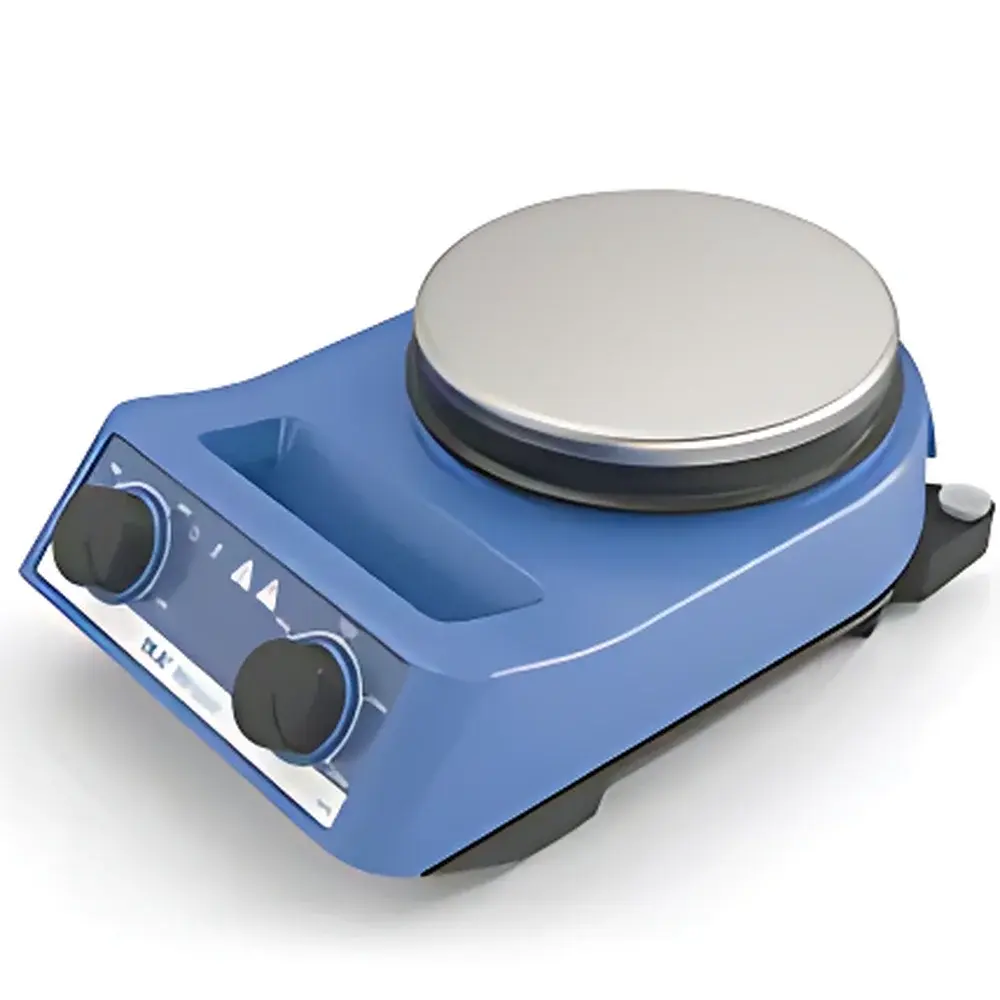
IKA RH Basic and Digital Heating Magnetic Stirrers
| Brand | IKA |
|---|---|
| Origin | Germany |
| Model | RH Basic / RH Digital |
| Instrument Type | Heating Magnetic Stirrer |
| Max. Stirring Volume | 15 L |
| Speed Range | 100–2000 rpm |
| Heating Temperature Range | 50–320 °C |
| Heating Power | 600 W |
| Plate Material | Stainless Steel 1.4301 (Cu-clad) |
| Safety Temp. Limit | 100–360 °C |
| Temp. Control Accuracy (with external probe) | ±1 K |
| Speed Display | Analog scale (RH Basic) / LED (RH Digital) |
| Touch Controls | RH Digital only |
| IP Rating | IP21 |
| Dimensions (W×D×H) | 160 × 100 × 250 mm |
| Weight | 2.8 kg |
| Operating Ambient | 5–40 °C, ≤80 % RH |
| Input Voltage | 230 / 115 / 100 V, 50/60 Hz |
| Total Power Consumption | 620 W |
Overview
The IKA RH Basic and RH Digital are precision-engineered heating magnetic stirrers designed for reliable, reproducible thermal mixing in academic, industrial, and quality control laboratories. Based on the proven Couette flow principle, these instruments generate uniform rotational motion via a rotating magnetic field beneath a non-magnetic ceramic or stainless-steel plate, driving PTFE- or glass-coated stir bars immersed in liquid samples. The integrated high-power (600 W) heating system—featuring a copper-clad 1.4301 stainless steel plate—enables rapid, homogeneous heat transfer across volumes up to 15 L of aqueous solution. Unlike entry-level units with passive thermal regulation, the RH series supports active temperature feedback control when paired with an external DIN 12878-compliant contact sensor (e.g., IKA ETS-D5), achieving ±1 K stability under dynamic load conditions. This architecture meets fundamental requirements for method development, dissolution testing, reagent preparation, and routine sample conditioning where both thermal and mechanical consistency are critical.
Key Features
- Robust dual-mode operation: RH Basic offers analog speed and thermal control with M10 mounting thread for vertical support rod integration; RH Digital adds LED-displayed real-time speed (100–2000 rpm) and plate temperature (50–320 °C), plus error-code diagnostics for fault identification.
- DIN 12878-standard sensor port enables direct connection of calibrated Pt100 or thermistor probes, supporting closed-loop temperature regulation compliant with ISO/IEC 17025 and GLP documentation workflows.
- Programmable safety cutoff (100–360 °C) prevents overheating during unattended operation and satisfies laboratory risk mitigation protocols per DIN EN 61010-1.
- Copper-enhanced stainless steel (1.4301) heating plate ensures rapid thermal response—approximately 6 K/min temperature rise in 1 L water—and long-term corrosion resistance against common solvents and buffers.
- Soft-start motor drive minimizes mechanical shock to sensitive samples and extends stir bar service life; optimized magnetic circuit delivers consistent torque even at low speeds and high viscosities.
- IP21-rated enclosure provides protection against vertically falling drips and solid objects ≥12.5 mm, suitable for standard wet-lab environments under controlled ambient conditions (5–40 °C, ≤80 % RH).
Sample Compatibility & Compliance
The RH stirrers accommodate standard laboratory glassware including beakers, flasks, and crystallization dishes up to 15 L capacity. Compatible stir bars range from 10 mm to 80 mm in length, with PTFE, PTFE-glass, or ceramic coatings recommended for aggressive media. The unit complies with key international safety and electromagnetic compatibility standards: DIN EN 61010-1 (electrical safety), DIN EN 61326-1 (EMC for lab equipment), and DIN EN 60529 (IP21 ingress protection). While not certified for hazardous area use, its design aligns with general-purpose GMP environment expectations for equipment qualification (IQ/OQ/PQ), particularly when used with traceable calibration records and sensor-based temperature validation.
Software & Data Management
The RH Basic and RH Digital operate as standalone instruments without digital connectivity (no RS232, USB, or analog output interfaces). All operational parameters—including setpoints, safety limits, and diagnostic states—are locally configured and monitored. RH Digital’s LED display and tactile touch controls provide intuitive user interaction without software dependency, reducing validation complexity in regulated settings. For laboratories requiring electronic recordkeeping, external data loggers may interface with third-party temperature probes connected via the DIN 12878 port; such configurations can be validated to meet FDA 21 CFR Part 11 requirements when paired with appropriate audit-trail-capable acquisition software.
Applications
- Preparation of homogeneous buffer solutions and culture media in microbiology and molecular biology labs.
- Controlled heating and mixing during titration, extraction, and precipitation procedures.
- Supporting ASTM D2196 and ISO 2557-2 viscosity sample conditioning prior to rheometric analysis.
- Dissolution testing in pharmaceutical QC according to USP , where precise temperature maintenance (±0.5 °C) is required during agitation cycles.
- Accelerated aging studies involving thermal stress exposure of polymer dispersions or colloidal suspensions.
- General-purpose benchtop mixing in chemistry teaching labs, where durability, ease of cleaning, and clear operational feedback are prioritized.
FAQ
What is the maximum recommended volume for stable stirring?
The RH series is rated for up to 15 L of water-equivalent viscosity. For higher-viscosity fluids (e.g., glycerol, polymer solutions), reduce volume proportionally and select longer, heavier stir bars to maintain vortex stability.
Can the RH Digital store multiple temperature or speed profiles?
No. The RH Digital does not feature programmable memory or profile storage; all parameters must be manually set for each operation.
Is external temperature sensing mandatory for accurate control?
Not mandatory—but strongly recommended. Plate-sensor control (±20 K accuracy) is insufficient for process-critical applications; using a DIN 12878 probe immersed in the sample achieves ±1 K accuracy and fulfills regulatory temperature verification requirements.
Does the unit support continuous operation over 24 hours?
Yes. The RH series is engineered for uninterrupted duty cycles under specified ambient conditions (≤40 °C, ≤80 % RH) and proper ventilation. Thermal management relies on passive convection; avoid enclosing the base or obstructing rear ventilation slots.
What stir bar length is optimal for 10 L mixing in a tall-form vessel?
For vessels >20 cm in height, use stir bars between 60–80 mm with elliptical or cross-shaped geometry to maximize radial force distribution and minimize axial vibration.



