
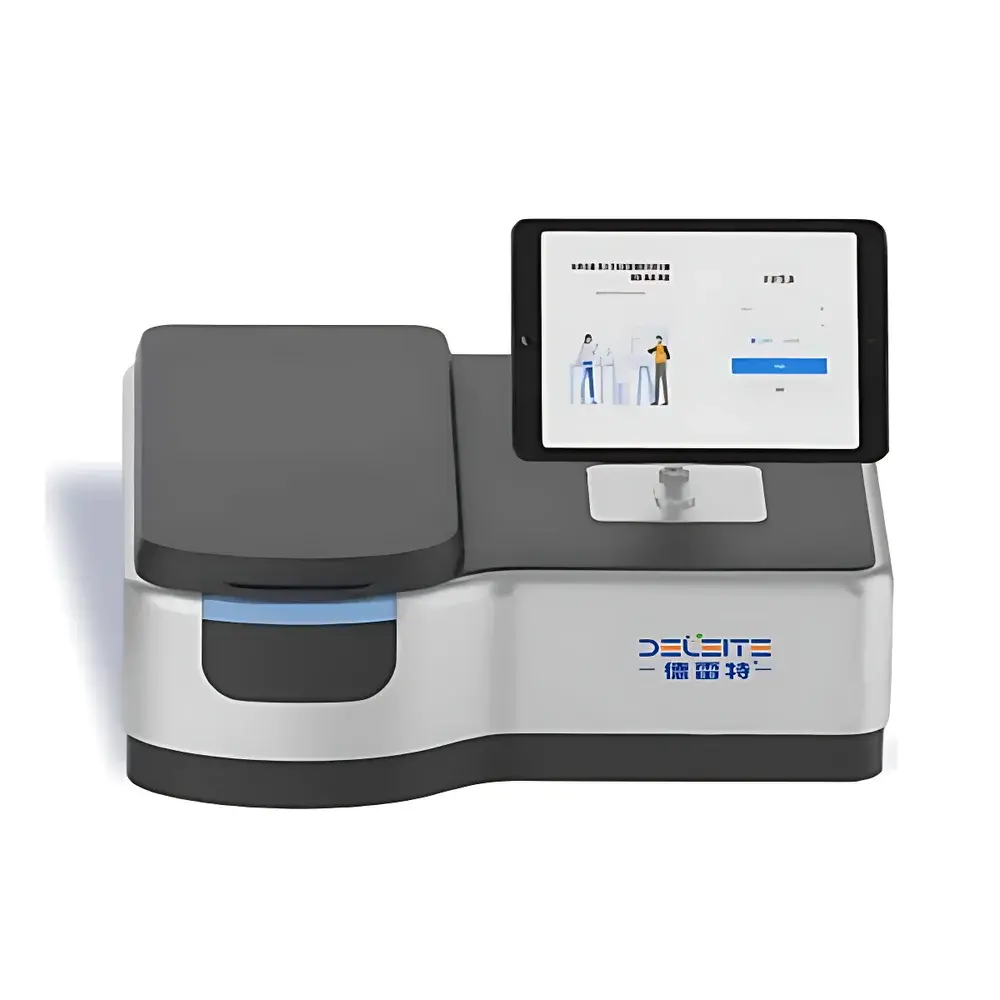
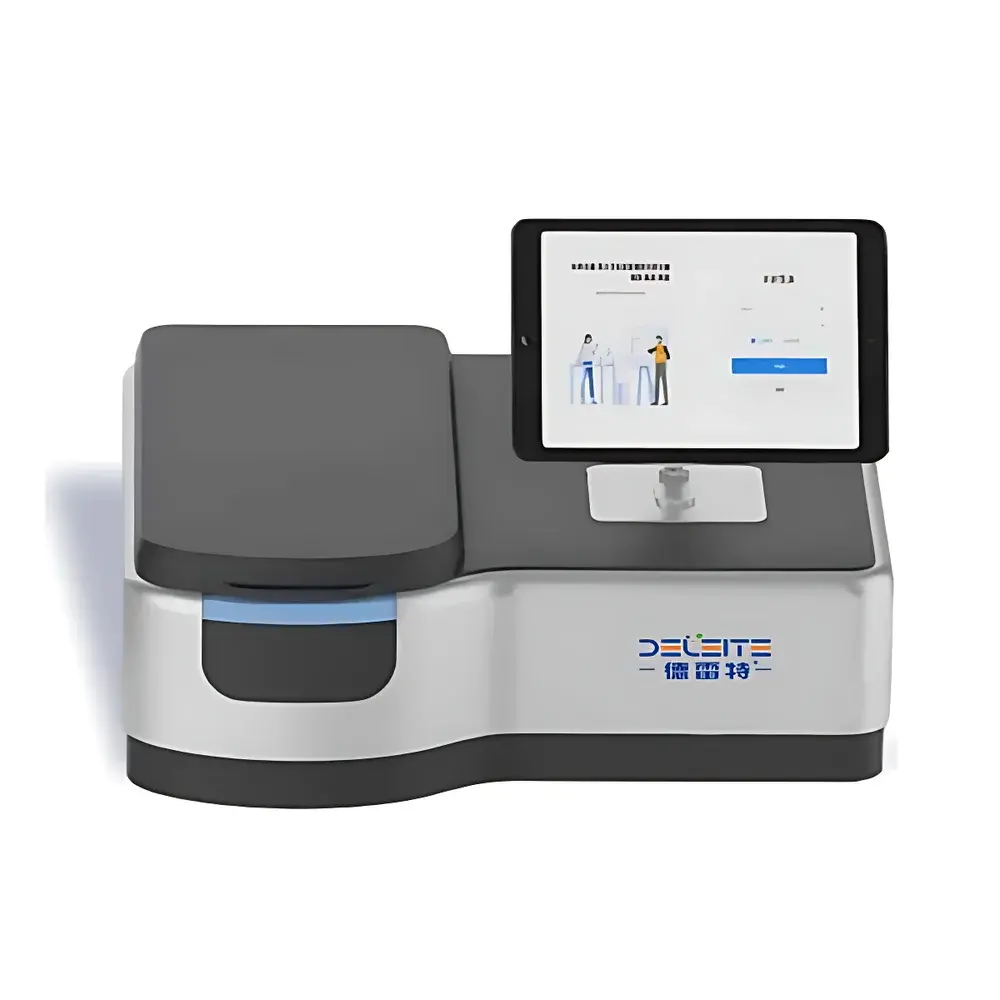
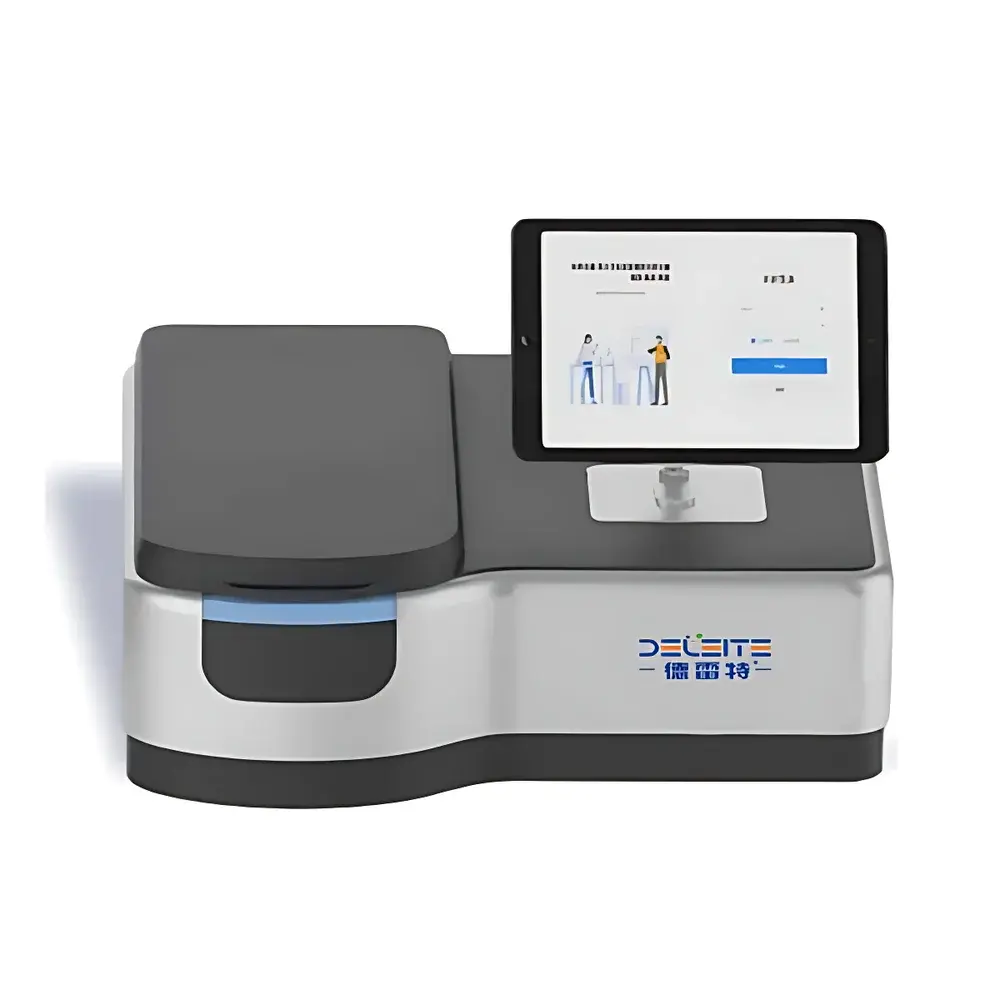
DELEITE NUV-600D Dual-Beam UV-Vis Spectrophotometer
| Brand | DELEITE |
|---|---|
| Origin | Shanghai, China |
| Model | NUV-600D |
| Optical System | Dual-beam |
| Detector | Photodiode Array (PDA) |
| Wavelength Range | 190–1100 nm |
| Spectral Bandwidth | 1.8 nm |
| Wavelength Accuracy | ±0.3 nm |
| Wavelength Repeatability | 0.1 nm |
| Stray Light | ≤0.05% T at 220 nm and 360 nm |
| Absorbance Resolution | 0.00001 Abs |
| Absorbance Accuracy | ±0.0005 A (0–0.5 A), ±0.0008 A (0.5–1.0 A), ±0.2% T (0–100% T) |
| Absorbance Repeatability | ±0.0004 A (0–0.5 A), ±0.0006 A (0.5–1.0 A), ≤0.15% T (0–100% T) |
| Baseline Flatness | ±0.0004 Abs |
| Photometric Range | –4 to +4 Abs |
| Wavelength Scanning Interval | 0.1 nm |
| Scan Time | ~2 minutes (full range) |
Overview
The DELEITE NUV-600D is a high-performance dual-beam ultraviolet-visible spectrophotometer engineered for precision quantitative and qualitative analysis across research laboratories, quality control environments, and environmental monitoring facilities. Operating on the fundamental principle of Beer–Lambert law-based absorbance measurement, the instrument employs a stable dual-beam optical architecture to continuously compensate for source intensity drift and detector sensitivity variation—ensuring exceptional photometric stability and long-term reproducibility. Its 190–1100 nm spectral coverage accommodates routine UV-Vis applications—from nucleic acid and protein quantification at 260/280 nm to visible-range colorimetric assays and near-IR extended analyses. The integrated photodiode array (PDA) detector enables rapid, simultaneous acquisition across the full wavelength range without mechanical scanning delays, supporting high-throughput workflows in regulated and non-regulated settings alike.
Key Features
- Dual-beam optical design with real-time reference beam correction for enhanced baseline stability and reduced drift over extended measurement sessions.
- 12.1-inch high-resolution touchscreen tablet (iPad-compatible Android OS) with auto-switching bilingual UI (English/Chinese), Bluetooth pairing, and responsive multi-interface navigation.
- Onboard audit trail, role-based user management (administrator/operator/analyst), permission controls, and operation logging—fully compliant with GLP requirements without PC dependency.
- Four-color status LED system: blue (power-on self-test), red (self-test failure), yellow (standby/wireless connection pending), green (operational readiness).
- Extended-life deuterium and tungsten-halogen lamp system with programmable lamp on/off scheduling to maximize source longevity and minimize maintenance cycles.
- Sub-millisecond wavelength stepping (0.1 nm interval) enabling full-spectrum scans in approximately two minutes with <0.00001 Abs resolution and ±0.0001 Abs baseline stability over 1 hour.
- Real-time anomaly detection with automated email/SMS alerts for instrument faults or out-of-spec results—integrated with cloud synchronization for remote diagnostics.
Sample Compatibility & Compliance
The NUV-600D supports a broad range of sample formats via optional accessories: standard 10-mm cuvettes, microvolume holders, temperature-controlled cells (up to 100 °C), integrating spheres for diffuse reflectance, variable-pathlength cells (1–100 mm), and solid-sample stages with adjustable incidence angles. It meets core performance criteria referenced in ISO 9001, ASTM E275, and USP for spectrophotometric instrumentation validation. While not pre-certified for FDA 21 CFR Part 11, its built-in electronic signature-ready audit trail, immutable log files, and user-access-tiered permissions provide a foundation for Part 11 compliance when deployed within validated laboratory information management systems (LIMS) or electronic lab notebooks (ELN).
Software & Data Management
The embedded software platform supports all standard UV-Vis measurement modes: photometric (T/A/C/E), quantitative analysis (single/multi-point calibration, equation-based concentration calculation), kinetic studies, wavelength scanning, multi-wavelength analysis, 3D spectral mapping, and dedicated nucleic acid/protein modules (A260/A280 ratio, extinction coefficient application). Data export is supported in CSV, PDF, and XML formats—with metadata embedding (operator ID, timestamp, method name, instrument serial number). Cloud connectivity allows secure remote data backup, firmware updates, and cross-site method sharing. Optional PC software extends functionality with advanced curve fitting, spectral deconvolution, and custom report generation aligned with ISO/IEC 17025 documentation standards.
Applications
- Pharmaceutical QC: assay verification, dissolution testing, excipient interference screening per ICH Q2(R2) guidelines.
- Environmental analysis: COD, ammonia nitrogen, total phosphorus, nitrate/nitrite, turbidity, and chlorine residual quantification using EPA-approved colorimetric methods.
- Biochemistry labs: DNA/RNA purity assessment, Bradford/Lowry/BCA protein assays, enzyme kinetics (e.g., NADH/NADPH monitoring at 340 nm).
- Materials science: thin-film transmittance/reflectance profiling, bandgap estimation of semiconductors, dye degradation kinetics.
- Academic teaching: hands-on instruction in spectroscopic theory, calibration practices, and error propagation analysis under controlled experimental conditions.
FAQ
Does the NUV-600D require a connected PC to perform basic measurements?
No—the instrument operates fully autonomously with its integrated tablet interface, onboard storage, and local data processing capabilities.
Is the photodiode array (PDA) detector thermally stabilized?
Yes, the PDA module incorporates active temperature regulation to maintain consistent quantum efficiency across ambient fluctuations (15–30 °C operating range).
Can the audit trail be exported for regulatory review?
Yes—audit logs are stored in encrypted SQLite format and can be exported as timestamped, digitally signed PDF reports compatible with internal QA audits.
What is the maximum allowable sample volume for the standard cuvette holder?
The standard holder accepts 10-mm pathlength quartz or glass cuvettes with volumes between 0.5 mL and 3.5 mL; microvolume adapters support down to 0.5 µL with enhanced pathlength correction algorithms.
How often does the wavelength calibration need verification?
Factory calibration is traceable to NIST SRM 2031 (Holmium oxide) and remains valid for 12 months under normal use; users may perform quick verification using built-in holmium or didymium filters at any time.
Related Products






