
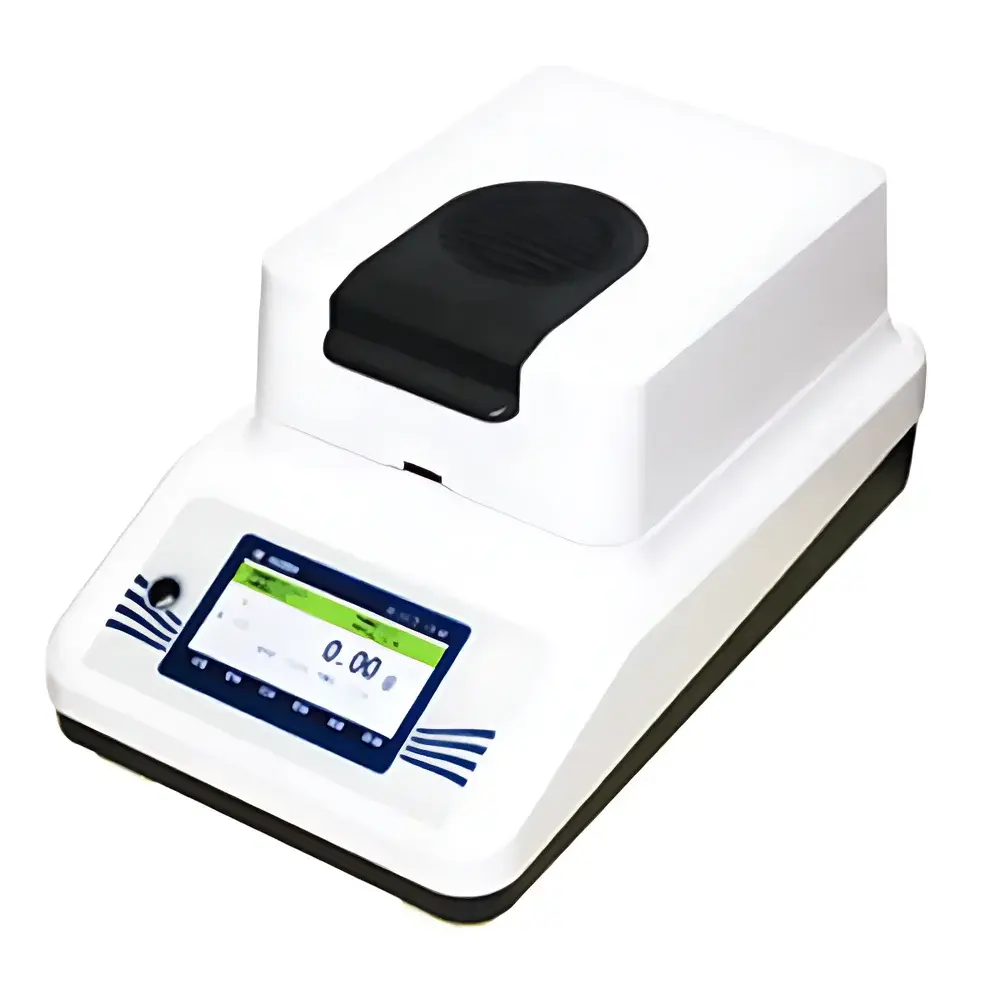
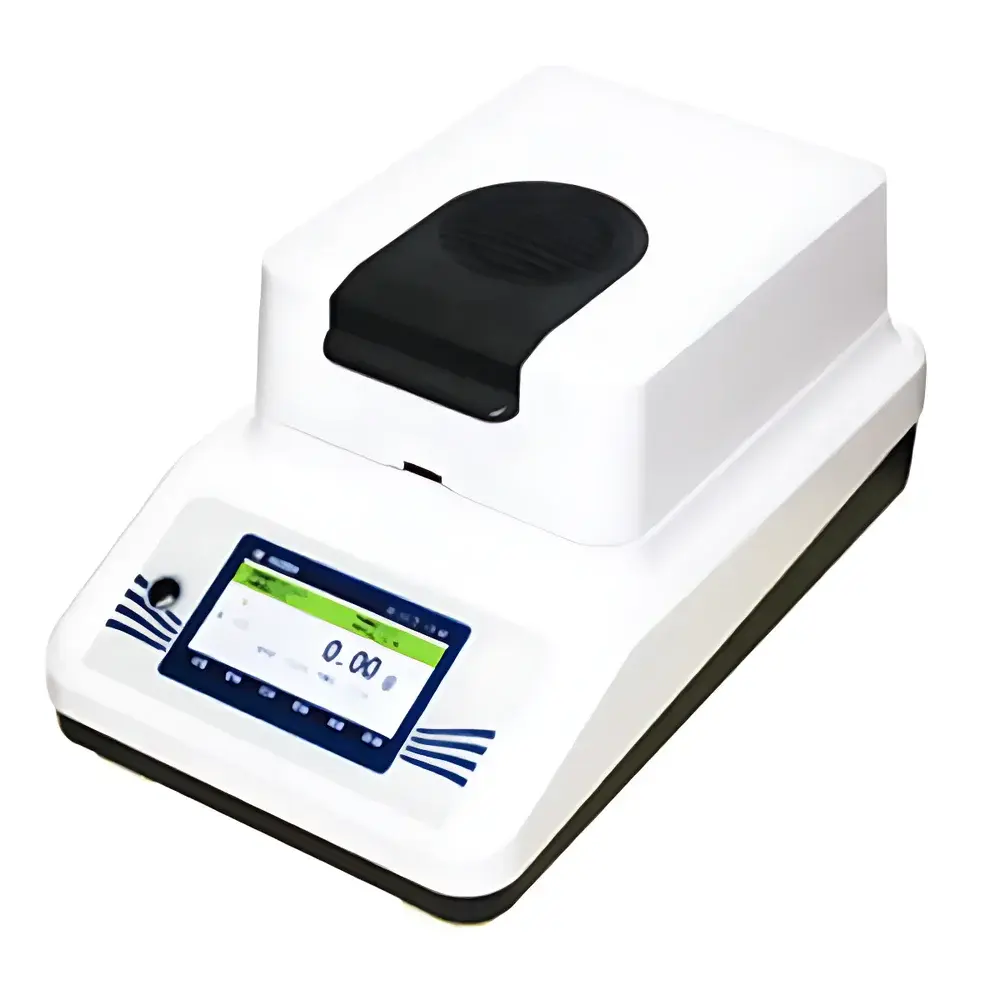
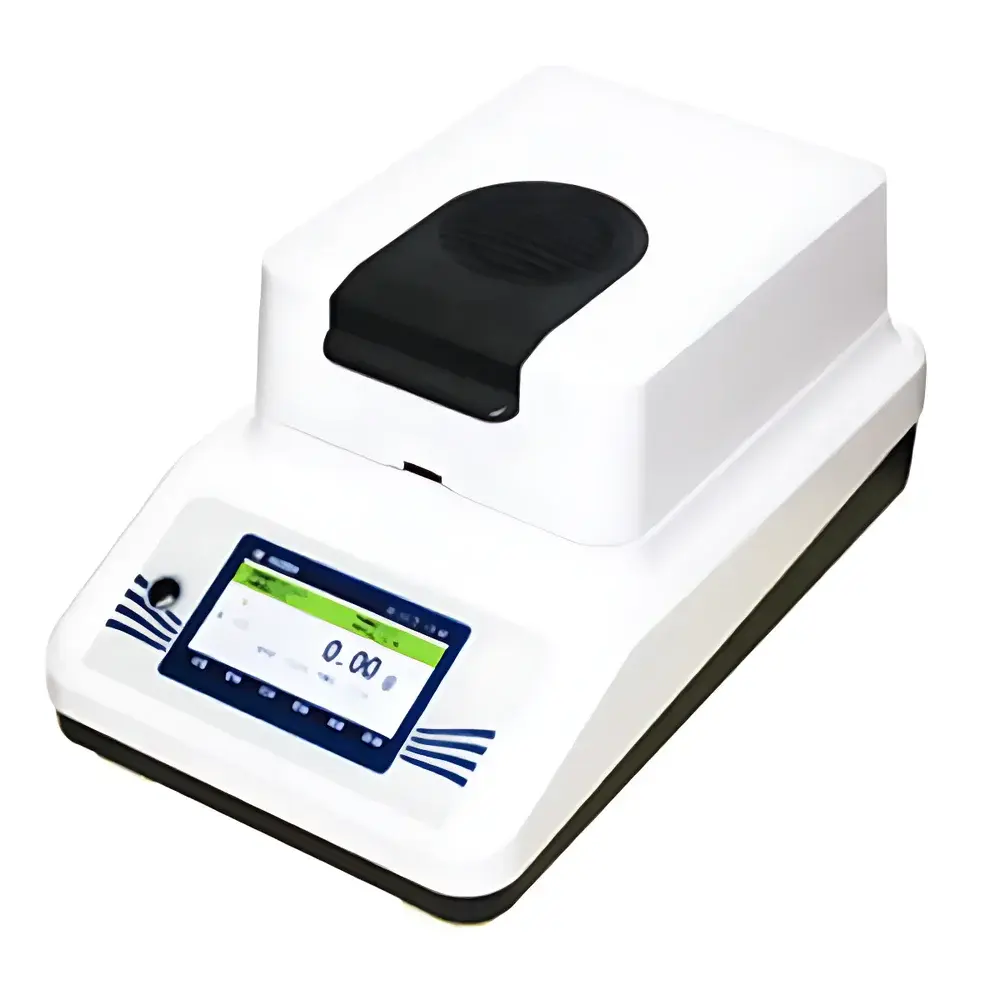
Yoke DSH-50A-1 Halogen Moisture Analyzer
| Brand | Yoke |
|---|---|
| Origin | Shanghai, China |
| Model | DSH-50A-1 Halogen Moisture Analyzer |
| Heating Source | Halogen Lamp |
| Readability | 1 mg |
| Weighing Range | 0–50 g |
| Repeatability (3 g sample) | ±0.2% |
| Recommended Sample Mass | 3–10 g |
| Heating Time | 1–99 min (1 min increments) |
| Temperature Range | 50–180 °C |
| End Point Modes | Timed & Automatic |
| Display | Moisture %, Solid %, Weight (g), Time, Date |
| Pan Diameter | 100 mm |
| Dimensions (W×D×H) | 265 × 160 × 150 mm |
| Net Weight | 5 kg |
| Communication | RS232 |
Overview
The Yoke DSH-50A-1 Halogen Moisture Analyzer is a thermogravimetric moisture determination instrument engineered for precision and operational efficiency in regulated industrial and laboratory environments. It operates on the principle of loss-on-drying (LOD), wherein a halogen lamp provides rapid, uniform, and controllable infrared heating to drive off volatile moisture from solid or semi-solid samples. The instrument continuously monitors mass loss in real time using a high-stability, temperature-compensated electromagnetic force restoration sensor. As drying progresses, the system evaluates rate-of-mass-change to determine endpoint—either via preset time or automatic detection based on user-defined mass stability criteria (e.g., ≤0.1 mg/30 s). This method complies with standardized thermogravimetric protocols referenced in ASTM E1447, ISO 712, USP <921>, and AOAC 952.08, making it suitable for QC release testing, raw material verification, and process validation across GMP-aligned facilities.
Key Features
- Halogen lamp heating system delivering fast thermal response (0–180 °C in <15 s), precise temperature control (±1 °C), and uniform radiant energy distribution across the 100 mm diameter stainless-steel sample pan.
- High-resolution 1 mg readability electromagnetic balance with integrated zero-point drift compensation and auto-tare functionality—enabling sequential multi-sample analysis without manual recalibration.
- Backlit dot-matrix LCD display with adjustable contrast, optimized for visibility under low-ambient lighting conditions common in production cleanrooms and analytical labs.
- Intuitive membrane keypad interface supporting direct parameter entry (temperature setpoint, duration, endpoint mode) and real-time monitoring of moisture %, dry solids %, residual weight, elapsed time, and system date/time.
- Robust mechanical architecture with thermal shielding between heating chamber and load cell, minimizing convection-induced measurement noise and ensuring long-term repeatability (≤0.2% RSD at 3 g load).
Sample Compatibility & Compliance
The DSH-50A-1 accommodates heterogeneous matrices including granular pharmaceutical actives, milled cereal grains, powdered polymers, lyophilized biologics, crude mineral ores, cellulose-based packaging materials, and textile fibers. Its open-chamber design allows rapid loading/unloading and visual inspection of sample behavior during drying—critical for detecting surface crust formation or thermal degradation. The instrument meets essential electrical safety requirements per IEC 61010-1 and supports documentation workflows compliant with FDA 21 CFR Part 11 when paired with validated RS232 data export to LIMS or ELN platforms. Routine operation aligns with GLP/GMP expectations for instrument qualification (IQ/OQ/PQ), traceable calibration (using certified weights and NIST-traceable moisture standards), and audit-ready record retention.
Software & Data Management
Data output is transmitted via standard RS232 serial interface (no proprietary drivers required) to external PCs or printers. Raw measurement logs include timestamped entries for initial mass, final mass, moisture content (% w/w), solid residue (%), drying curve slope, and endpoint confirmation flag. When integrated into enterprise systems, exported files support automated parsing for statistical process control (SPC) charting, batch release trending, and deviation investigation (OOS/OOT). Optional CSV formatting enables direct import into Excel, JMP, or Minitab for comparative analysis across product lines or supplier lots. All stored parameters—including user ID, method name, and environmental notes—are retained per test cycle to satisfy ALCOA+ data integrity principles.
Applications
- Food & Beverage: Monitoring moisture in flour, coffee beans, dairy powders, and snack products to prevent microbial growth and extend shelf life.
- Pharmaceuticals: Verifying LOD specifications for APIs, excipients, and tablet granules per USP <921> and EP 2.2.32.
- Chemicals & Polymers: Quantifying residual solvent in resins, catalysts, and pigment dispersions prior to extrusion or compounding.
- Agriculture & Feed: Assessing grain moisture for storage compliance (e.g., ≤14% for maize) and feed formulation accuracy.
- Paper & Textiles: Controlling fiber moisture during pulping, drying, and finishing to ensure dimensional stability and tensile consistency.
FAQ
What regulatory standards does the DSH-50A-1 support for moisture testing?
It supports methodologies aligned with ASTM E1447 (standard test method for moisture in solids by thermogravimetry), ISO 712 (cereals and cereal products), USP <921> (water determination), and AOAC Official Method 952.08 (moisture in foods).
Can the instrument be calibrated and verified in-house?
Yes—routine calibration uses Class M2 certified weights (e.g., 10 g, 20 g) and reference moisture standards (e.g., sodium tartrate dihydrate, 15.66% H₂O); full qualification requires documented IQ/OQ protocols.
Is the halogen heating source suitable for heat-sensitive samples?
The 50–180 °C range and programmable ramp profiles allow gentle drying of thermolabile compounds; endpoint auto-detection prevents over-drying and decomposition artifacts.
How is data integrity ensured during RS232 transmission?
Each exported record includes checksum validation, timestamp synchronization, and uneditable metadata fields (operator ID, method ID, instrument serial number) to meet ALCOA+ traceability requirements.
What maintenance is required to sustain measurement accuracy?
Monthly cleaning of the pan and chamber with lint-free ethanol wipes; annual sensor linearity verification and lamp output assessment using calibrated IR radiometers.



