
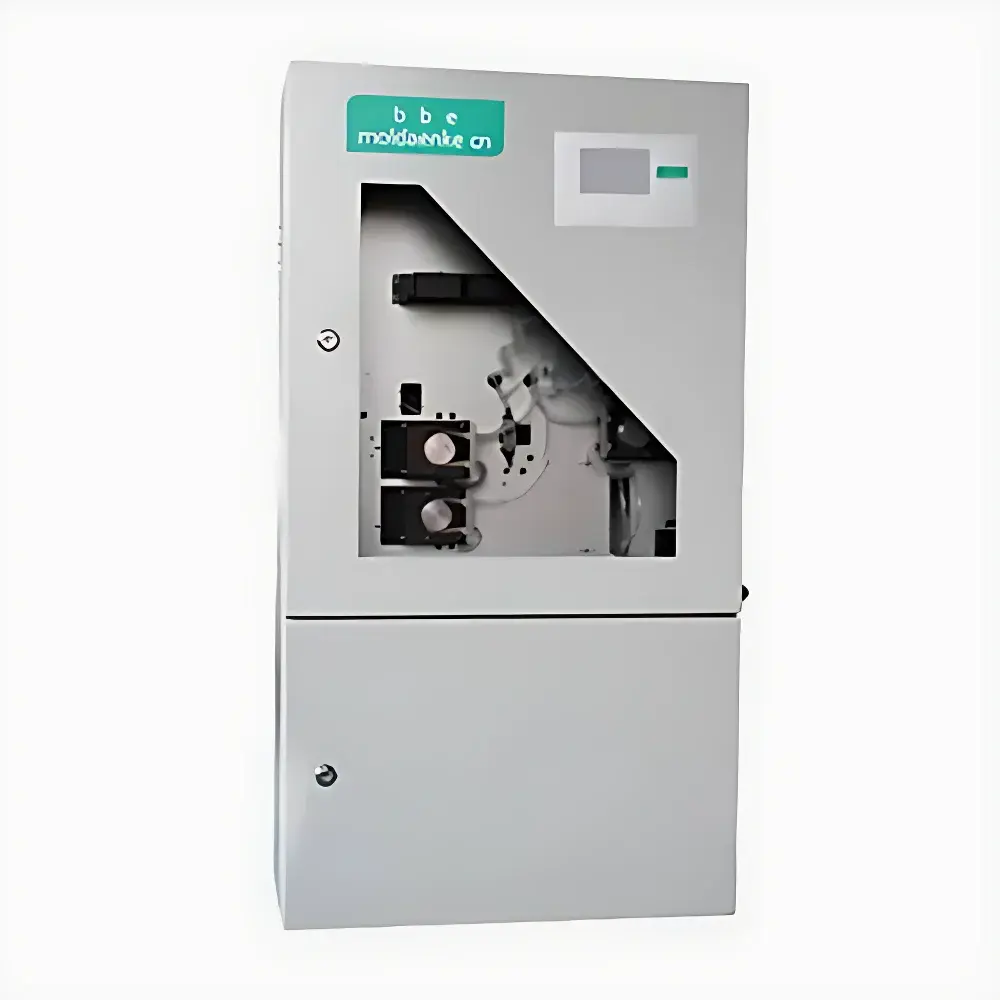
BBE BG00750002 Online Sulfide Analyzer
| Brand | BBE / bbe Moldaenke |
|---|---|
| Origin | Shanghai, China |
| Manufacturer Type | Original Equipment Manufacturer (OEM) |
| Instrument Type | Online Analyzer |
| Model | BG00750002 |
| Communication Options | 4–20 mA output, RS232/RS485 serial interface, MODBUS RTU/TCP, TCP/IP (optional) |
| Automation Features | Fully automated analysis cycle, programmable measurement interval, auto-cleaning, auto-calibration (manual calibration supported), power-loss recovery with automatic restart |
Overview
The BBE BG00750002 Online Sulfide Analyzer is an industrial-grade, continuous-monitoring instrument engineered for real-time quantification of dissolved sulfide (H₂S, HS⁻, S²⁻) in aqueous matrices. It operates on the principle of colorimetric detection following acidification and gas-diffusion separation — a method standardized under ISO 10597:2021 (Water quality — Determination of sulfide — Colorimetric method using methylene blue) and aligned with EPA Method 376.1 for sulfide in wastewater. The system integrates a dedicated gas-permeable membrane module to isolate gaseous H₂S from the sample stream, followed by reaction with N,N-dimethyl-p-phenylenediamine (DMPD) under acidic conditions to form methylene blue, measured photometrically at 670 nm. This selective diffusion-based approach eliminates interferences from suspended solids, turbidity, and most common metal ions (e.g., Fe²⁺, Cu²⁺), ensuring high specificity in complex environmental and industrial effluents.
Key Features
- Fully automated operation: Pre-programmable analysis cycle (interval adjustable from 15 min to 24 h), including sample aspiration, reagent dosing, reaction incubation, optical measurement, and waste discharge.
- Integrated auto-cleaning mechanism: High-pressure water flush and air purge between cycles prevent biofilm formation and sensor fouling — critical for long-term stability in raw sewage or algae-rich surface water.
- High-precision peristaltic pumping system: Dual-channel, chemically resistant tubing with pulse-free flow delivery ensures volumetric accuracy ≤±1.5% and measurement repeatability (RSD) <2.0% over 7-day continuous operation.
- Modular architecture: Separable sample conditioning unit, reaction manifold, and optical detection module enable field-level component replacement without system recalibration.
- Intuitive 7-inch capacitive touchscreen HMI: Local configuration, real-time trend display, event log review, and diagnostic status monitoring — all compliant with IEC 61000-6-2/4 EMC standards.
- Robust fault handling: Multi-level alarm logic (e.g., low reagent level, flow interruption, photometer drift >5% FS, temperature deviation >±3°C) with relay outputs and configurable notification via Modbus register flags.
Sample Compatibility & Compliance
The BG00750002 is validated for use with unpreserved, unfiltered liquid samples across pH 5.0–9.5 and temperature 5–40°C. It meets operational requirements for Class I (raw influent), Class II (treated effluent), and Class III (drinking water distribution) monitoring per ISO 5667-3 and EN 14855:2015. Reagent consumption is optimized to ≤1.2 mL per analysis cycle; standard calibration verification follows ISO/IEC 17025 traceability protocols using certified sulfide reference standards (NIST SRM 2781). The analyzer supports GLP-compliant data integrity through time-stamped audit trails, user-access control (3-tier role permissions), and optional 21 CFR Part 11–compliant electronic signatures when integrated with BBE’s AQUA-Connect software suite.
Software & Data Management
Data acquisition and remote supervision are enabled via embedded Linux-based firmware supporting dual communication modes: analog 4–20 mA current loop (HART-compatible) and digital interfaces (RS485/Modbus RTU, Ethernet/TCP-IP, Modbus TCP). All measurement values, diagnostic codes, and maintenance timestamps are logged internally (≥30 days at 15-min resolution) and exportable as CSV or XML. When paired with BBE’s AQUA-Connect SCADA platform, the instrument supports OPC UA integration, automated report generation (daily/weekly compliance summaries), and predictive maintenance alerts based on pump actuation count and optical path degradation rate.
Applications
- Real-time sulfide surveillance at wastewater treatment plant headworks and anaerobic digesters to prevent H₂S corrosion and odor nuisance.
- Continuous compliance monitoring for industrial dischargers subject to local limits (e.g., China’s GB 8978-1996, EU Urban Wastewater Directive Annex I).
- Early warning detection in drinking water distribution networks where sulfate-reducing bacteria activity may compromise pipe integrity.
- Process control in pulp & paper mills, tanneries, and petrochemical facilities where sulfide is a key process indicator and corrosion risk parameter.
- Research-grade longitudinal studies in rivers, lakes, and estuaries requiring high-frequency sulfide dynamics under varying redox conditions.
FAQ
What is the typical detection range and limit of detection (LOD)?
The standard configuration offers a dynamic range of 0–5 mg/L S²⁻ with an LOD of 0.005 mg/L (based on 3σ of blank signal, n=10). Extended-range modules (0–50 mg/L) are available upon request.
Does the analyzer require daily manual intervention?
No routine daily maintenance is required. Scheduled tasks include monthly reagent replenishment and quarterly optical window inspection. Full system validation is recommended every 90 days per ISO/IEC 17025 guidelines.
Can it operate reliably in high-sulfate or high-iron wastewater?
Yes — the gas-diffusion membrane selectively transports only molecular H₂S, effectively excluding sulfate (SO₄²⁻) and iron-bound sulfides (e.g., FeS), which remain in the aqueous phase and do not interfere.
Is remote firmware update supported?
Yes, secure OTA (over-the-air) updates are enabled via HTTPS-encrypted connection to BBE’s authorized update server, with rollback capability and SHA-256 signature verification.
How is calibration traceability documented?
Each calibration event generates a digital certificate containing operator ID, reference standard lot number, uncertainty budget, and instrument serial number — stored both locally and synchronized to the central AQUA-Connect database.
Related Products







