
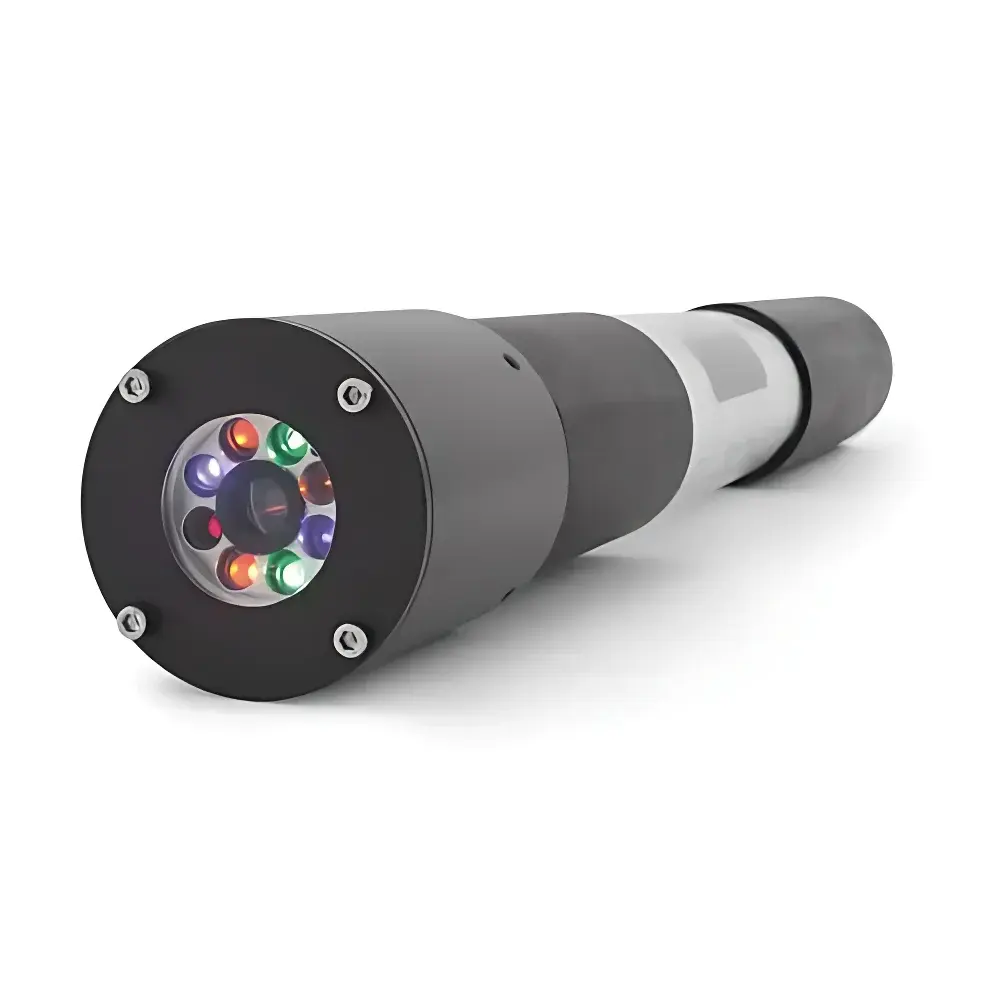
BBE Algae Torch Online Chlorophyll a and Phycocyanin In-Situ Fluorometer
| Brand | BBE Moldaenke |
|---|---|
| Origin | Germany |
| Manufacturer | BBE Moldaenke GmbH |
| Type | Imported Instrument |
| Model | Algae Torch Online |
| Application | Real-time in-situ chlorophyll a and phycocyanin quantification in natural and engineered water systems |
Overview
The BBE Algae Torch Online is a submersible, in-situ fluorometer engineered for continuous, real-time quantification of chlorophyll a (Chl a) and phycocyanin (PC) — key fluorescent biomarkers of phytoplankton biomass and cyanobacterial presence — directly in aquatic environments. Based on the principle of excitation-emission fluorescence spectroscopy, the instrument employs dual-wavelength LED excitation (470 nm for Chl a, 590 nm for PC) and high-sensitivity photodiodes to detect emitted fluorescence at characteristic wavelengths (685 nm and 650 nm, respectively). Its optical design incorporates built-in turbidity compensation via red-light backscatter measurement (650 nm), enabling robust signal correction across variable suspended solids concentrations — a critical capability for reliable operation in turbid reservoirs, rivers, drinking water intakes, and eutrophic lakes. Unlike extractive laboratory methods requiring filtration, solvent extraction, and spectrophotometric analysis (e.g., ISO 10260 or EPA Method 445.0), the Algae Torch Online delivers field-deployable, non-destructive, and reagent-free monitoring with no sample pre-treatment.
Key Features
- In-situ dual-parameter detection: Simultaneous, independent quantification of chlorophyll a (indicative of total algal biomass) and phycocyanin (a specific marker for cyanobacteria), supporting early identification of potentially toxic cyanobacterial blooms.
- Turbidity-adaptive fluorescence correction: Integrated red-light backscatter sensor (650 nm) measures particle density in real time; proprietary algorithms apply dynamic compensation factors to fluorescence signals, minimizing interference from suspended sediments and organic particulates.
- Sub-second response and rapid cycle time: Full measurement cycle completed in <20 seconds, enabling high-temporal-resolution profiling (e.g., minute-interval logging) essential for capturing diurnal dynamics and transient bloom events.
- Self-contained operational architecture: All components — optical sensing head, microprocessor, display, data logger, and communication interface — are integrated into a single IP68-rated stainless-steel housing rated for continuous submersion up to 10 m depth.
- Low-maintenance, reagent-free operation: No consumables, filters, or chemical reagents required; calibration verification performed via factory-traceable reference standards; optional automated biofouling mitigation via integrated wiper or ultrasonic cleaning module.
Sample Compatibility & Compliance
The Algae Torch Online is validated for direct deployment in raw surface waters including drinking water reservoirs, intake channels, rivers, lakes, ponds, and aquaculture systems. It operates reliably across pH 5–9, conductivity up to 5,000 µS/cm, and temperatures from 0 °C to 40 °C. While not a certified reference method per ISO/IEC 17025, its performance aligns with QA/QC expectations for continuous environmental monitoring under ISO 5667-3 (water sampling) and supports compliance with EU Water Framework Directive (WFD) ecological status assessment indicators. Data integrity meets GLP-aligned requirements, with timestamped, audit-trail-enabled storage and optional 21 CFR Part 11-compliant software modules for regulated utilities.
Software & Data Management
Data output is provided via RS-485 (Modbus RTU), SDI-12, or optional 4–20 mA analog outputs. The device supports seamless integration into SCADA, PLC, and cloud-based water intelligence platforms (e.g., OSIsoft PI, Ignition, or custom MQTT brokers). BBE’s proprietary TorchView software enables remote configuration, spectral diagnostics, calibration history tracking, and multi-sensor trend visualization. Raw fluorescence intensities, compensated concentration values (µg/L Chl a, µg/L PC), turbidity index, temperature, and diagnostic flags are logged with UTC timestamps. Export formats include CSV and XML; metadata fields comply with OGC SensorML conventions for interoperability in environmental data infrastructures.
Applications
- Early-warning surveillance for cyanobacterial harmful algal blooms (cyanoHABs) in drinking water source protection zones
- Operational optimization of reservoir mixing and hypolimnetic oxygenation systems
- Long-term limnological research on phytoplankton phenology and nutrient–biomass relationships
- Regulatory compliance monitoring under national water quality frameworks (e.g., U.S. EPA Cyanobacteria Monitoring Collaborative guidelines)
- Educational field instrumentation for university hydrology and aquatic ecology laboratories
- Real-time feed-forward control of UV disinfection or ozone dosing in advanced treatment plants
FAQ
How does the turbidity compensation algorithm work?
The instrument emits red light (650 nm) and measures the intensity of backscattered signal. This value correlates with suspended particle concentration and is used to dynamically adjust the chlorophyll a and phycocyanin fluorescence signals using empirically derived correction coefficients.
Is factory calibration traceable to international standards?
Yes — primary calibrations are performed against NIST-traceable liquid fluorescence standards and verified using BBE’s certified reference suspensions of Microcystis aeruginosa and Chlorella vulgaris.
Can the sensor be deployed in saline or brackish water?
It is rated for conductivity up to 5,000 µS/cm; for higher salinities (>10 ppt), optional titanium housing and anti-fouling coatings are recommended.
What maintenance intervals are recommended for long-term unattended operation?
Visual inspection every 3–6 months; cleaning frequency depends on local biofouling pressure — typically quarterly in temperate freshwater, monthly in eutrophic or warm-water sites.
Does the device support remote firmware updates?
Yes, over Modbus TCP or via SD card upload using TorchView software; update logs and version history are retained in internal memory with rollback capability.
Related Products







