
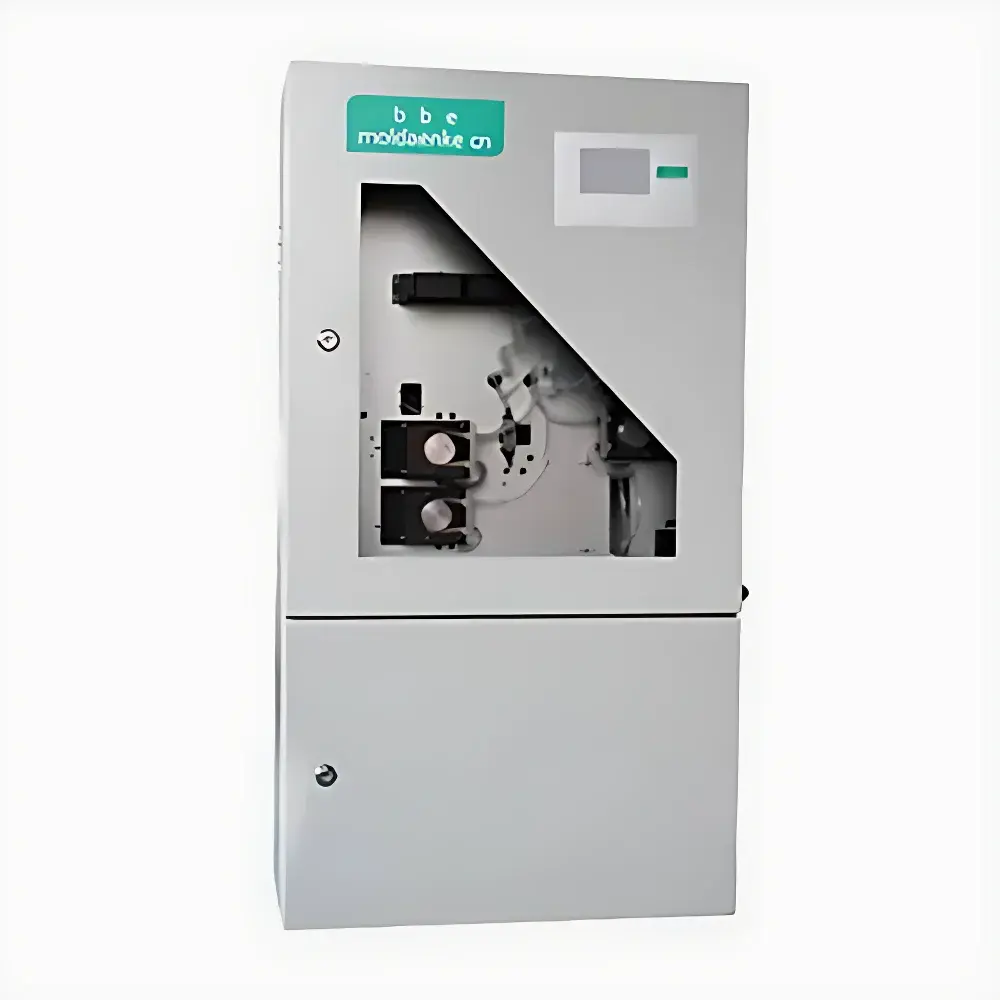
BBE BG00750001 Online Total Phenol Analyzer
| Brand | BBE / bbe Moldaenke |
|---|---|
| Origin | Shanghai, China |
| Manufacturer Type | Original Equipment Manufacturer (OEM) |
| Country of Origin | China |
| Model | BG00750001 |
| Instrument Type | Online Volatile Phenol Analyzer |
| Output Interfaces | 4–20 mA, RS232/RS485, MODBUS RTU/TCP, Ethernet (optional) |
Overview
The BBE BG00750001 Online Total Phenol Analyzer is a fully automated, continuous-monitoring instrument engineered for reliable quantification of total phenolic compounds—including volatile phenols—in aqueous environmental matrices. It operates on the principle of colorimetric detection following acid-catalyzed diazotization and coupling with 4-aminoantipyrine (4-AAP), a method aligned with ISO 6439, ASTM D1788, and EPA Method 420.1 for phenol determination. Unlike discrete lab-based spectrophotometers, this system integrates sample conditioning, reagent dosing, reaction incubation, optical measurement, and waste handling within a single robust architecture—designed for unattended operation in demanding field or plant environments. Its core measurement cycle is programmable from 15 minutes to 24 hours, enabling optimization for regulatory compliance monitoring (e.g., discharge permits) or process control applications where real-time trend analysis is critical.
Key Features
- Fully automated operation with integrated auto-calibration (using certified phenol standard solutions) and manual calibration capability for traceability verification.
- Detection limit ≤ 1 µg/L as phenol (typical), validated per ISO/IEC 17025-compliant internal protocols; reproducibility < ±3% RSD at 10 µg/L under continuous operation.
- High-precision peristaltic pumping system with PTFE/silicone tubing and pressure-compensated flow control ensures consistent sample/reagent delivery and minimizes carryover between cycles.
- Modular hardware design enables field-replaceable modules—including digestion, reaction, photometric cell, and fluidic manifolds—reducing mean time to repair (MTTR) and supporting future range extension (e.g., 0–5 mg/L or 0–50 mg/L).
- 7-inch capacitive touchscreen HMI with multilingual UI (English, Spanish, German, Chinese), intuitive workflow navigation, and embedded diagnostic logs.
- Comprehensive fault management: real-time error logging, audible/visual alarms for low reagent, clogged line, optical path contamination, power interruption, and automatic recovery upon power restoration.
Sample Compatibility & Compliance
The BG00750001 accepts raw or filtered water samples with turbidity ≤ 100 NTU and suspended solids ≤ 50 mg/L. It is validated for use with surface water, drinking water distribution systems, municipal wastewater influent/effluent, and industrial effluents containing common interferents (e.g., sulfides, nitrites, oxidants) when operated with built-in interference compensation routines. The analyzer complies with EN 14181 (QAL1/QAL2 requirements for automated monitoring systems), supports GLP/GMP data integrity principles, and provides full audit trail functionality—including user action logs, calibration records, and measurement history—with optional 21 CFR Part 11-compliant electronic signature module.
Software & Data Management
Embedded firmware supports dual-mode communication: analog 4–20 mA output (linear or square-root scaled) for PLC/SCADA integration, and digital protocols including MODBUS RTU (RS485), MODBUS TCP (Ethernet), and ASCII over RS232. Local data storage retains ≥ 30 days of 15-minute interval results with timestamps, QC flags, and status codes. Remote access via secure HTTP/HTTPS enables configuration updates, firmware upgrades, and live diagnostics. Optional BBE AnalyzeCloud™ platform provides centralized fleet monitoring, predictive maintenance alerts, and automated report generation aligned with ISO 14001 or ISO 50001 reporting frameworks.
Applications
- Continuous compliance monitoring at wastewater treatment plant discharge points per national emission standards (e.g., China’s GB 3838–2002, EU Urban Wastewater Treatment Directive).
- Early-warning detection of phenolic contamination in drinking water sources downstream of petrochemical, pharmaceutical, or resin manufacturing facilities.
- Process optimization in activated sludge or advanced oxidation units where phenol load correlates with biodegradation efficiency or oxidant demand.
- Long-term trend analysis in river basin management programs tracking agricultural runoff or legacy industrial site leachate.
- Support for ISO 14064-1 greenhouse gas inventory calculations where phenol removal efficiency informs indirect emissions modeling.
FAQ
What phenolic compounds does the BG00750001 quantify?
It measures total phenol equivalents based on the 4-AAP reaction, responding to mono-substituted phenols (e.g., phenol, cresols, xylenols) and some di-substituted derivatives—but not chlorinated or nitrophenols without prior hydrolysis.
Is sample filtration required prior to analysis?
Yes; particulate matter > 50 µm must be removed using a 40–60 µm inline filter to prevent manifold blockage and optical cell fouling.
Can the analyzer operate in hazardous areas (ATEX Zone 2)?
The base unit is rated IP65 for outdoor cabinet installation; explosion-proof variants with ATEX/IECEx certification are available upon request with customized enclosure and purge systems.
How often must reagents be replenished?
At 1-hour measurement intervals, typical reagent consumption is ~1.2 L/month per reagent channel (acid, diazotizing agent, 4-AAP); onboard level sensors trigger low-reagent alarms 72 hours in advance.
Does the system support remote calibration verification using NIST-traceable standards?
Yes; the protocol allows injection of external certified reference materials (CRMs) via the sample inlet port, with results automatically flagged and stored separately from routine measurements for QA/QC review.







