
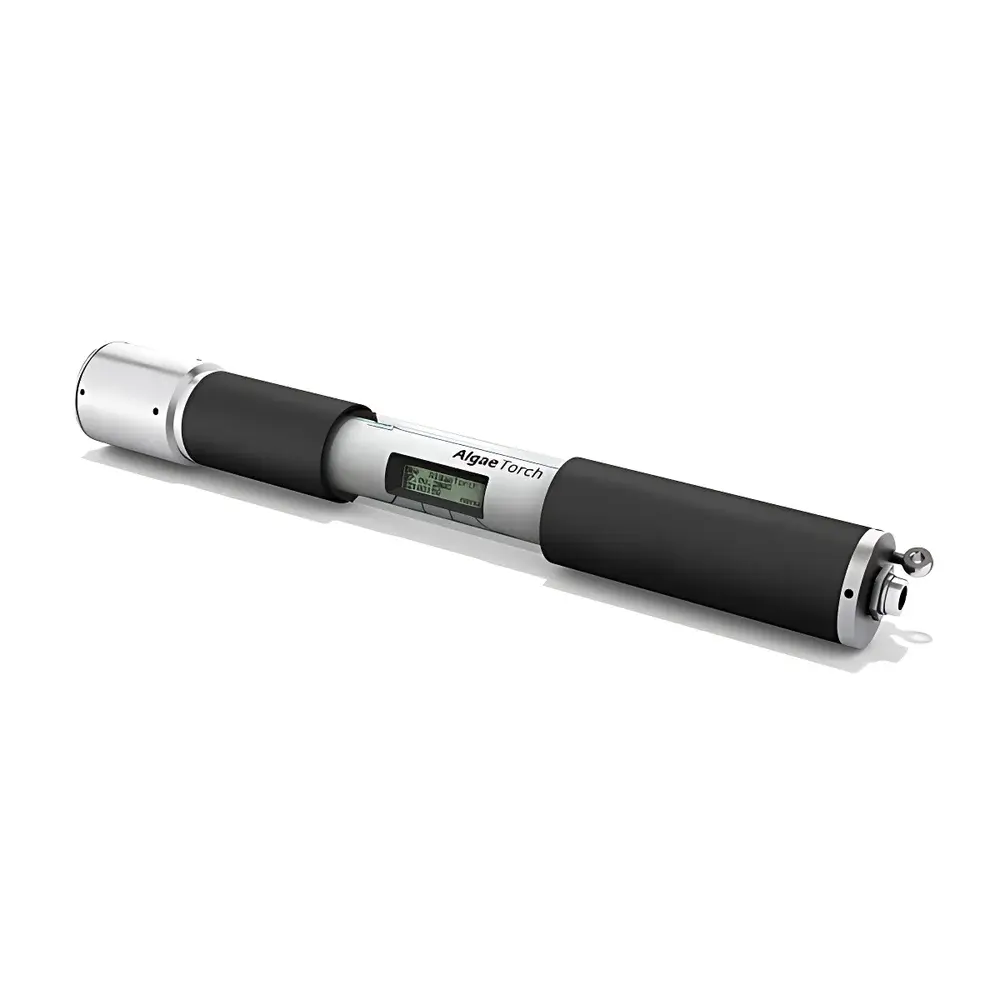
BBE Algae Torch Portable Chlorophyll a and Cyanobacteria Analyzer
| Brand | BBE / bbe Moldaenke |
|---|---|
| Origin | Germany |
| Manufacturer | Yes |
| Import Status | Imported |
| Model | Algae Torch |
| Measurement Parameters | Total Chlorophyll a (0–500 µg/L), Cyanobacterial Density, Turbidity (0–200 NTU), GPS Coordinates |
| Detection Time | <20 s |
| Resolution | 0.1 µg/L (Chl-a) |
| LOD | 0.15 µg/L |
| Excitation Wavelengths | 470 nm, 526 nm, 610 nm |
| Weight | 1.3 kg |
| Dimensions (H × Ø) | 500 mm × 60 mm × 68 mm |
| Power Supply | Internal Rechargeable Battery (AC Adapter: 110/240 V, 50/60 Hz) |
| Operating Temperature | 0–35 °C |
| Storage Temperature | 0–50 °C |
| IP Rating | IP68 |
| Depth Rating | 10 m (standard), 100 m (optional version) |
| Data Storage | 2000 measurements |
| Interface | USB |
| Software | bbe++ for Windows |
| Accessories | 10-m rope, telescopic pole, nylon backpack, underwater data cable extensions (10–30 m), sensor performance kits |
Overview
The BBE Algae Torch Portable Chlorophyll a and Cyanobacteria Analyzer is an in-situ, field-deployable fluorometric instrument engineered for real-time, quantitative assessment of phytoplankton biomass in natural and engineered water bodies. It operates on the principle of in vivo chlorophyll a fluorescence excitation and spectral deconvolution—leveraging three discrete LED excitation wavelengths (470 nm, 526 nm, and 610 nm) to selectively stimulate photosynthetic pigments and distinguish cyanobacterial contributions from total algal biomass. Unlike laboratory-based spectrophotometric or HPLC methods, the Algae Torch eliminates sample filtration, extraction, and solvent handling, enabling direct immersion measurement with no pre-treatment required. Its optical architecture incorporates automatic turbidity compensation up to 200 NTU, ensuring robust performance in highly scattering waters such as eutrophic lakes, reservoirs, and estuarine environments. Designed for compliance with field monitoring protocols aligned with ISO 10260 (water quality — determination of chlorophyll a by fluorescence), the device delivers traceable, repeatable results under variable ambient light and temperature conditions (0–35 °C).
Key Features
- True in-situ quantification of total chlorophyll a (0–500 µg/L) and cyanobacterial cell density in less than 20 seconds per measurement
- Triple-wavelength excitation (470 nm, 526 nm, 610 nm) enables spectral discrimination between cyanobacteria and other phytoplankton groups based on phycobiliprotein and chlorophyll fluorescence signatures
- Integrated GPS module records georeferenced coordinates for spatial mapping and time-series correlation; exported directly to KML for visualization in Google Earth
- IP68-rated housing with depth capability up to 100 m (with optional pressure-compensated variant), validated per IEC 60529 standards
- Self-contained rechargeable battery system supports >8 hours of continuous operation; AC adapter included for benchtop charging (110/240 V, 50/60 Hz)
- Onboard memory stores up to 2000 complete measurement sets—including Chl-a, cyanobacteria density, turbidity, timestamp, GPS location, and instrument diagnostics
- Automatic turbidity correction algorithm mitigates scattering interference without user calibration or reference blanks
- Compact form factor (500 × 60 × 68 mm, 1.3 kg) optimized for handheld use, boat deployment, or integration with profiling systems and autonomous platforms
Sample Compatibility & Compliance
The Algae Torch is validated for direct immersion in freshwater, brackish, and low-salinity marine environments. It requires no reagents, filters, or consumables and is compatible with all common water matrices—including turbid reservoir inflows, stratified lake epilimnia, wastewater effluents, and aquaculture recirculation systems. The instrument meets design and performance criteria referenced in ASTM D3731 (Standard Practice for Determination of Phytoplankton Pigments by Fluorometry), EPA Method 445.0 (In Vivo Chlorophyll a Fluorescence), and EU Water Framework Directive (WFD) monitoring guidelines for phytoplankton community assessment. Its firmware supports audit-trail logging and timestamped data export, facilitating GLP-compliant field reporting and regulatory submission workflows.
Software & Data Management
Data acquisition and post-processing are managed via bbe++ software—a native Windows application supporting configuration, real-time telemetry display, batch export, and geospatial visualization. Measurements appear as time-stamped concentration profiles overlaid on interactive maps; spectral response curves and raw fluorescence intensity values are accessible for method validation. Export formats include CSV (for Excel and statistical packages), TXT (ASCII-compatible), and KML (Google Earth integration). All files retain embedded metadata: instrument serial number, firmware version, GPS coordinates, depth, temperature, and operator ID. The software enforces secure user authentication and maintains immutable logs compliant with FDA 21 CFR Part 11 requirements when configured with digital signature modules.
Applications
- Early-warning monitoring of cyanobacterial blooms in drinking water source reservoirs and recreational lakes
- Long-term limnological surveys tracking seasonal phytoplankton succession and trophic state transitions
- Regulatory compliance sampling for WFD Article 8 reporting and national lake monitoring programs
- Field validation of satellite-derived chlorophyll products (e.g., Sentinel-3 OLCI, Landsat-8 OLI)
- Research-grade calibration of fixed-location buoy networks and autonomous gliders
- Educational demonstrations of in vivo fluorescence principles and aquatic ecosystem dynamics
- Rapid response assessments during algal toxicity events or post-storm runoff episodes
FAQ
Does the Algae Torch require calibration with standard solutions before each use?
No. The instrument performs factory calibration traceable to NIST-certified chlorophyll a standards. Field verification is recommended quarterly using a certified reference suspension; full recalibration is performed at authorized BBE service centers.
Can the device differentiate Microcystis from Anabaena or other cyanobacteria genera?
It quantifies total cyanobacterial density based on phycocyanin fluorescence but does not resolve genus-level taxonomy. For taxonomic identification, complementary microscopy or molecular analysis is required.
Is the GPS module accurate enough for precise spatial mapping?
Yes. The integrated GPS achieves ≤3 m horizontal accuracy (CEP) under open-sky conditions and embeds latitude, longitude, altitude, and UTC timestamp in every measurement record.
How is turbidity compensation implemented optically?
A dedicated 610 nm excitation channel measures background scattering interference; this signal is subtracted algorithmically from the primary chlorophyll and phycocyanin channels prior to concentration calculation.
What maintenance is required for long-term field deployment?
Routine cleaning of the optical windows with deionized water and soft lint-free cloth is sufficient. Pressure housing O-rings should be inspected and lubricated annually per BBE Maintenance Protocol No. MT-ALG-07.







