
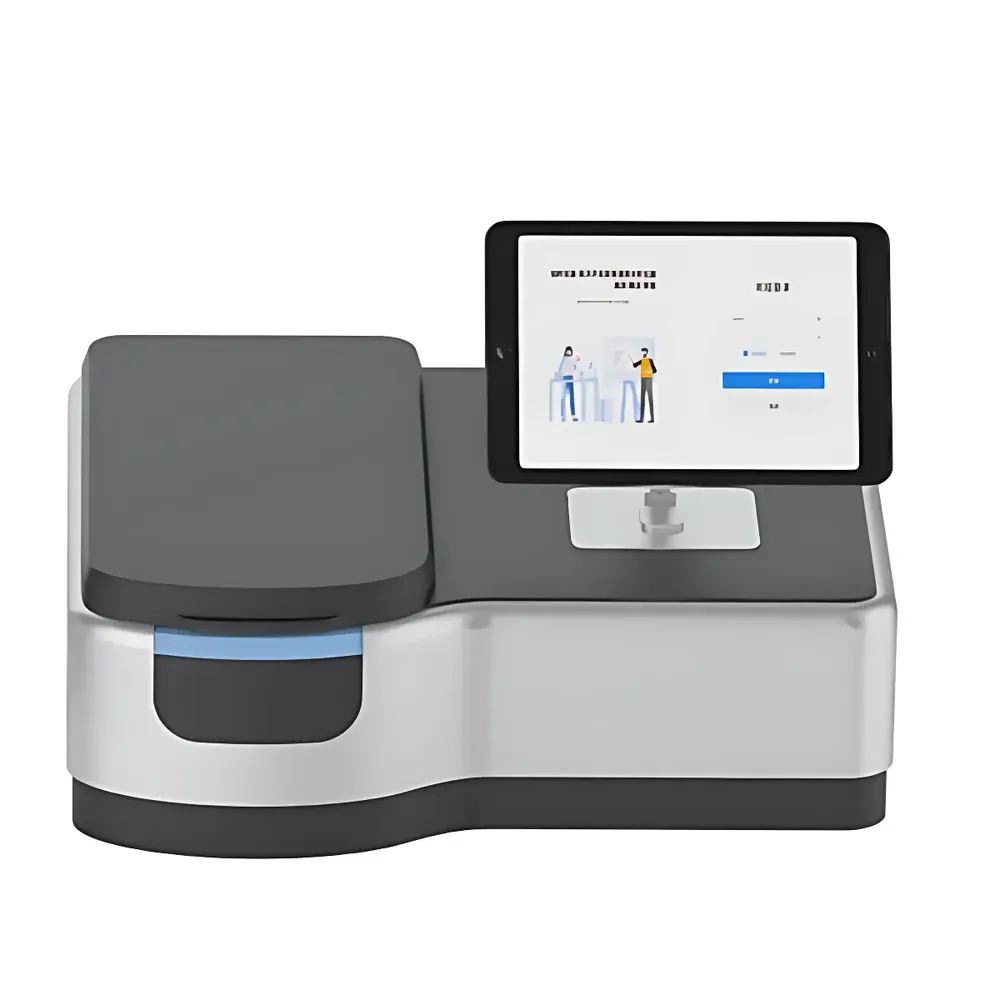
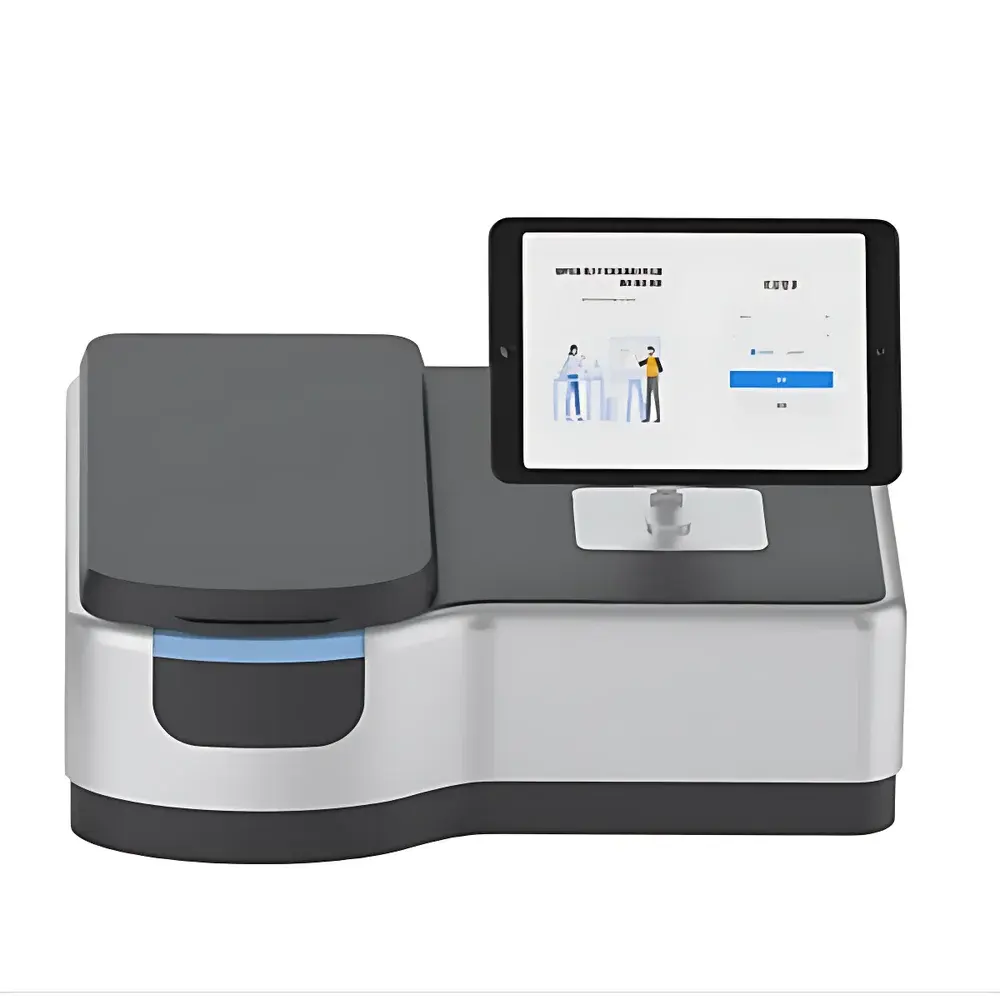
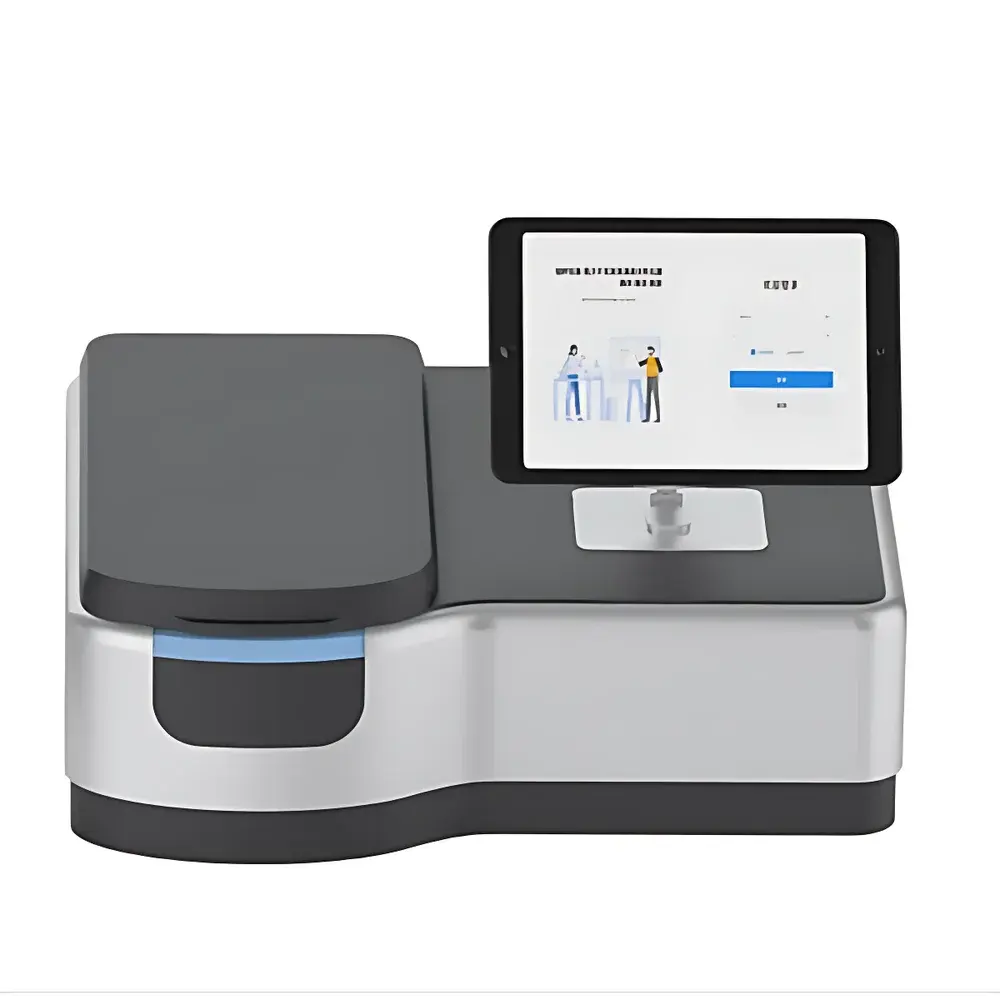
Yoke M8 Xenon Lamp UV-Vis Spectrophotometer
| Brand | Yoke |
|---|---|
| Origin | Shanghai, China |
| Model | M8 |
| Optical System | Double-beam |
| Detector | Photomultiplier Tube (PMT) |
| Wavelength Range | 190–1100 nm |
| Wavelength Accuracy | ±0.3 nm |
| Wavelength Repeatability | ≤0.1 nm |
| Spectral Bandwidth | 1 nm |
| Stray Light | ≤0.03% T (at 220 nm, NaI solution) |
| Absorbance Resolution | 0.00001 Abs |
| Absorbance Range | –4 to +4 Abs |
| Light Sources | Deuterium lamp + Tungsten-halogen lamp |
| Automation | Motorized wavelength scanning, auto-zero, auto-calibration |
| Connectivity | Bluetooth 5.0, Wi-Fi, cloud-enabled IoT architecture |
| Display | Integrated 11-inch 2.8K resolution tablet with touch interface |
Overview
The Yoke M8 Xenon Lamp UV-Vis Spectrophotometer is a high-performance double-beam spectrophotometric platform engineered for precision quantitative and qualitative analysis across research laboratories, quality control environments, and environmental monitoring facilities. Unlike conventional instruments relying solely on deuterium/tungsten dual-lamp systems, the M8 integrates a stabilized xenon flash lamp as its primary broadband source—enabling rapid, stable, and drift-free spectral acquisition without mechanical lamp switching. This architecture eliminates intensity discontinuities at the deuterium–tungsten crossover region (~350 nm), ensuring seamless baseline integrity across the full 190–1100 nm range. The optical design employs Czerny–Turner monochromator geometry with holographic grating, optimized for minimal aberration and high throughput. Coupled with a low-noise photomultiplier tube (PMT) detector and real-time reference beam correction, the system delivers exceptional photometric stability (<0.0003 Abs/h at 500 nm) and high signal-to-noise ratio—critical for trace-level quantitation and kinetic studies requiring sub-second temporal resolution.
Key Features
- Integrated 11-inch 2.8K resolution tablet with capacitive multi-touch interface, supporting automatic language switching (English/Chinese) and Bluetooth 5.0 pairing for seamless peripheral integration.
- True double-beam optics with real-time reference compensation, minimizing errors from source fluctuation, detector drift, or environmental temperature variation.
- Advanced photometric resolution of 0.00001 Abs—enabling reliable detection of minute absorbance changes in enzymatic assays, low-concentration nucleic acid quantification, and thin-film optical density profiling.
- Automated wavelength scanning, zeroing, and calibration routines compliant with ISO 6223 and ASTM E275-22 guidelines for spectrophotometric validation.
- IoT-ready architecture with secure TLS 1.2 encrypted data transmission; supports remote diagnostics, firmware over-the-air (FOTA) updates, and audit-trail–enabled operation logs aligned with GLP/GMP documentation requirements.
- Modular accessory ecosystem including Peltier-controlled cuvette holders (±0.1 °C stability), integrating sphere for diffuse reflectance (4–95% R), variable-pathlength cells (0.1–100 mm), and solid-sample holders with adjustable incidence angles (0°–85°).
Sample Compatibility & Compliance
The M8 accommodates standard 10-mm square quartz or fused-silica cuvettes, microvolume platforms (down to 0.5 µL), and specialized sample geometries including thin films, powders, and opaque solids via reflection accessories. Its optical path is compatible with all common solvent systems—including aggressive organics (e.g., chloroform, DMF) and aqueous buffers—without degradation of PMT sensitivity. The instrument meets IEC 61010-1 safety standards for laboratory electrical equipment and conforms to electromagnetic compatibility (EMC) requirements per EN 61326-1. Data integrity protocols support 21 CFR Part 11-compliant electronic signatures when deployed with validated third-party LIMS or ELN integrations. Routine performance verification follows NIST-traceable SRM 930e (neutral density filters) and SRM 2034 (UV transmission standards).
Software & Data Management
Embedded software provides native support for all core UV-Vis methodologies: fixed-wavelength photometry, single/multi-point quantitative analysis (with linear, quadratic, and cubic calibration models), time-resolved kinetics (up to 100 spectra/sec), full-spectrum scanning (1–5 nm/s), spectral derivative analysis, and 3D contour mapping (wavelength × time × absorbance). Raw spectral data exports in ASTM E131-compliant .jdx format, as well as CSV and XML for interoperability with MATLAB, Python (SciPy), and commercial chemometrics packages. Multi-tier user authentication (administrator, analyst, viewer) enforces role-based access control; all method edits, measurement executions, and report generations are timestamped and cryptographically signed within an immutable audit trail.
Applications
- Pharmaceutical QC: USP and EP 2.2.25-compliant assay of active pharmaceutical ingredients (APIs), dissolution testing, and excipient interference screening.
- Environmental analysis: Quantification of nitrate, phosphate, COD, and heavy metal complexes (e.g., Cr(VI)–diphenylcarbazide) per EPA Methods 353.2, 365.1, and 4500-P E.
- Biomolecular characterization: A260/A280 and A260/A230 ratios for nucleic acid purity assessment; Bradford/Lowry/BCA protein assays; enzyme kinetics (e.g., LDH, ALP) under controlled thermal conditions.
- Materials science: Bandgap determination of semiconductors (Tauc plot analysis), thin-film thickness modeling via interference fringe analysis, and pigment dispersion stability evaluation.
- Academic teaching labs: Modular experiment templates aligned with ACS undergraduate curriculum standards for spectroscopic fundamentals and analytical method validation.
FAQ
Does the M8 support regulatory-compliant data archiving for FDA submissions?
Yes—when configured with validated network storage and electronic signature modules, the M8 generates ALCOA+ (Attributable, Legible, Contemporaneous, Original, Accurate, Complete, Consistent, Enduring, Available) compliant records meeting FDA 21 CFR Part 11 and EU Annex 11 expectations.
Can the xenon lamp be replaced in the field without optical realignment?
Yes—the lamp module is pre-aligned and factory-calibrated; replacement requires only mechanical insertion and software-initiated intensity normalization using built-in reference standards.
Is spectral bandwidth adjustable during measurement?
No—the fixed 1 nm spectral bandwidth is optimized for resolution–throughput balance per ISO 9220 and ensures reproducible compliance with pharmacopoeial monographs specifying bandwidth limits.
What validation documentation is supplied with the instrument?
Each unit ships with a Factory Acceptance Test (FAT) report, NIST-traceable wavelength and photometric accuracy certificates, and a comprehensive IQ/OQ protocol template compliant with ISO/IEC 17025 and GxP frameworks.
How does the M8 handle stray light correction in low-transmittance measurements?
Stray light is minimized optically via double-monochromator design and corrected mathematically using the instrument’s embedded Bouguer–Lambert law solver, which applies iterative correction coefficients derived from NaI (220 nm) and KCl (198 nm) reference measurements.
Related Products





