
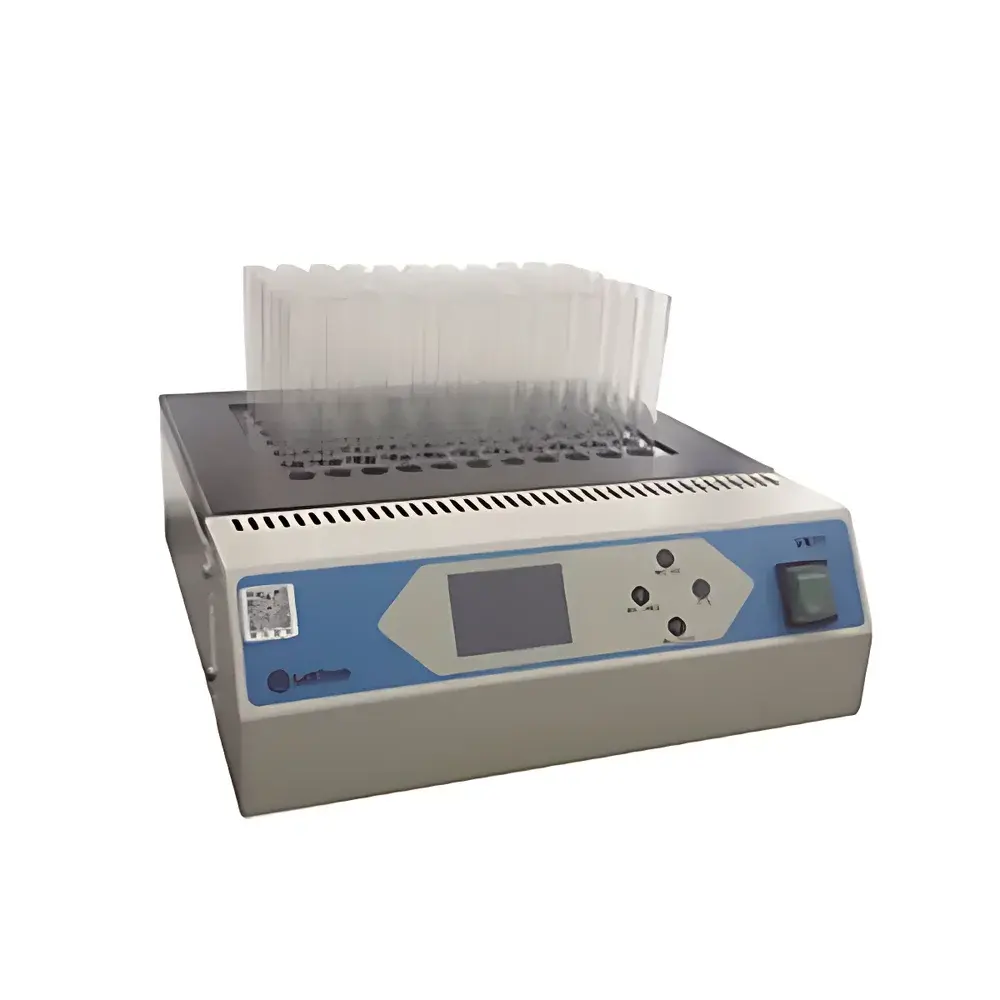
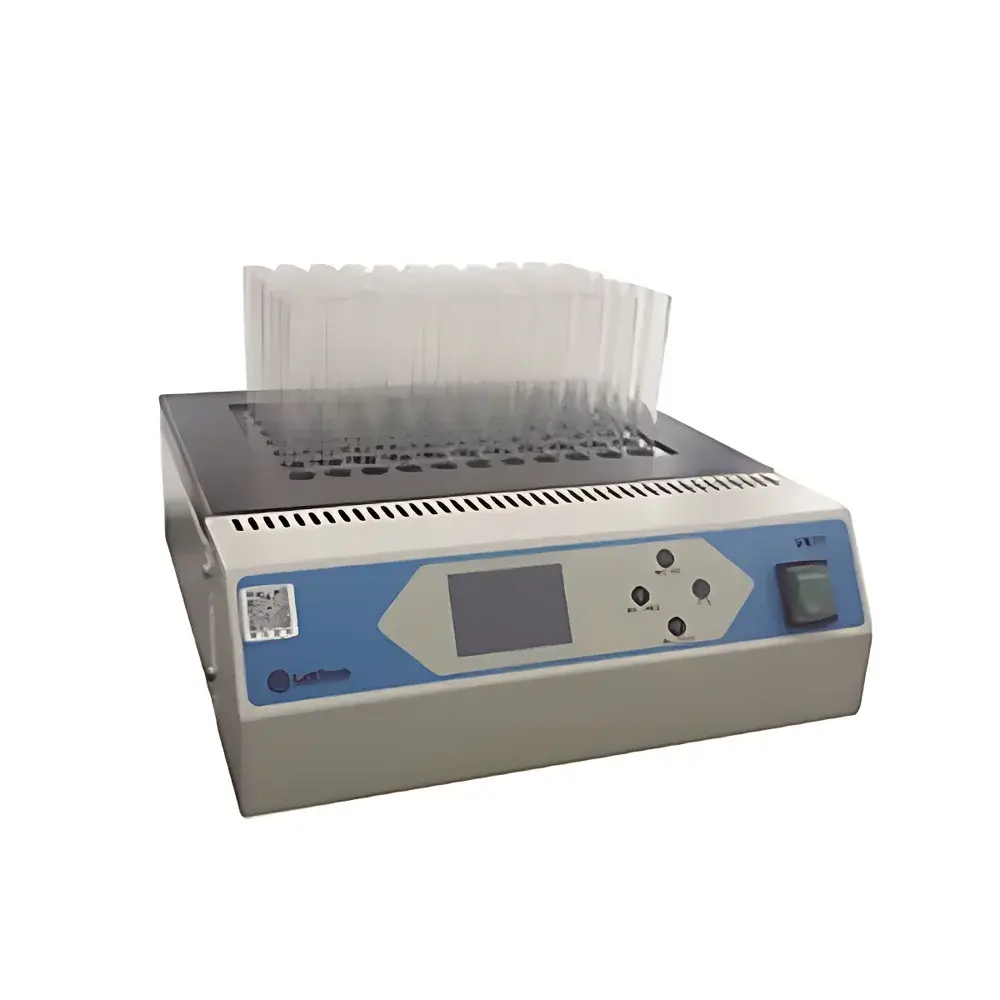
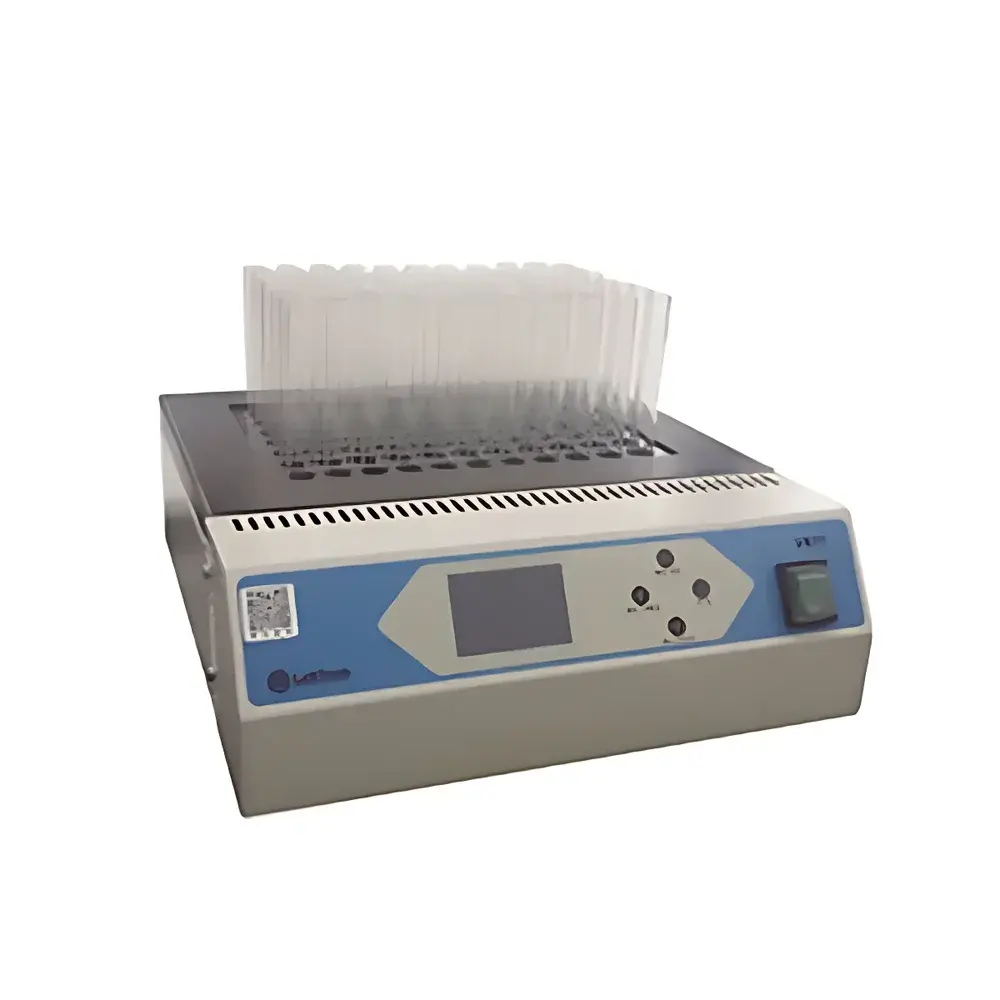
LabTech VB77 Urinary Iodine Digestion System
| Brand | LabTech |
|---|---|
| Origin | Beijing, China |
| Model | VB77 |
| Instrument Type | Electric Heating Digestion System |
| Automation Level | Semi-Automatic |
| Sample Capacity | 77 positions |
| Tube Format | 16 mm OD borosilicate glass test tubes |
| Heating Method | Surround-type (360° circumferential) resistive heating |
| Temperature Range | Ambient to 180 °C (adjustable in 1 °C increments) |
| Temperature Uniformity | ≤ ±1 °C between wells at 100 °C |
| Temperature Control | Intelligent PID algorithm with real-time feedback and dual-sensor monitoring |
| Timing Function | Programmable timer (1 min – 99 h 59 min) |
| Compliance | Designed to meet WS/T 107.1–2016, GB/T 5750.5–2006, and ASTM D1252 for COD digestion |
Overview
The LabTech VB77 Urinary Iodine Digestion System is a purpose-engineered semi-automatic electric heating digestion instrument optimized for high-throughput, standardized sample preparation in occupational health and public health laboratories. It implements a surround-type (360° circumferential) resistive heating architecture, where thermal energy is uniformly distributed around each 16 mm OD borosilicate test tube—eliminating radial thermal gradients common in conventional block heaters. This design, combined with an intelligent dual-sensor PID temperature control system, ensures exceptional spatial and temporal thermal stability: ≤ ±1 °C well-to-well temperature deviation at 100 °C, a critical performance benchmark for iodine recovery consistency in urinary matrices per WS/T 107.1–2016. The VB77 operates within a calibrated range of ambient to 180 °C, supporting not only iodine-specific acid digestion (e.g., HNO₃/H₂SO₄ or alkaline persulfate oxidation) but also standardized protocols for chemical oxygen demand (COD) analysis per ASTM D1252 and water quality testing per GB/T 5750.5–2006.
Key Features
- 77-position high-capacity digestion block engineered for batch processing of urinary samples—significantly reducing turnaround time in large-scale epidemiological screening programs.
- Circumferential heating geometry with embedded thermal shielding minimizes convective loss and enhances heat transfer efficiency to the tube wall, improving digestion reproducibility across all positions.
- Intelligent PID temperature regulation with real-time dual-point sensing (block surface + internal reference zone) delivers rapid thermal equilibration and sustained setpoint adherence under load variation.
- Programmable digital timer (1 minute to 99 hours 59 minutes) enables unattended operation; auto-shutdown prevents over-digestion and supports GLP-compliant workflow continuity.
- Robust stainless-steel housing with corrosion-resistant coating withstands prolonged exposure to aggressive reagents (e.g., concentrated nitric acid, sulfuric acid, persulfate solutions).
- Front-panel interface with LED display and tactile keypad allows intuitive parameter entry without reliance on external software—ideal for regulated environments requiring audit-trail simplicity.
Sample Compatibility & Compliance
The VB77 is validated for use with standard 16 mm outer diameter borosilicate glass test tubes (e.g., Kimble Chase 9826 or equivalent), accommodating typical urine sample volumes of 0.5–2.0 mL. Its thermal profile satisfies the mandatory digestion conditions specified in WS/T 107.1–2016 (“Determination of iodine in urine — Spectrophotometric method”) and aligns with the heating ramp and hold requirements of GB/T 5750.5–2006 (“Standard examination methods for drinking water — Inorganic nonmetallic indicators”). For COD applications, it meets the 150 °C / 2-hour reflux condition outlined in ASTM D1252–22 (Method B). While the instrument itself does not generate electronic records, its deterministic timer and fixed-setpoint operation support manual logbook documentation compliant with ISO/IEC 17025:2017 clause 7.7 (control of data and information management).
Software & Data Management
The VB77 operates as a standalone hardware platform with no embedded operating system or network connectivity. All operational parameters—including target temperature, dwell time, and start delay—are entered directly via the front-panel interface and retained in non-volatile memory during power cycling. No proprietary software installation is required, eliminating cybersecurity vulnerabilities and compatibility dependencies. For laboratories implementing electronic laboratory notebooks (ELN) or LIMS integration, the device’s deterministic behavior (repeatable time/temperature profiles) allows full traceability through manual entry of run parameters into validated systems. Audit trails remain under user control, consistent with FDA 21 CFR Part 11 principles when paired with procedural controls for operator authentication and record review.
Applications
- Urinary iodine quantification in population-based nutrition surveillance and occupational health monitoring.
- Pre-analytical digestion for inductively coupled plasma mass spectrometry (ICP-MS) or inductively coupled plasma optical emission spectrometry (ICP-OES) analysis of trace iodine.
- COD determination in wastewater, drinking water, and environmental samples using dichromate reflux methodology.
- Acid digestion of biological fluids prior to colorimetric or electrochemical iodine detection (e.g., cerium arsenite or Sandell–Kolthoff reaction).
- Controlled thermal decomposition of organic matrices in food safety testing (e.g., iodized salt, dairy, seafood).
FAQ
What tube size is compatible with the VB77?
The VB77 accepts standard 16 mm outer diameter borosilicate glass test tubes—no adapters or modifications required.
Does the VB77 support method validation per CLIA or CAP guidelines?
While the VB77 is not a clinical analyzer, its thermal uniformity (≤ ±1 °C at 100 °C) and programmable timing enable consistent execution of validated digestion protocols referenced in CLIA-waived or moderately complex testing workflows.
Can the VB77 be used for microwave-assisted digestion?
No—the VB77 is a conductive/resistive heating system only; it does not incorporate microwave energy generation or cavity design.
Is calibration certificate included with shipment?
A factory-issued temperature verification report (at 100 °C and 150 °C) is provided; users are responsible for periodic in-house verification per ISO/IEC 17025 or internal SOPs.
How is maintenance performed on the heating block?
The block requires no routine lubrication or consumable replacement; cleaning is limited to wiping residual acid with damp lint-free cloth after cooling—avoid abrasive agents or submersion.



