
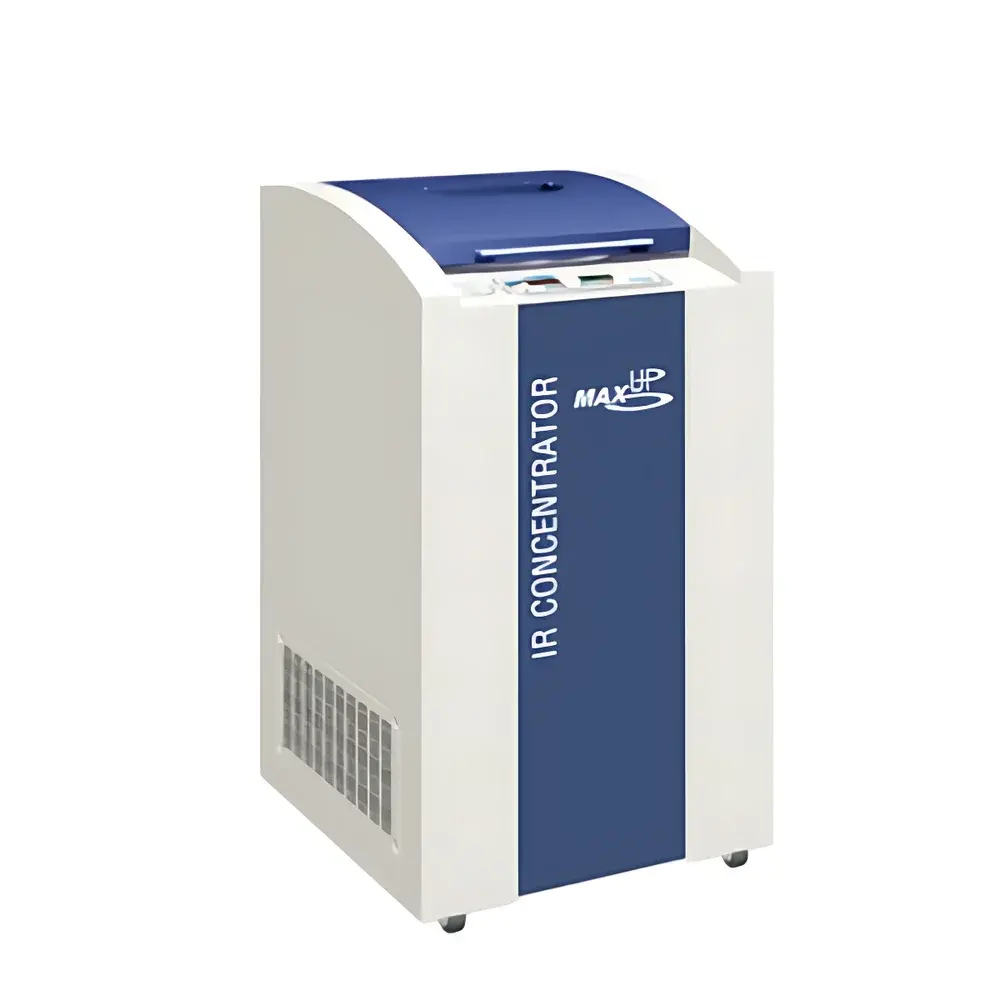
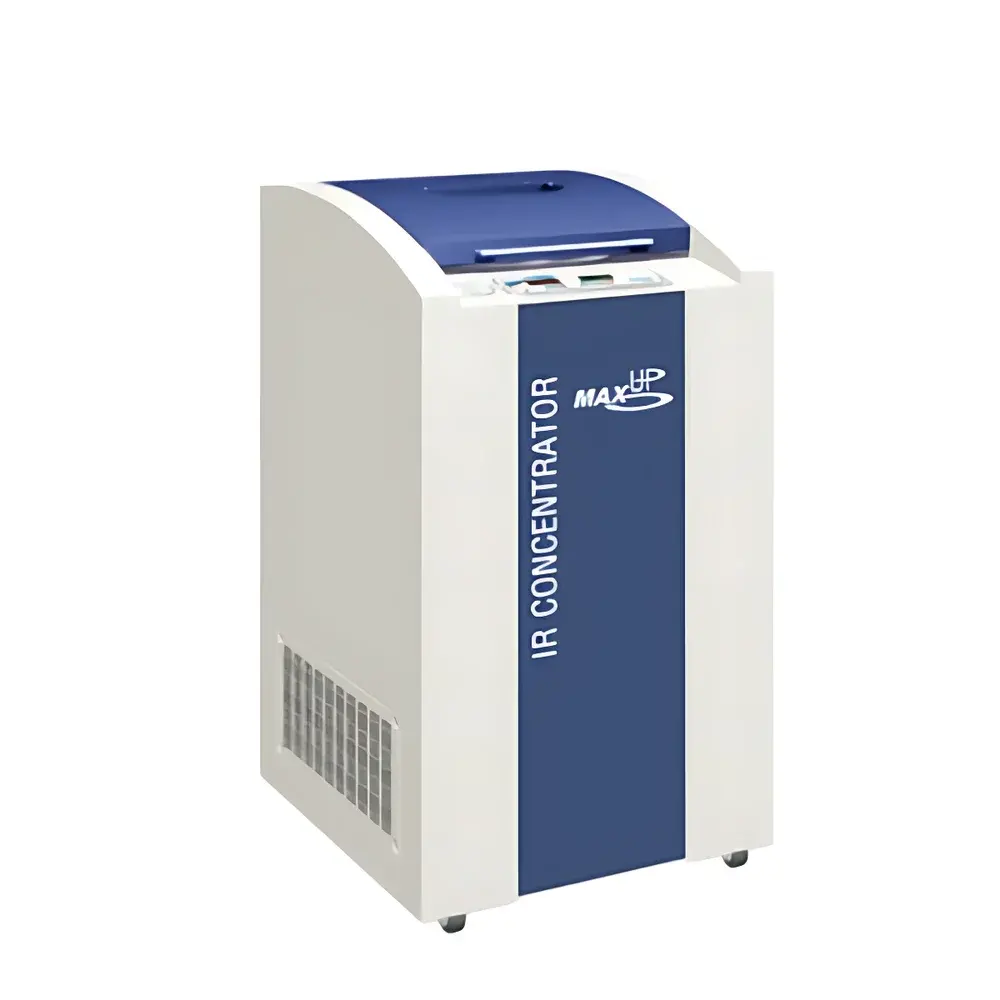
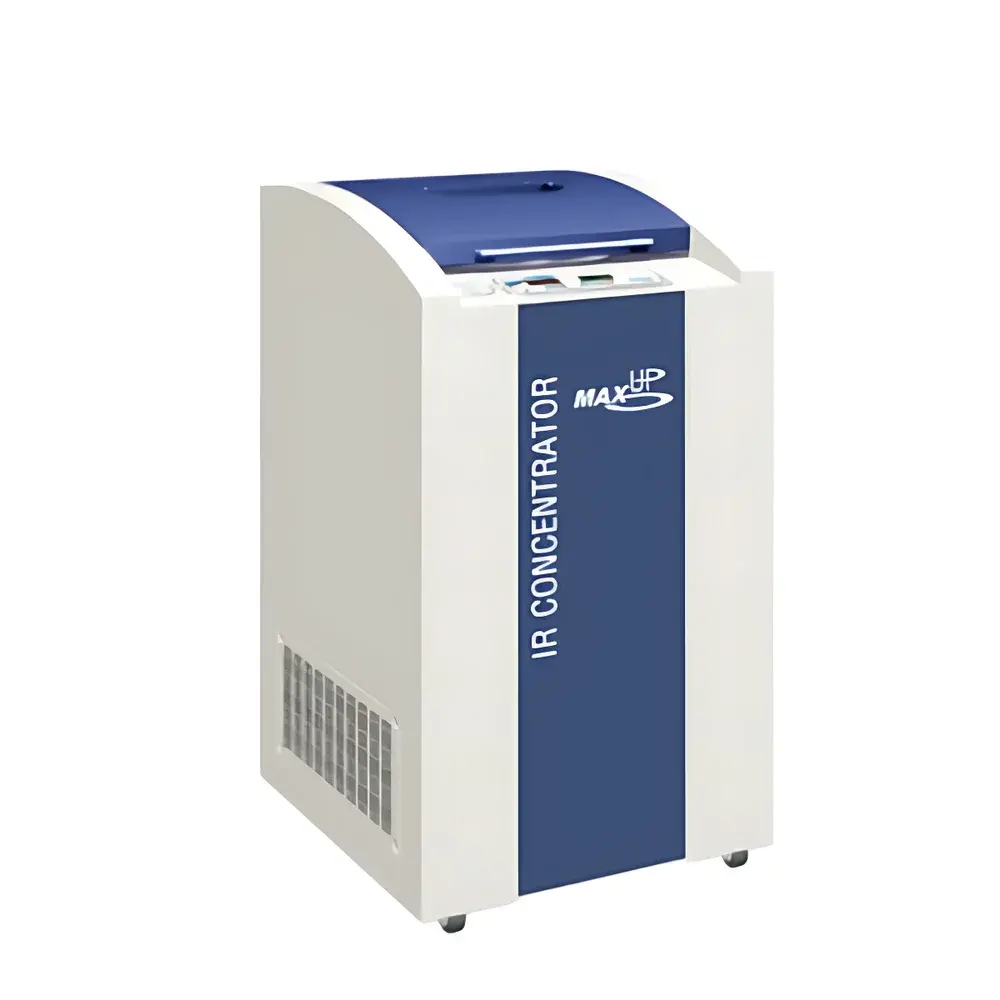
WIGGENS WB-504C Cryo Vacuum Centrifugal Concentrator
| Brand | WIGGENS |
|---|---|
| Origin | Germany |
| Model | WB-504C |
| Instrument Type | Vacuum Centrifugal Concentrator |
| Temperature Range | 4–80 °C |
| Temperature Control Accuracy | ±0.1 °C |
| Sample Capacity | 250 mL × 4 positions |
| Rotational Speed | ≤1500 rpm |
| Ultimate Vacuum | ≥2 mbar |
| Cold Trap | −20 °C, 2 L collection volume |
| Dimensions (W×D×H) | 600 × 630 × 1085 mm |
| Weight | 138 kg |
| Power Supply | 220 V, 50/60 Hz |
Overview
The WIGGENS WB-504C Cryo Vacuum Centrifugal Concentrator is an integrated benchtop system engineered for efficient, gentle, and reproducible concentration and drying of biological and chemical samples under reduced pressure and controlled temperature. It combines simultaneous centrifugation, vacuum application, infrared radiation heating, and active cold trapping to accelerate solvent removal while preserving thermolabile analytes—including proteins, nucleic acids (DNA/RNA), peptides, enzymes, hormones, and small-molecule metabolites. Unlike conventional rotary evaporators or nitrogen blow-down systems, the WB-504C employs a dual-sensor PID-controlled thermal architecture with spatially localized infrared irradiation focused exclusively on the liquid surface—minimizing bulk heating and thermal degradation. Its built-in PTFE-coated diaphragm vacuum pump and integrated −20 °C cold trap ensure continuous vapor condensation and stable vacuum conditions, eliminating backstreaming and enabling high-yield recovery of volatile solvents such as ethanol, methanol, acetonitrile, and ethyl acetate.
Key Features
- Gentle infrared heating via a quartz-glass lid: delivers directional radiant energy only to the sample surface, reducing thermal stress on heat-sensitive biomolecules.
- Dual independent temperature sensors: one in the chamber wall and one embedded in the rotor bucket, enabling real-time feedback control and uniform thermal management across all sample positions.
- Automatic rotor imbalance detection: continuously monitors rotational dynamics during operation and triggers immediate deceleration if mass asymmetry exceeds safety thresholds—ensuring operator safety and mechanical integrity.
- Predetermined pre-heating mode: allows users to activate chamber warming prior to sample loading, significantly reducing total process time without compromising temperature stability.
- Centralized vacuum inlet design: located at the top of the central shaft to prevent cross-contamination between samples and minimize aerosol carryover or sample loss during evaporation.
- Compact, self-contained architecture: integrates a corrosion-resistant PTFE diaphragm pump (WIGGENS C610) and a 2 L cryogenic condenser—eliminating external pump dependencies and optimizing footprint for regulated laboratory environments.
Sample Compatibility & Compliance
The WB-504C accommodates diverse sample formats through interchangeable rotors: up to 132 × 1.5 mL microtubes, 12 × 15 mL conical tubes, 8 × 50 mL tubes, 4 × 250 mL bottles, or dual 96-well plates. All rotor assemblies are precision-balanced and certified for use at ≤1500 rpm under vacuum. The system complies with IEC 61010-1 for electrical safety and meets CE marking requirements for laboratory instrumentation. Its closed-loop vacuum and condensation pathway supports GLP/GMP-aligned workflows where traceability, contamination control, and process consistency are critical—particularly in nucleic acid purification, proteomics sample preparation, and pharmaceutical stability testing per USP and ISO/IEC 17025 guidelines.
Software & Data Management
Operation is managed via an intuitive LED touchscreen interface with tactile feedback and multilingual support (English, German, French, Spanish). All parameters—including setpoints, actual values, runtime, vacuum level, and error logs—are timestamped and stored internally for ≥10,000 cycles. Optional RS232/USB data export enables integration with LIMS or electronic lab notebooks. Audit trail functionality satisfies FDA 21 CFR Part 11 requirements when paired with validated user access controls and electronic signature protocols. No proprietary software installation is required for basic operation; firmware updates are performed via USB drive with cryptographic verification.
Applications
- Concentration of dilute nucleic acid solutions post-extraction or enzymatic reaction cleanup.
- Desalting and buffer exchange of purified proteins prior to LC-MS or crystallization trials.
- Removal of organic solvents following solid-phase extraction (SPE) or liquid-liquid extraction (LLE) in environmental or clinical toxicology labs.
- Rapid drying of tissue lysates, cell culture supernatants, or chromatographic fractions without foam formation or bumping.
- Preparative-scale lyophilization support for unstable intermediates in synthetic biology and oligonucleotide manufacturing.
FAQ
What solvents are compatible with the WB-504C’s cold trap and vacuum system?
Ethanol, methanol, isopropanol, acetonitrile, chloroform, ethyl acetate, and hexane are routinely processed. Strongly acidic or halogenated solvents (e.g., trifluoroacetic acid) require optional PTFE-liner upgrades and extended purge cycles.
Can the WB-504C operate unattended overnight?
Yes—its programmable timer (up to 99 h 59 min), automatic shutdown on completion or fault detection, and thermal runaway protection enable secure unattended operation.
Is rotor calibration required before each run?
No. All WIGGENS rotors are factory-balanced and serialized; routine verification is only needed annually or after mechanical impact per ISO 15195 recommendations.
How is vacuum integrity maintained during long-duration runs?
The C610 diaphragm pump features oil-free operation and auto-compensation for membrane wear; vacuum stability is actively monitored and adjusted via proportional feedback to maintain ≥2 mbar throughout the cycle.
Does the system support IQ/OQ documentation packages?
Yes—WIGGENS provides vendor-validated Installation Qualification (IQ) and Operational Qualification (OQ) templates aligned with ASTM E2500 and EU Annex 15 standards, including test protocols for temperature uniformity, vacuum decay, and rotor speed accuracy.
Related Products



