
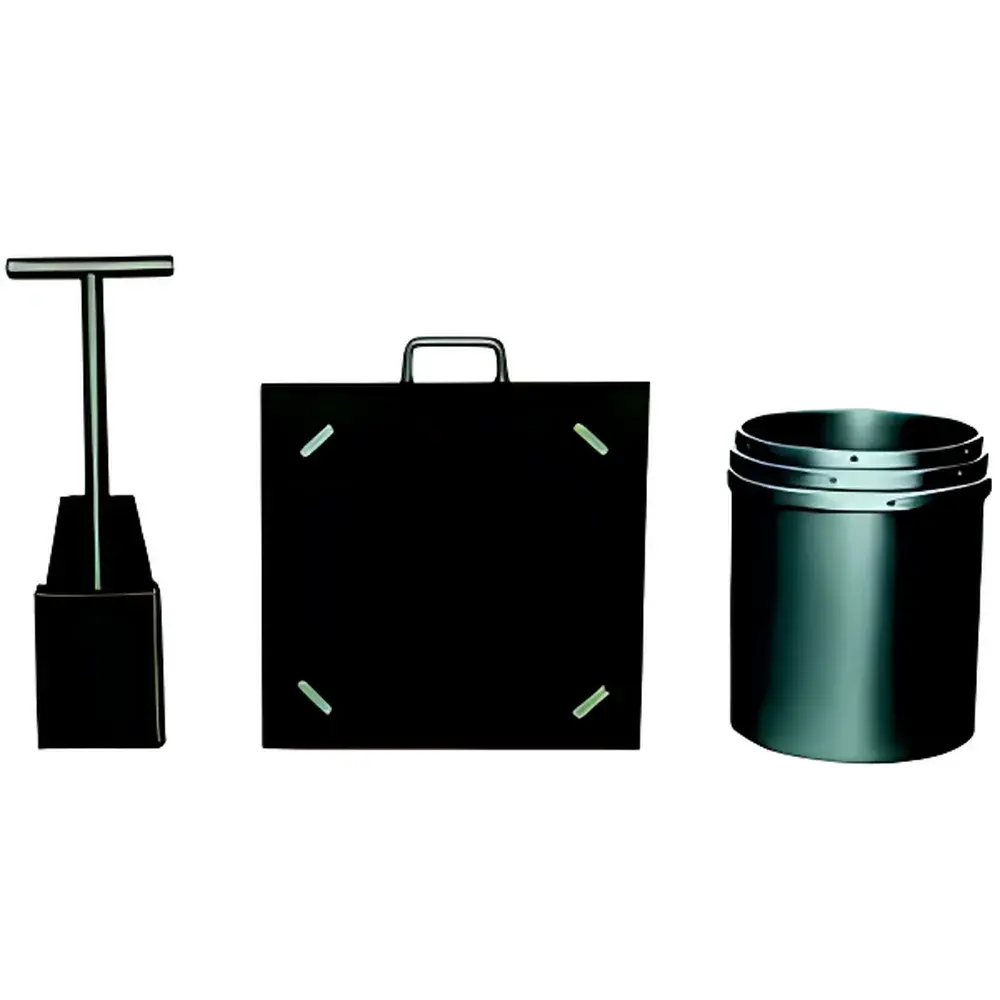
DIK-4201 Cylindrical Soil Infiltrometer
| Brand | DAIKI |
|---|---|
| Origin | Japan |
| Model | DIK-4201 |
| Infiltration Cylinder Dimensions (Large) | Ø300 mm × H350 mm, 6 kg |
| (Medium) | Ø290 mm × H350 mm, 5.5 kg |
| (Small) | Ø280 mm × H350 mm, 5 kg |
| Control Panel | 320 mm × 320 mm × 9 mm, 42 kg total system weight |
| Configuration | One large + one medium + one small infiltration cylinder, power adapter, control panel |
Overview
The DAIKI DIK-4201 Cylindrical Soil Infiltrometer is a field-deployable, gravity-driven infiltration measurement system engineered for quantitative assessment of saturated and near-saturated hydraulic conductivity (Ksat) in undisturbed or minimally disturbed soil profiles. Based on the constant-head (or falling-head, via optional configuration) cylindrical double-ring principle, the instrument applies standardized hydraulic boundary conditions to isolate vertical water flux through the soil surface while minimizing lateral flow divergence. This methodology aligns with ASTM D3385–22 *Standard Test Method for Infiltration Rate of Soils in Field Using Double-Ring Infiltrometer*, and supports derivation of key hydrological parameters including initial infiltration rate, steady-state infiltration rate, and cumulative infiltration over time—critical inputs for irrigation scheduling, stormwater management modeling, vadose zone characterization, and land-use impact assessment.
Key Features
- Triple-cylinder modular design: Includes three precision-machined stainless-steel infiltration cylinders (Ø280 mm, Ø290 mm, Ø300 mm), each with uniform wall thickness (2.5 mm), laser-levelled base rims, and calibrated volume markings for accurate water level monitoring.
- Integrated control panel: Ruggedized 320 mm × 320 mm × 9 mm aluminum panel houses analog/digital water-level sensors, manual valve controls, bubble-level indicators, and real-time timer interface—enabling synchronized start/stop recording across all cylinders without external instrumentation.
- Field-optimized mechanical architecture: Cylinders feature anti-slip knurled bases and tapered bottom edges for consistent insertion into variable soil textures (sand to clay loam); no external power required during measurement phase—only the control panel uses low-voltage DC input (12 V, included adapter).
- Minimized edge effect correction: The concentric ring geometry and standardized spacing between inner and outer cylinders reduce lateral water movement, improving reproducibility in heterogeneous soils per ISO 11274:2020 *Soil quality — Determination of field-saturated hydraulic conductivity*.
- Transport-ready configuration: All components nest compactly; total system mass (42 kg) complies with IEC 60068-2-64 for vibration resistance during vehicular transport to remote sampling sites.
Sample Compatibility & Compliance
The DIK-4201 is validated for use in mineral soils with bulk densities ≤1.8 g/cm³ and organic matter content <20% (w/w). It accommodates surface slopes up to 8% when leveled using the built-in dual-axis bubble vials. The system meets requirements for GLP-compliant field data collection: all measurements are manually recorded with traceable timestamps, and cylinder dimensions conform to the geometric tolerances specified in ASTM D3385–22 Annex A1. While not inherently compliant with FDA 21 CFR Part 11 (as it generates non-electronic primary records), digital data loggers may be interfaced via optional RS-485 output module (sold separately) to support 21 CFR Part 11–aligned audit trails in regulated environmental monitoring programs.
Software & Data Management
The DIK-4201 operates as a hardware-only platform; no proprietary software is bundled. However, raw time–depth data (e.g., water level drop vs. elapsed time) are structured for direct import into standard hydrological analysis tools including HYDRUS-1D, EPA SWMM, and Microsoft Excel. Users may apply the Philip infiltration equation, Horton model, or Kostiakov-Lewis empirical fit using built-in spreadsheet functions or Python-based open-source libraries (e.g., SciPy’s curve_fit). DAIKI provides a comprehensive technical manual (English/Japanese bilingual) containing calculation templates, uncertainty propagation guidance per GUM (JCGM 100:2018), and calibration verification procedures using NIST-traceable volumetric standards.
Applications
- Irrigation system design and efficiency evaluation in agricultural watersheds
- Pre- and post-construction infiltration testing for Low Impact Development (LID) practices (e.g., bioretention cells, permeable pavements)
- Long-term monitoring of soil structural degradation or crusting under repeated tillage or compaction stress
- Validation of pedotransfer functions used in regional-scale groundwater recharge modeling
- Soil health assessment in ecological restoration projects, particularly where macroporosity and preferential flow pathways influence carbon sequestration dynamics
FAQ
What soil types are suitable for measurement with the DIK-4201?
The instrument is optimized for mineral soils ranging from coarse sand to silty clay loam. Soils with high gravel content (>15% by volume) or surface sealing require pre-wetting and extended equilibration; organic soils (e.g., peat) are not recommended due to excessive compressibility under cylinder weight.
Is calibration required before each use?
Yes—cylinder internal volume must be verified annually using distilled water and a Class A volumetric flask; dimensional checks (diameter, height) should be performed quarterly with certified calipers per ISO 9001:2015 clause 7.1.5.
Can the DIK-4201 be used on sloped terrain?
Measurements are valid on slopes ≤8% when the control panel is leveled using integrated bubble vials and cylinders are driven vertically using the alignment guide sleeve (optional accessory). Data interpretation must include slope-adjusted hydraulic gradient corrections.
Does the system comply with ISO/IEC 17025 for accredited testing laboratories?
While the DIK-4201 itself is not certified, its measurement procedure—including uncertainty budgeting, traceable calibration, and documented environmental controls (temperature, wind speed)—can be incorporated into an ISO/IEC 17025:2017 accredited method if validated per Clause 7.2.2.
What maintenance is required for long-term reliability?
Cylinders and panels must be rinsed with deionized water after each use; stainless-steel surfaces should be inspected semiannually for pitting corrosion using 10× magnification per ASTM E3022–16. Rubber gaskets and valve seals require replacement every 24 months or after 200 field deployments.
Related Products







