
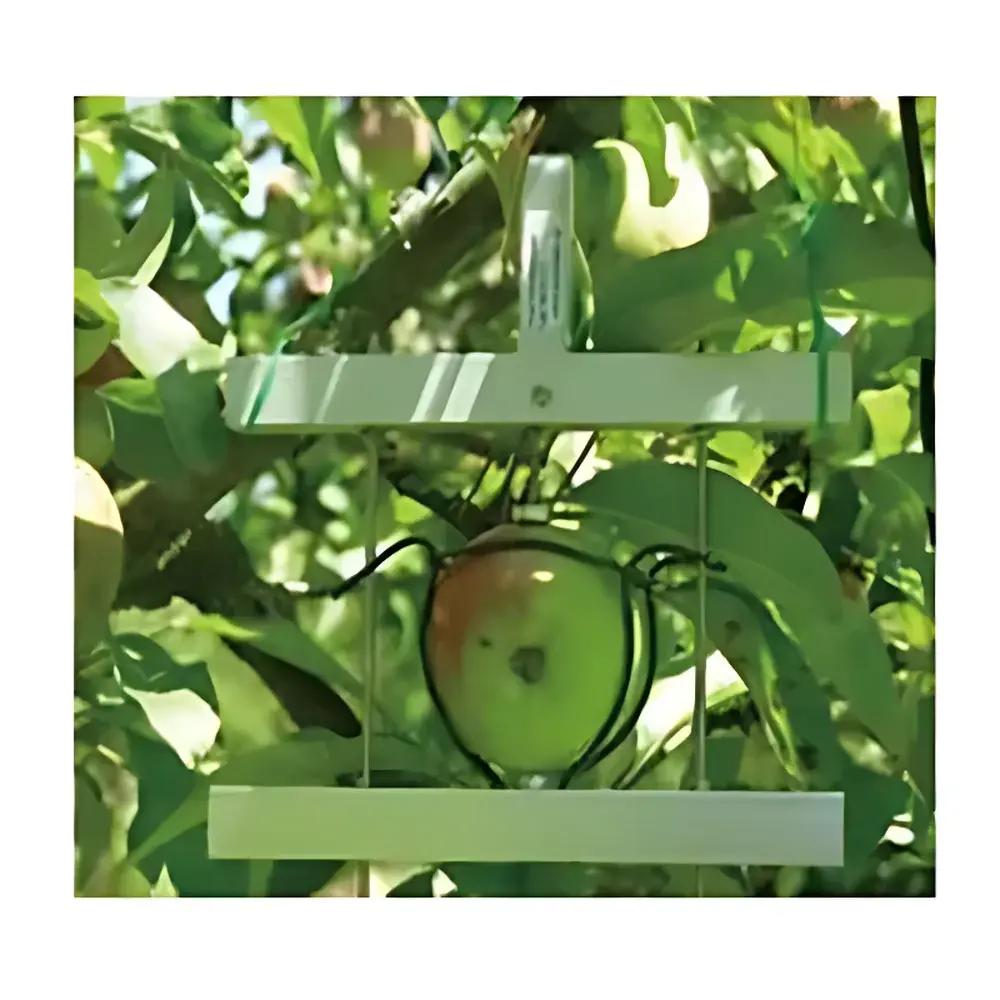
Ecomatik DF Series Non-Destructive Plant Growth Monitor
| Brand | Ecomatik |
|---|---|
| Origin | Germany |
| Model | DF1 / DF2 / DF3 |
| Measurement Principle | High-Resolution Linear Displacement Transduction via Spring-Loaded Contact Probe |
| Sensor Range | 15 mm (DF1), 25.4 mm (DF2), 50.8 mm (DF3) |
| Full-Scale Diameter Monitoring Range | 0–110 mm (expandable) |
| Accuracy | ±2 µm (DF1), ±3.3 µm (DF2), ±6.6 µm (with CR1000 Logger) |
| Resolution | 0.04% of reading + 6–20 µm (logger-dependent) |
| Temperature Coefficient | <0.2 µm/°C |
| Operating Temperature | −25 to +70 °C |
| Relative Humidity | 0–100% RH |
| Weight | 15 g (DF1), 26 g (DF2), 37 g (DF3) |
| Power | Internal battery, >2 years continuous logging (with DL10 datalogger) |
| Data Storage | Up to 1,900,000 records (4 sensors, 1-min interval, 1-year capacity) |
| Interface | Analog voltage output (0–2.5 V or 0–5 V), compatible with Campbell Scientific CR1000/CR6, Delta-T Devices GP2, DataTaker DT80/DT85, and other standard analog-input loggers |
| IP Rating | IP67 (fully weatherproof) |
Overview
The Ecomatik DF Series Non-Destructive Plant Growth Monitor is an engineered solution for long-term, high-resolution in situ monitoring of radial expansion and contraction dynamics in fleshy fruits, vegetables, and woody stems. Based on precision linear displacement transduction, the DF sensor employs a passive, spring-loaded contact probe that applies negligible static load (<0.5 mN) to the plant surface—ensuring zero mechanical interference with physiological processes such as turgor-driven growth, diurnal shrinkage/swelling cycles, or stress-induced volume changes. Unlike clamp-based or optical triangulation systems, the DF design eliminates measurement drift caused by thermal expansion of mounting hardware or ambient light variability. Each variant (DF1, DF2, DF3) is mechanically optimized for distinct size classes of spherical or near-spherical plant organs, enabling consistent sub-micrometer-level resolution across heterogeneous field or greenhouse trials.
Key Features
- True non-invasive operation: Contact force remains below 0.5 mN—orders of magnitude lower than typical fruit epidermal fracture thresholds.
- Three calibrated variants: DF1 (15 mm stroke, ideal for cherries, grapes), DF2 (25.4 mm stroke, optimized for apples, citrus), DF3 (50.8 mm stroke, designed for melons, pumpkins, and thick-stemmed crops).
- Expandable full-scale range: Standard calibration covers 0–110 mm diameter; custom calibrations available up to 200 mm upon request.
- Environmental resilience: IP67-rated housing withstands prolonged exposure to rain, snow, UV radiation, and mechanical impact from falling twigs or small fruit.
- Low-power architecture: Internal lithium-thionyl chloride battery supports >2 years of continuous 1-minute logging when paired with DL10 or equivalent low-power dataloggers.
- Modular analog interface: Outputs standardized 0–2.5 V or 0–5 V signals compatible with all major scientific dataloggers—including Campbell Scientific CR1000/CR6, Delta-T GP2, DataTaker DT80/DT85, and Onset HOBO RX3000 series.
- Thermal stability: Temperature coefficient <0.2 µm/°C ensures minimal drift across natural diurnal temperature fluctuations (−25 to +70 °C operating range).
Sample Compatibility & Compliance
The DF sensor is validated for use on intact, firm-skinned plant organs exhibiting elastic-plastic surface behavior under minimal loading—including pome fruits, stone fruits, cucurbits, root vegetables (e.g., radishes, beets), and young woody stems. It is not recommended for highly compliant tissues such as ripe tomatoes, soft berries, or fungal fruiting bodies, where surface deformation exceeds the probe’s mechanical hysteresis threshold. All DF models comply with IEC 60529 (IP67), EN 61326-1 (EMC for laboratory and industrial use), and RoHS 2011/65/EU. Data acquisition configurations using CR1000 or DT85 loggers support audit-trail-capable deployments aligned with GLP principles; raw analog voltage outputs are traceable to NIST-calibrated reference standards via documented logger calibration certificates.
Software & Data Management
The DF sensor does not require proprietary firmware or drivers. Raw voltage outputs are ingested directly into widely adopted environmental data platforms—including Campbell Scientific LoggerNet, Delta-T DLOG, DataTaker DeLogger, and open-source tools such as R (‘dplyr’, ‘lubridate’) and Python (‘pandas’, ‘xarray’). When deployed with CR1000/CR6 loggers, users may implement real-time quality control flags (e.g., outlier detection based on first derivative thresholds) and apply temperature-compensated conversion equations embedded in the datalogger program. Internal memory capacity supports up to 1,900,000 records across four simultaneously connected DF units at 1-minute intervals—equivalent to 12 months of uninterrupted operation. USB interface enables rapid local data retrieval without network dependency.
Applications
- Phenotyping studies: Quantifying genotype-specific growth kinetics under drought, salinity, or elevated CO₂ treatments.
- Irrigation scheduling: Detecting pre-dawn stem shrinkage as an early indicator of plant water deficit.
- Fruit development modeling: Resolving daily growth increments during cell division vs. cell expansion phases.
- Post-harvest physiology: Monitoring respiration-linked diameter fluctuations during cold storage.
- Ecophysiological monitoring: Long-term tracking of stem swelling in perennial orchard species across seasons.
- Validation of remote sensing proxies: Ground-truthing radar or thermal indices of canopy water status.
FAQ
Can the DF sensor be used on tomato fruits?
No—ripe tomato skin exhibits excessive compliance under even minimal probe load, leading to non-linear response and measurement hysteresis. DF is validated only for firm-skinned produce with Young’s modulus >1 MPa.
What is the minimum measurable diameter change?
At optimal signal-to-noise ratio (e.g., CR1000 with 24-bit ADC), effective resolution is 0.2 µm for DF1, 0.3 µm for DF2, and 0.5 µm for DF3—subject to logger configuration and cable shielding.
Is calibration required after installation?
No field recalibration is needed. Each unit ships with individual NIST-traceable calibration certificate specifying offset, gain, linearity error, and temperature coefficient. Zero-point verification can be performed in situ using mechanical stops.
How is probe orientation maintained on curved surfaces?
The DF mount incorporates a self-aligning universal joint with 12° angular tolerance, ensuring perpendicular probe contact across variable curvature—validated via photogrammetric alignment testing on 30–110 mm diameter spheres.
Does the sensor require protective housing in direct sunlight?
No—the titanium-alloy probe body and UV-stabilized polymer housing meet ISO 4892-3 for 5,000-hour xenon arc exposure; surface temperature rise remains within specified operating limits.





