
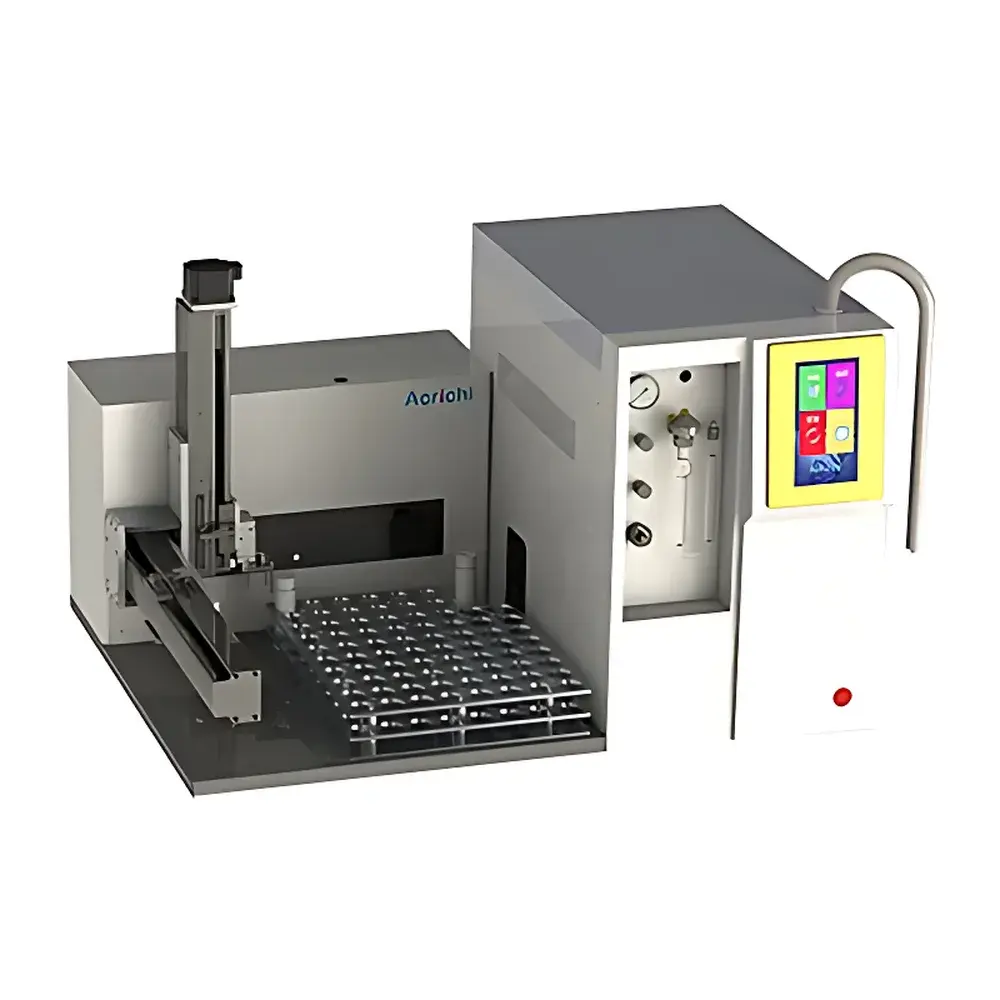
Acrichi PTC-86 Automated Solid-Liquid Integrated Purge and Trap Concentrator
| Brand | Acrichi |
|---|---|
| Origin | Beijing, China |
| Model | Acrichi PTC-86 |
| Sample Capacity | 86 positions |
| Injection Precision | RSD ≤ 10% |
| Trap Temperature Range | Ambient to 450 °C |
| Purge Sample Heating Range | Ambient to 100 °C |
| Sample Vial Cooling Range | −40 °C to Ambient |
| Purge Flow Rate | 5–500 mL/min (continuously adjustable) |
| Valve & Transfer Line Temp Control | Ambient to 220 °C (±1 °C) |
| Cold Trap Temp Control | −40 °C to Ambient (electronic cooling, ±1 °C) |
| Water Removal Trap Temp Range | Ambient to 400 °C |
| Distilled Water Rinse Temp Range | Ambient to 90 °C (±1 °C) |
| Solid Sample Vial Temp Range | Ambient to 100 °C (±1 °C) |
| Ramp Rate (Trap) | >4800 °C/min |
| Power | 800 W |
| Dimensions | 650 × 880 × 530 mm |
| Weight | ~40 kg |
Overview
The Acrichi PTC-86 is an automated solid-liquid integrated purge and trap concentrator engineered for high-throughput, unattended volatile organic compound (VOC) preconcentration prior to gas chromatography-mass spectrometry (GC-MS) or gas chromatography-flame ionization detection (GC-FID) analysis. It operates on the principle of dynamic headspace extraction: inert gas purging displaces VOCs from aqueous or solid-phase matrices into a thermally desorbed, cryogenically focused trap, followed by rapid thermal desorption into the GC inlet. This system eliminates manual intervention across all critical stages—sample conditioning, purge, trap focusing, dry-purge, desorption, and trap bake-out—ensuring analytical reproducibility and minimizing carryover. Designed for compliance-driven laboratories, the PTC-86 supports method validation under EPA Methods 502.2, 524.4, 624, 8260D, and ISO 15681-2, with full temperature traceability and hardware-level event logging.
Key Features
- 86-position autosampler compatible with standard 40-mL VOC vials and 40-mL amber glass soil extraction vials equipped with crimp-top septa
- Fully integrated thermal control architecture: independent PID-regulated zones for purge heater, six-port valve manifold, transfer lines, cold trap, water removal trap, rinse water bath, and solid-sample incubation block—all maintained within ±1 °C accuracy
- Ultra-fast trap heating ramp (>4800 °C/min) enabling sharp, narrow analyte bands and optimal chromatographic resolution
- Electronic Peltier-based cold trap capable of reaching −40 °C without liquid nitrogen or mechanical compressors, reducing operational cost and infrastructure dependency
- Inert flow path throughout: Siltek®-deactivated stainless steel lines, fused silica transfer tubing, and chemically resistant O-rings minimize adsorption and catalytic degradation of reactive VOCs (e.g., chlorinated ethenes, carbonyls)
- Integrated leak-check routine executed prior to each run using pressure decay monitoring; automatic fault reporting and pause-on-abort logic prevent data corruption
- Intuitive 10.1-inch capacitive touchscreen interface with multilingual support (English, Spanish, Chinese), real-time status dashboard, and audit-trail-enabled method editing
Sample Compatibility & Compliance
The PTC-86 accommodates heterogeneous sample types without hardware modification: drinking water, wastewater, groundwater, sediment slurries, homogenized soils, and fortified solid matrices (e.g., sand, clay, activated carbon). Its solid-sample heating module (ambient to 100 °C) enables controlled thermal desorption of semi-volatiles from low-permeability solids. The water removal trap (ambient to 400 °C) selectively condenses and sequesters moisture upstream of the cold trap, mitigating column contamination and detector saturation in GC-MS. All thermal zones are calibrated per ISO/IEC 17025 requirements, and the system logs timestamped temperature profiles for every run—supporting GLP/GMP documentation and FDA 21 CFR Part 11-compliant electronic records when paired with validated LIMS or CDS software.
Software & Data Management
The embedded firmware supports up to 10 user-defined methods stored locally with version-controlled parameter sets (purge time, flow rate, trap desorption duration, bake-out temperature). Method execution triggers external GC-MS start via TTL or Ethernet event signaling (IEEE 802.3), enabling synchronized instrument control. Raw thermal event logs—including valve actuation timestamps, temperature deviations, and pressure transients—are exportable as CSV for QA/QC review. Optional integration with ChromaTOF, MassHunter, or OpenLab CDS permits direct injection of method files and auto-population of sample metadata. Audit trails record operator ID, method edits, calibration events, and error codes—retained for ≥36 months per laboratory SOP.
Applications
- Regulatory environmental testing: VOC screening in EPA-designated drinking water sources and Superfund site soils
- Industrial hygiene monitoring: workplace air condensates and wipe extracts analyzed per NIOSH Method 1003
- Pharmaceutical residual solvent analysis: Class 1 and 2 solvents (e.g., benzene, chloroform) in drug substance batches per ICH Q3C guidelines
- Food safety: off-flavor compound profiling (e.g., geosmin, 2-methylisoborneol) in bottled water and dairy products
- Forensic toxicology: detection of accelerants (e.g., gasoline range organics) in fire debris per ASTM E1387
FAQ
Does the PTC-86 require liquid nitrogen or compressed air for operation?
No. Cryogenic trapping is achieved solely via solid-state Peltier cooling; compressed air is optional for pneumatic valve actuation but not required for core purge-and-trap functionality.
Can the system handle high-salinity or turbid water samples without clogging?
Yes. The purge gas diffuser is designed for bubble dispersion in viscous or particulate-laden matrices; optional inline filtration (0.45 µm PTFE) is available for suspended solids >50 mg/L.
Is method transfer from legacy purge-and-trap systems supported?
Yes. Parameter mapping tables and conversion utilities are provided for seamless migration from Tekmar, OI Analytical, or Thermo Scientific platforms, including purge time normalization and trap desorption profile alignment.
What maintenance intervals are recommended for long-term reliability?
Cold trap cleaning every 200 runs; six-port valve rotor seal replacement every 12 months or 5,000 cycles; annual full-system thermal calibration with NIST-traceable reference thermistors.
How is cross-contamination between solid and liquid samples prevented?
The system enforces strict wash protocols: post-run hot rinse (90 °C distilled water), dry-purge with helium, and trap bake-out at 450 °C for ≥10 minutes—validated per ASTM D7717 carryover acceptance criteria (<0.1% relative to previous high-concentration standard).





