
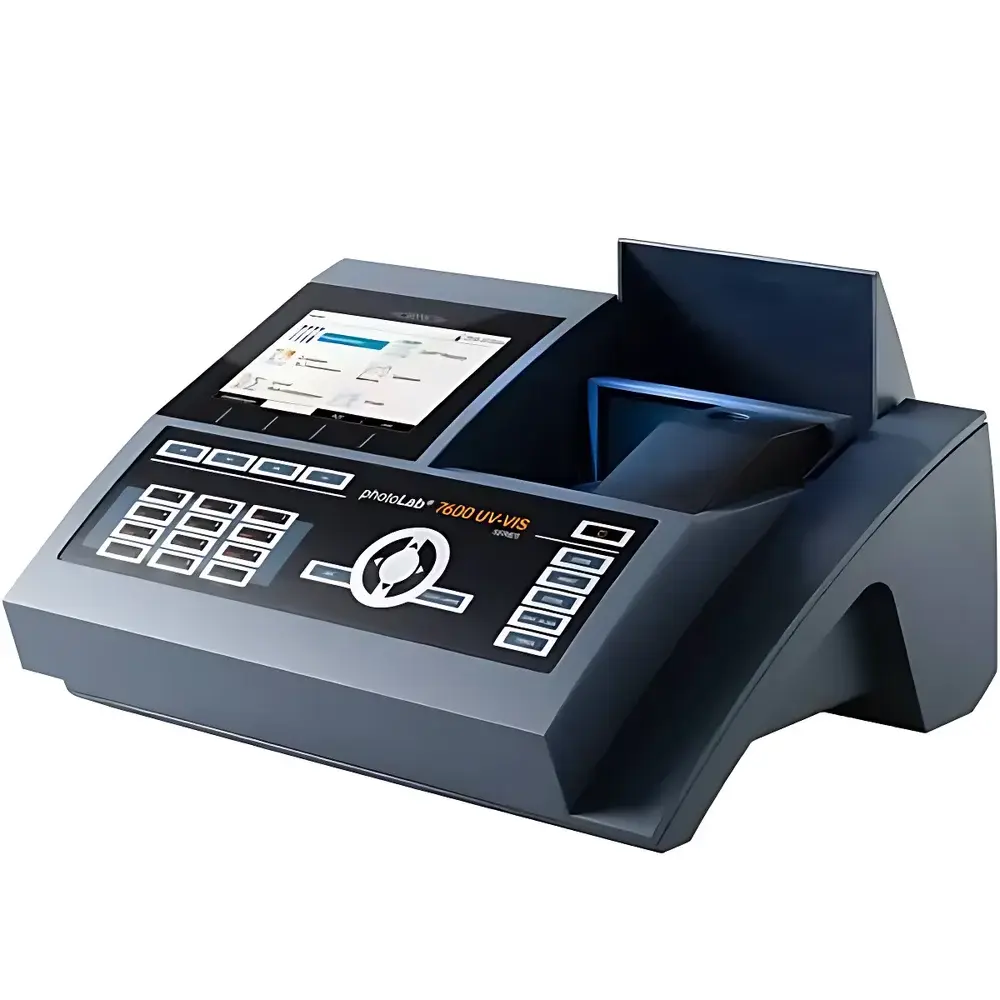
WTW photoLab 7600 VIS UV-Vis Spectrophotometer
| Brand | WTW |
|---|---|
| Origin | Germany |
| Model | photoLab 7600 VIS |
| Optical Design | Pseudo-double-beam |
| Detector Type | Photodiode Array (PDA) |
| Wavelength Range | 190–1100 nm |
| Automatic Wavelength Selection | Yes |
| Spectral Bandwidth | 4 nm |
| Wavelength Accuracy | ±0.003E (for E < 0.600), ±0.5% (for 0.600 < E < 2.00) |
Overview
The WTW photoLab 7600 VIS UV-Vis Spectrophotometer is a high-performance, laboratory-grade spectrophotometric platform engineered for precision quantitative and qualitative analysis across environmental, industrial, and research laboratories. Utilizing a pseudo-double-beam optical architecture with a stepper-motor-driven holographic grating monochromator and pulsed xenon lamp source, it delivers stable baseline performance and minimized photometric drift during extended measurement sequences. The instrument operates across the full ultraviolet-to-near-infrared spectrum (190–1100 nm), enabling compliance with standard methods requiring UV detection (e.g., nitrate, nitrite, COD, SAC, free ammonia) as well as visible-range colorimetric assays (e.g., phosphate, iron, chloride). Its integrated photodiode array detector provides rapid spectral acquisition without mechanical scanning, supporting both single-wavelength quantification and full-spectrum capture at speeds up to 2000 nm/min.
Key Features
- Pseudo-double-beam optics with real-time reference compensation for enhanced photometric stability and reduced sensitivity to lamp intensity fluctuations
- Automated cuvette recognition via integrated barcode scanning — supports 10 mm square, 20 mm rectangular, 50 mm rectangular, and 16 mm round cuvettes with automatic pathlength correction and method-specific calibration assignment
- Preloaded library of over 200 validated analytical methods compliant with DIN, ISO, and EPA protocols — including COD (total and soluble), NO₃-N, NO₂-N, free NH₃, CO₂, SAC (spectral absorption coefficient), and true color
- OptRF technology integration for reagent-free photometric analysis — enables direct, non-destructive quantification of key water quality parameters using built-in IQ Sensor Net-compatible algorithms
- Intuitive 7-inch backlit color touchscreen interface with guided workflow navigation, step-by-step operation prompts, and context-sensitive help
- Onboard data management: stores up to 500 individual measurements, 500 full spectra, and 400 kinetic curves with timestamp, operator ID, and method metadata
- Multi-wavelength and kinetic measurement modes — supports reaction rate monitoring, enzyme kinetics, and time-resolved absorbance profiling under ambient conditions
Sample Compatibility & Compliance
The photoLab 7600 VIS accommodates standard quartz, glass, and plastic cuvettes with automatic geometry identification. Its optical design meets ISO 9001 and ISO/IEC 17025 laboratory quality system requirements when operated with AQA (Analytical Quality Assurance) routines — including blank verification, calibration verification, and system suitability checks. All preprogrammed methods align with internationally recognized standards such as ISO 8467 (COD by UV absorption), ISO 7890-3 (nitrate/nitrite), DIN 38404-4 (color), and US EPA Method 353.2 (nitrate). The instrument’s firmware and data handling architecture support audit-trail functionality required under GLP and GMP environments, and its Ethernet/USB connectivity enables secure integration into LIMS or ELN platforms.
Software & Data Management
The instrument ships with photoLab PC software, which includes a comprehensive database of certified reference methods, an integrated color library (CIE L*a*b*, APHA, Pt-Co), and advanced spectral processing tools. Users can export raw absorbance/transmittance data in CSV or XML formats, overlay multiple spectra with customizable color coding, perform arithmetic operations (e.g., spectral subtraction, ratioing, summation), and generate calibration curves with linear, quadratic, or polynomial regression. Software updates are delivered via USB or Ethernet, and all firmware revisions maintain backward compatibility with existing method libraries and calibration files. The system logs all user actions, parameter changes, and measurement events in a tamper-resistant internal log — satisfying traceability requirements under FDA 21 CFR Part 11 when paired with appropriate access controls.
Applications
The photoLab 7600 VIS serves as a core analytical tool in municipal and industrial wastewater laboratories, drinking water QA/QC facilities, chemical manufacturing QC departments, and academic environmental research groups. Typical applications include routine monitoring of nutrient species (NO₃⁻, NO₂⁻, NH₃), organic load indicators (COD, TOC proxy via UV₂₅₄), disinfection byproduct precursors (SAC, SUVA), turbidity-corrected color analysis, and method development for novel photometric assays. Its OptRF capability extends utility to continuous or semi-continuous monitoring scenarios where reagent consumption, waste generation, or operational complexity must be minimized — particularly in remote or mobile field labs.
FAQ
What is the difference between pseudo-double-beam and true double-beam optics?
Pseudo-double-beam design uses a single optical path with rapid alternation between sample and reference beams via a rotating mirror or shutter — achieving comparable stability to true double-beam systems while reducing mechanical complexity and cost.
Can the photoLab 7600 VIS be used for regulatory reporting?
Yes — when operated with validated methods, documented AQA procedures, and proper calibration traceability, it meets data integrity requirements for ISO 17025-accredited testing and EPA-compliant environmental reporting.
Is method validation supported by the instrument?
The device includes built-in AQA tools for linearity verification, limit of detection estimation, repeatability assessment, and calibration standard verification — all aligned with ICH Q2(R2) and ISO/IEC 17025 guidance.
How does OptRF reagent-free analysis work?
OptRF applies multivariate UV spectral modeling calibrated against reference wet-chemistry datasets — enabling prediction of analyte concentrations from characteristic absorption patterns without added reagents or derivatization steps.
What file formats are supported for data export?
CSV, XML, and proprietary .pld files — compatible with common spreadsheet, statistical, and laboratory informatics platforms; spectral data include wavelength, absorbance, and transmittance columns with metadata headers.
Related Products



