
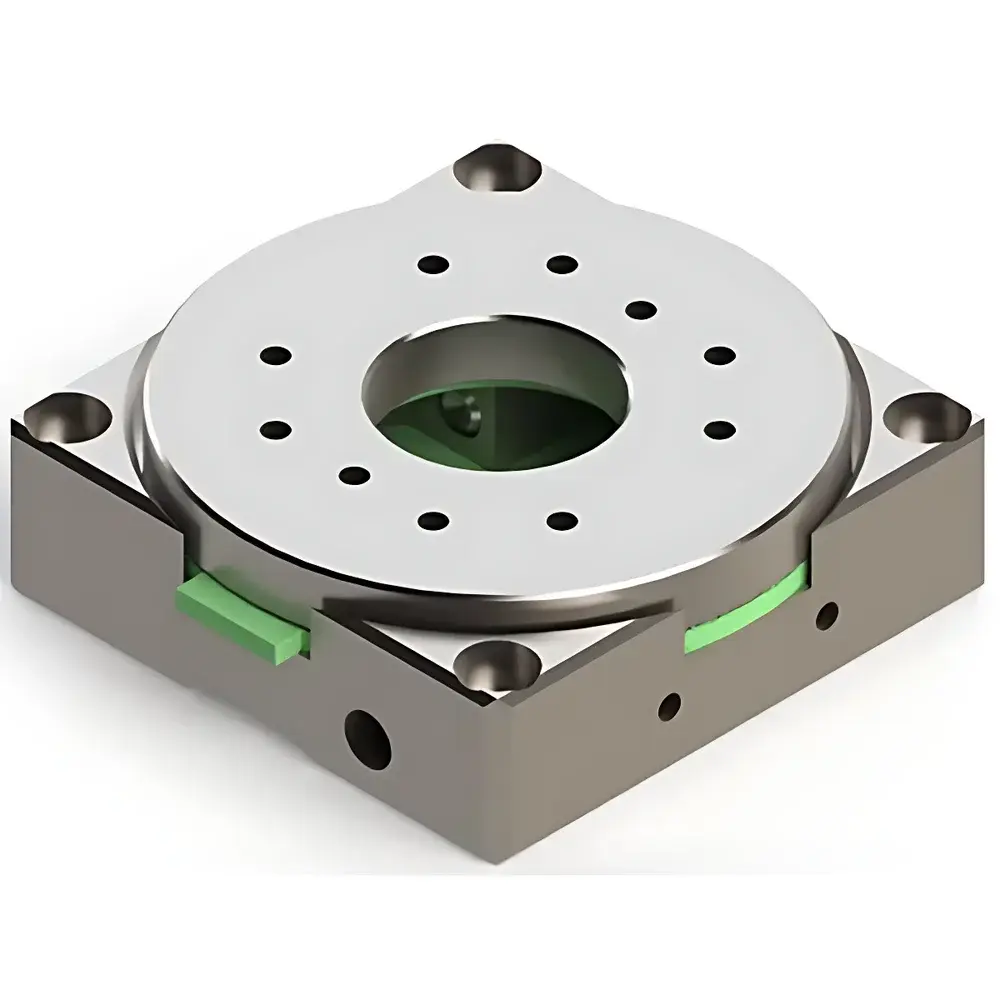
3i NMI-PR35 Piezo Rotator Stage (360° Continuous Rotation)
| Brand | 3i |
|---|---|
| Origin | Germany |
| Manufacturer Type | Authorized Distributor |
| Origin Category | Imported |
| Model | PIEZO ROTATOR |
| Price | Upon Request |
| Dimensions (L×W×H) | 35 mm × 35 mm × 11.5 mm |
| Weight | 65 g |
| Clear Aperture | 13 mm |
| Body Material | Titanium Alloy & Beryllium Copper (or Beryllium Copper Only for mK Operation) |
| Actuator | PZT Piezoceramic |
| Cabling | Insulated Twisted Pair — Copper for PZT, Phosphor Bronze for Resistive Sensor |
| Coarse Travel Range (Stepping Mode) | 360° Continuous |
| Max. Drive Speed (300 K) | ~32°/s |
| Input Voltage Range (PZT) | 0–60 V |
| Fine Angular Positioning Range (300 K) | 40 m° |
| Fine Angular Positioning Range (4 K) | 6 m° |
| Fine Positioning Resolution | µ° |
| DC Input Voltage Range (Sensor) | 0–100 V (300 K), 0–150 V (4 K) |
| Encoder Type | Cermet Resistive Sensor |
| Encoder Travel Range | 315° |
| Encoder Resolution | ~5 m° |
| Encoder Power Consumption (Active) | 10–100 µW |
| Repeatability (Unidirectional) | ±45 m° |
| Max. Static Load (RT) | 200 g |
| Max. Dynamic Torque about Axis | 2 N·cm |
| Environmental Compatibility | Ambient Temperature, Cryogenic (Down to 4 K), Ultra-High Vacuum (UHV), Bakeable to 100 °C |
Overview
The 3i NMI-PR35 Piezo Rotator Stage is a high-precision, ultra-compact rotational positioning system engineered for demanding applications in low-temperature physics, quantum optics, scanning probe microscopy, and synchrotron beamline instrumentation. Based on direct-drive piezoelectric actuation and integrated cermet resistive angular encoding, the stage delivers continuous 360° rotation with sub-millidegree repeatability and microdegree resolution in both coarse stepping and fine closed-loop modes. Its monolithic titanium–beryllium copper mechanical architecture ensures exceptional thermal stability across wide temperature ranges—from ambient conditions down to millikelvin cryogenic environments—while maintaining compatibility with ultra-high vacuum (UHV) systems and bake-out protocols up to 100 °C. Unlike gear- or motor-driven alternatives, the NMI-PR35 eliminates backlash, hysteresis-induced drift, and electromagnetic interference, making it suitable for interferometric alignment, polarization control of single-photon sources, and real-time sample orientation in dilution refrigerator inserts.
Key Features
- Continuous 360° rotational capability with no mechanical stops or cable wrap limitations
- Dual-mode operation: coarse stepping (up to ~32°/s at 300 K) and fine closed-loop positioning (±40 m° range at room temperature, ±6 m° at 4 K)
- Sub-microdegree angular resolution enabled by high-stability PZT actuators and µ°-class closed-loop feedback
- Cryogenic-optimized design: fully functional from 300 K to ≤4 K; compatible with dry and wet dilution refrigerators
- UHV-rated construction with non-outgassing materials; bakeable to 100 °C without disassembly
- Integrated cermet resistive angular encoder with 315° travel range and ~5 m° resolution, consuming only 10–100 µW during measurement
- Low-mass (65 g), compact footprint (35 mm × 35 mm × 11.5 mm), and 13 mm central aperture for optical or probe access
- Maximum static load capacity of 200 g and dynamic torque rating of 2 N·cm about the rotation axis
Sample Compatibility & Compliance
The NMI-PR35 is designed for integration into multi-stage cryogenic platforms, UHV deposition chambers, and laser-based metrology setups where positional fidelity, thermal contraction matching, and electromagnetic silence are critical. Its beryllium copper variant meets ASTM F2872 specifications for low-temperature structural alloys, while titanium components conform to ISO 5832-3 for biocompatible metallic implants—reflecting its high-purity, low-magnetic-permeability material selection. The device complies with IEC 61326-1 for electromagnetic compatibility in laboratory environments and satisfies mechanical safety requirements per ISO 12100 for precision motion equipment. No internal electronics or active cooling are required, eliminating thermal load concerns in cryostats and enabling passive thermal anchoring strategies.
Software & Data Management
The NMI-PR35 operates via analog voltage input (0–60 V for actuation; 0–100 V/0–150 V for sensor bias), supporting seamless integration with standard motion controllers (e.g., Thorlabs KDC101, Newport ESP300, or custom LabVIEW/Python DAQ systems). Encoder output is ratiometric and linearized, permitting direct angular position readout without proprietary firmware. All calibration coefficients—including temperature-dependent scaling factors for fine-range compression at cryogenic temperatures—are supplied in NIST-traceable documentation. Raw sensor data supports GLP-compliant audit trails when logged via time-stamped acquisition systems compliant with FDA 21 CFR Part 11 requirements.
Applications
- Polarization state control of entangled photon pairs in quantum communication testbeds
- Angle-resolved photoemission spectroscopy (ARPES) sample goniometers operating below 10 K
- In-situ alignment of fiber-coupled superconducting nanowire single-photon detectors (SNSPDs)
- Rotational calibration of atomic force microscope (AFM) cantilevers under UHV
- Multi-axis sample orientation in neutron scattering instruments with magnetic shielding constraints
- Thermally stable mirror mounts for cavity ring-down spectroscopy in cryogenic gas cells
FAQ
Is the NMI-PR35 compatible with liquid helium cryostats?
Yes—the stage is qualified for operation at 4 K and below, with full functionality maintained in both pumped and bath-cooled configurations.
Can the encoder be read out without powering the piezo actuator?
Yes—the cermet resistive sensor operates independently and requires only a low-power bias voltage (0–100 V), enabling passive position monitoring during actuator standby.
What is the maximum allowable thermal gradient across the stage body?
For optimal angular repeatability, axial thermal gradients should not exceed 0.5 K/mm during cooldown; this is typically achieved using graded thermal anchoring to intermediate temperature stages.
Does the stage support bidirectional repeatability specification?
The published ±45 m° repeatability is unidirectional; bidirectional repeatability is ±90 m° due to inherent hysteresis in the PZT stack, which can be compensated via software-based look-up tables.
Are custom aperture sizes or mounting hole patterns available?
Yes—3i offers OEM mechanical customization including non-standard clear apertures, threaded mounting options (M2, M3, or 4-40), and alternative cabling configurations upon request.
Related Products



