
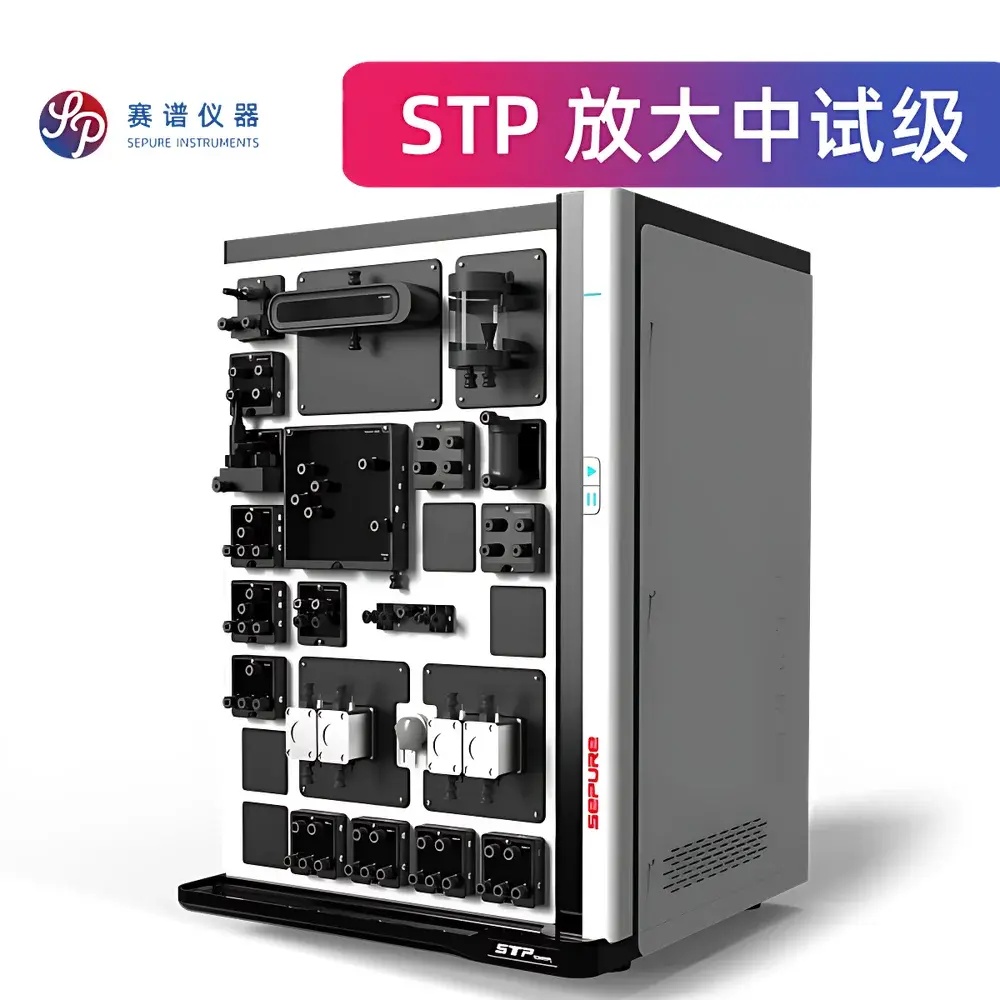
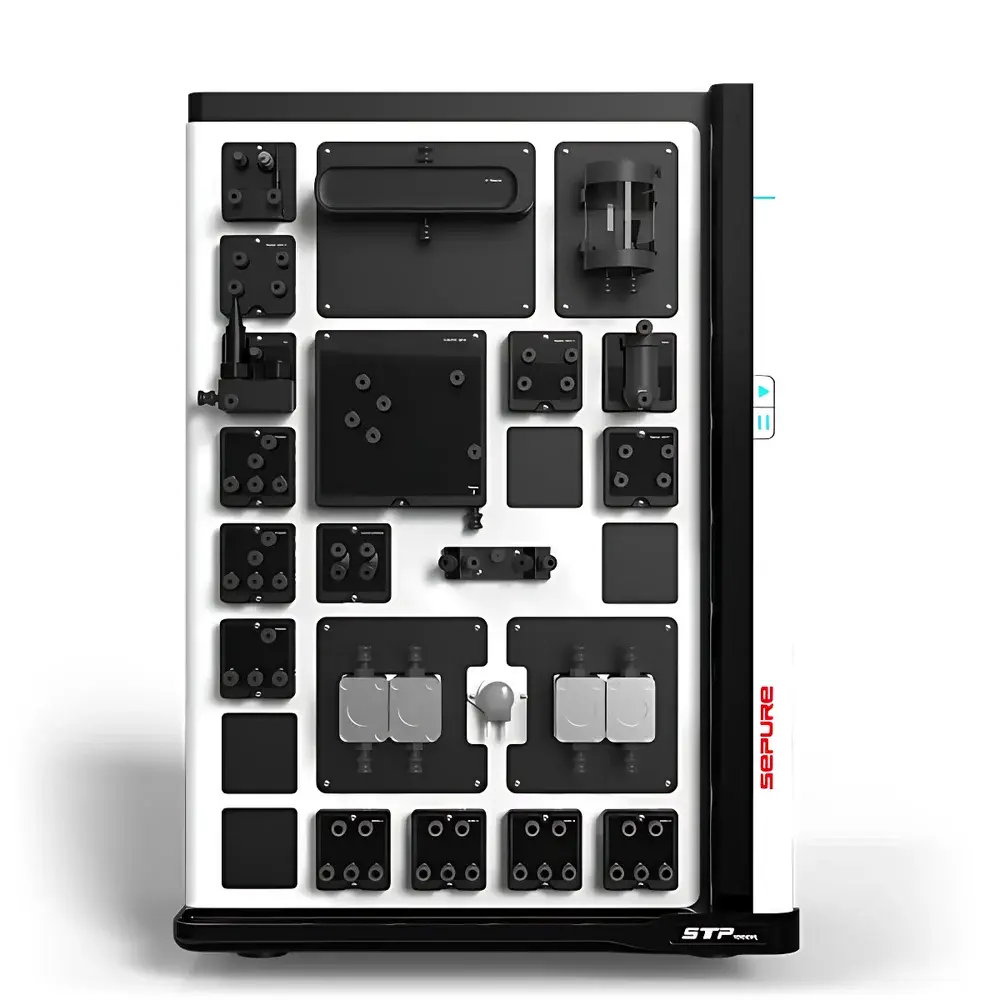
Sepure STP 1000R Pilot-Scale Protein Chromatography System
| Brand | Sepure Instruments |
|---|---|
| Origin | Jiangsu, China |
| Manufacturer Type | OEM Manufacturer |
| Model | STP 1000R |
| Purification Principle | Ion Exchange Chromatography (IEX) |
| Gradient Type | Linear Gradient |
| Detectors | UV-Vis (200–800 nm), Conductivity, pH |
| Flow Rate Range | 0.1–999.99 mL/min |
| Flow Rate Precision | RSD < 0.5% |
| UV Detection Range | 200–800 nm |
| Maximum System Pressure | 1.6 MPa |
| Conductivity Range | 0.001–999.99 mS/cm |
Overview
The Sepure STP 1000R Pilot-Scale Protein Chromatography System is an engineered solution for mid-scale process development and pre-GMP purification of therapeutic proteins, monoclonal antibodies (mAbs), viral vectors, and other biologics. Designed around the principles of preparative liquid chromatography under controlled hydraulic and chemical conditions, the system implements high-fidelity ion exchange chromatography (IEX) with precise gradient formation, real-time multi-parameter monitoring, and full traceability—enabling seamless transition from lab-scale optimization to clinical manufacturing. Its modular architecture supports column diameters from 26 mm to 200 mm, accommodating both analytical-to-pilot scaling and parallel column screening strategies. The system operates within a validated pressure envelope of up to 1.6 MPa (232 psi), ensuring compatibility with rigid resin matrices including POROS™, Capto™, and SOURCE™ series media.
Key Features
- High-precision dual-plunger piston pump delivering stable flow rates from 0.1 to 999.99 mL/min with ≤0.5% RSD across the full range—critical for reproducible linear gradient generation in IEX method development.
- Integrated diaphragm valve manifold minimizing carryover and cross-contamination; all fluidic pathways constructed from PEEK, PTFE, or 316L stainless steel compliant with USP Class VI and ISO 10993-1 requirements.
- Multi-channel detection suite: configurable UV-Vis detector (200–800 nm, ±1 nm wavelength accuracy), conductivity sensor (0.001–999.99 mS/cm, ±2% or ±0.1 mS/cm), pH probe (0–14, ±0.1 units in 2–12 range), and column pressure transducer (0–6000 psi, ±2%).
- Dynamic magnetic stirrer mixer (15 mL volume) enabling low-dead-volume, high-homogeneity gradient blending without pulsation-induced band broadening.
- Expandable valve configuration supporting up to nine inlet ports, nine collection outlets, and programmable column orientation (forward/reverse/series/parallel/bypass) for complex multi-step purification workflows.
- Integrated air trap (160 mL) with inline bypass capability to prevent bubble-induced signal artifacts during UV and conductivity measurements.
Sample Compatibility & Compliance
The STP 1000R is validated for use with aqueous and mildly organic mobile phases common in protein IEX applications—including sodium acetate, sodium phosphate, and Tris-HCl buffers across pH 3–11. All wetted materials meet extractables and leachables criteria per ICH Q5A(R2) and are compatible with standard CIP/SIP protocols using 0.1–1.0 M NaOH, 70% ethanol, or 20% IPA solutions. The system conforms to FDA 21 CFR Part 11 requirements through PURfect P® software’s electronic signature, audit trail, and data integrity controls—including immutable raw data storage, user access levels (admin/operator/auditor), and time-stamped event logging. It supports GLP and GMP-aligned validation documentation packages (IQ/OQ/PQ), and meets ISO 13485:2016 design control expectations for medical device-associated bioprocessing equipment.
Software & Data Management
PURfect P® is a Windows 10–based chromatography workstation offering intuitive graphical workflow configuration, real-time overlay of UV, conductivity, pH, and pressure traces, and automated fraction collection based on threshold, time, or volume triggers. Method files include complete instrument parameter definitions, gradient profiles, valve sequences, and calibration metadata. All acquired data are stored in vendor-neutral HDF5 format with embedded metadata tags compliant with FAIR principles. Software supports CSV export, PDF report generation with digital signatures, and integration with LIMS via OPC UA or RESTful API endpoints. Audit trails record every parameter change, run initiation, and user login—retained for ≥30 years per configurable retention policy.
Applications
- Process development of monoclonal antibody capture and polishing steps using SP Sepharose, Capto S ImpRes, or Fractogel EMD SO₃⁻ resins.
- Scale-down modeling for commercial IEX processes, including residence time distribution analysis and mass balance verification.
- Characterization of host cell protein (HCP) clearance efficiency and aggregate removal kinetics.
- Buffer exchange and desalting of viral vector preparations prior to ultrafiltration/diafiltration.
- Method scouting for charge variant separation of bispecific antibodies and Fc-fusion proteins.
FAQ
Is the STP 1000R suitable for GMP manufacturing environments?
Yes—the system is designed to support GMP-compliant operations through hardware-level traceability, software-enforced access control, and full 21 CFR Part 11 compliance. It has been successfully deployed in clinical-stage manufacturing suites for Phase II/III biologics.
Can the system be integrated into existing automation infrastructure?
Yes—PURfect P® provides OPC UA server functionality and supports custom script execution (Python/Lua) for bidirectional communication with SCADA, MES, or DCS platforms.
What validation documentation is provided with the system?
Each unit ships with a Factory Acceptance Test (FAT) report, IQ/OQ protocol templates, and a certified calibration certificate for all detectors and flow sensors—traceable to NIST standards.
Does the system support pH gradient elution?
While the primary gradient mode is conductivity-based linear gradients, pH-controlled elution is achievable using external buffer blending modules interfaced via analog I/O or digital command protocols.
How is cleaning-in-place (CIP) validated on this platform?
The system includes dedicated CIP cycle programming, pressure/flow profiling tools, and conductivity endpoint detection—enabling qualification of rinse efficiency per PDA Technical Report No. 29 and EU Annex 15 guidelines.





