
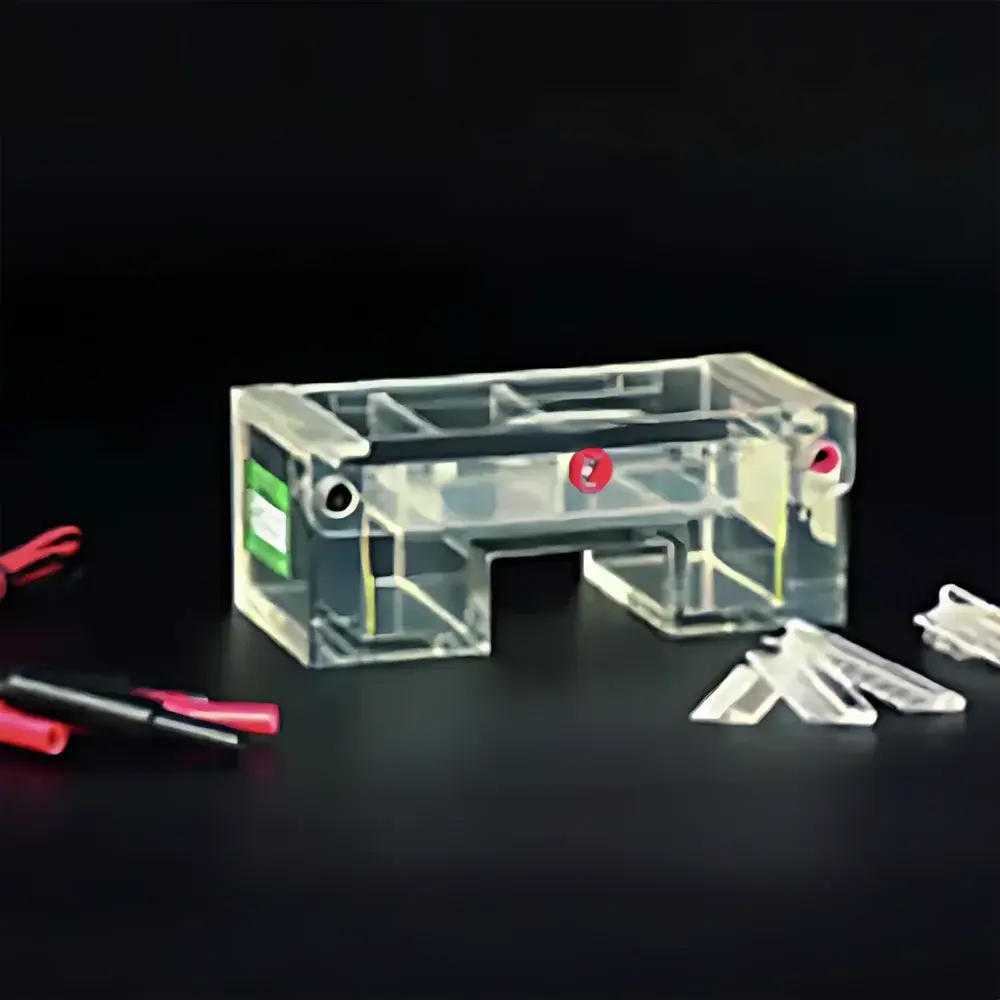
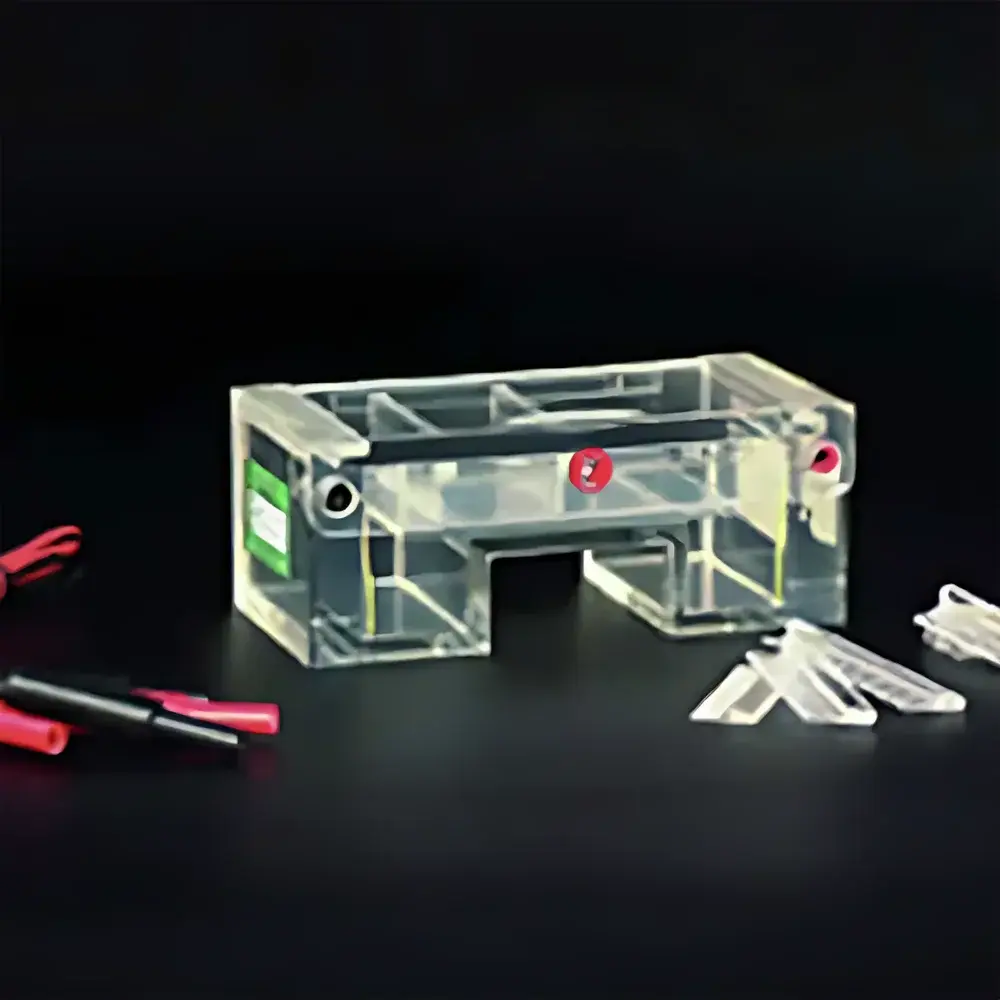
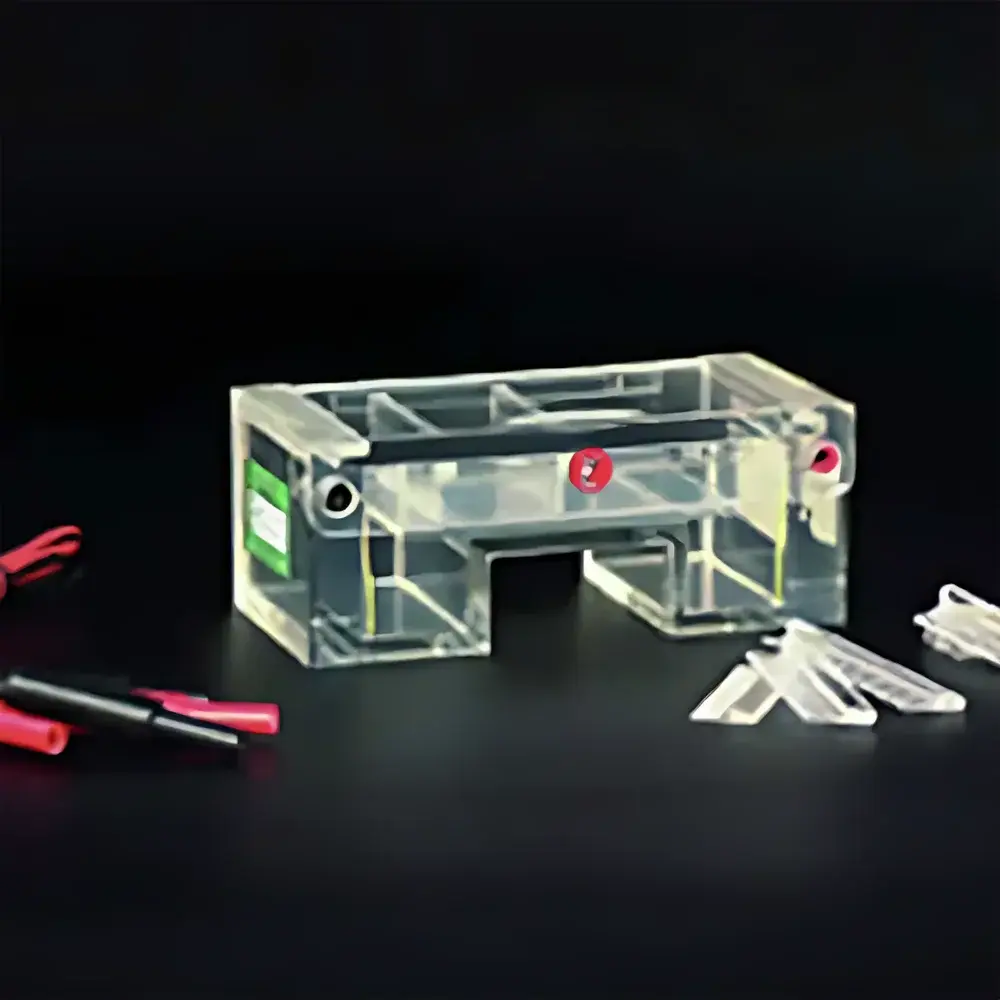
Beijing Liuyi DYCP-31C Horizontal Agarose Gel Electrophoresis Tank
| Brand | Beijing Liuyi/LY |
|---|---|
| Origin | Beijing, China |
| Manufacturer Type | General Distributor |
| Product Category | Domestic |
| Model | DYCP-31C |
| Instrument Type | Horizontal Electrophoresis Tank |
| Gel Tray Dimensions (L×W) | 110 × 65 mm |
| Sample Combs | 9-well and 14-well configurations |
| External Dimensions (L×W×H) | 180 × 95 × 75 mm |
| Buffer Capacity | ~255 mL |
| Weight | ~1 kg |
Overview
The Beijing Liuyi DYCP-31C Horizontal Agarose Gel Electrophoresis Tank is a compact, benchtop electrophoresis system engineered for routine nucleic acid separation and analysis in academic laboratories, quality control environments, and molecular biology teaching facilities. Designed according to standard horizontal electrophoresis principles—where an electric field drives charged biomolecules through a porous agarose matrix—the DYCP-31C enables reliable DNA fragment migration based on size-dependent mobility under constant voltage conditions. Its modular construction supports dual-gel operation, allowing simultaneous electrophoretic runs for comparative analysis or experimental replication without requiring additional hardware. The tank’s low-profile geometry and optimized buffer volume ensure uniform field distribution across the gel surface while minimizing Joule heating and buffer depletion during standard run durations (typically 20–60 min at 80–120 V). All components—including the UV-transparent acrylic tank body, platinum-coated electrode assembly, and removable comb holders—are chemically resistant to common electrophoresis buffers (e.g., TAE, TBE) and compatible with post-run staining protocols involving ethidium bromide, SYBR Safe, or GelRed.
Key Features
- Compact footprint (180 × 95 × 75 mm) optimized for space-constrained lab benches and fume hoods
- Dual-gel capability via parallel gel tray positioning—enables side-by-side comparison of samples or controls under identical electrophoretic conditions
- Interchangeable sample combs: 9-well and 14-well formats available in both 1.0 mm and 2.0 mm thicknesses to accommodate varying loading volumes and resolution requirements
- Gel tray dimensions standardized at 110 × 65 mm—compatible with widely adopted imaging systems and UV transilluminators (e.g., 254 nm and 302 nm excitation)
- Buffer reservoir volume of ~255 mL ensures stable conductivity and thermal equilibrium during extended runs
- Corrosion-resistant platinum wire electrodes mounted on adjustable end caps for precise alignment and long-term current stability
- Lightweight (~1 kg) yet rigid acrylic construction facilitates handling, cleaning, and storage without compromising structural integrity
Sample Compatibility & Compliance
The DYCP-31C is validated for use with standard agarose concentrations ranging from 0.7% to 2.0% (w/v), supporting resolution of DNA fragments between 100 bp and 20 kbp. It accommodates common molecular weight markers (e.g., 100 bp DNA Ladder, Lambda HindIII digest) and is routinely employed in applications aligned with ISO/IEC 17025-accredited testing workflows for nucleic acid integrity assessment. While the unit itself does not carry CE or UL certification as a standalone component, its design conforms to general laboratory safety guidelines for low-voltage DC electrophoresis systems (< 300 V). When paired with compliant power supplies—such as the DYY-6C, DYY-7C, or DYY-8C series—the complete electrophoresis setup meets functional requirements for GLP-compliant documentation when integrated into validated SOPs.
Software & Data Management
As a passive electrophoresis tank, the DYCP-31C requires no embedded firmware or proprietary software. All operational parameters—including voltage, current, run time, and buffer composition—are defined externally by the connected power supply. For traceability and audit readiness, users are advised to record run conditions manually or via LIMS-integrated power supply interfaces (e.g., DYY-8C models with RS-232 output). Gel documentation workflows typically involve post-electrophoresis imaging using third-party digital gel documentation systems compliant with FDA 21 CFR Part 11 requirements for electronic records, where applicable.
Applications
- Routine DNA fragment analysis in undergraduate and graduate molecular biology laboratories
- Verification of PCR product size and amplification specificity prior to sequencing or cloning
- Quality control assessment of plasmid preps, restriction digests, and ligated constructs
- Preparative electrophoresis for excision and purification of target bands (e.g., gel extraction protocols)
- Teaching demonstrations of charge-to-mass ratio effects on macromolecular mobility
- Supporting ISO 13485-certified in vitro diagnostic development workflows requiring documented nucleic acid separation steps
FAQ
What power supplies are compatible with the DYCP-31C?
The DYCP-31C is designed for use with constant-voltage DC power supplies rated up to 300 V and 500 mA. Recommended models include the DYY-6C (dual-output timer-controlled), DYY-7C (transfer-capable), and DYY-8C (dual-stabilized with digital display and memory function).
Can this tank be used with polyacrylamide gels?
No. The DYCP-31C is specifically engineered for agarose-based horizontal electrophoresis. Polyacrylamide gel electrophoresis (PAGE) requires vertical apparatus configurations, higher voltage tolerance, and specialized casting accessories not supported by this platform.
Is the tank UV-transparent for direct visualization of ethidium bromide-stained gels?
Yes. The acrylic body exhibits high transmission at 254 nm and 302 nm wavelengths, enabling real-time monitoring under standard UV transilluminators without gel removal.
How should the tank be cleaned after use?
Rinse thoroughly with deionized water immediately after each run. For residual buffer salt deposits or dye contamination, soak in 70% ethanol for 10 minutes followed by ultrasonic cleaning (optional) and air-drying in a dust-free environment.
Does the DYCP-31C support gradient gel pouring?
No. Its fixed-height gel tray and comb design do not accommodate gradient-forming devices or multi-step polymerization setups. It is intended for uniform-concentration agarose gel preparation only.




