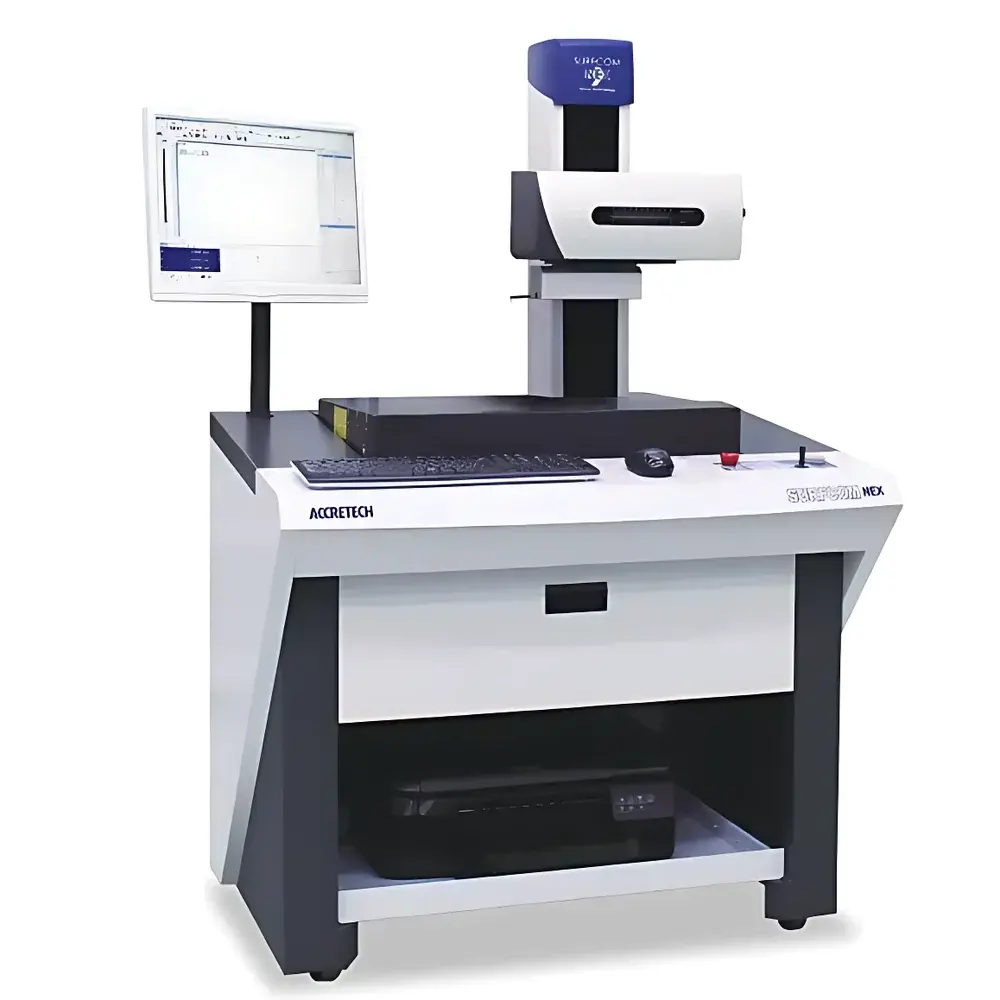
Accretech SURFCOM NEX Contact Profilometer
| Brand | Accretech (Tokyo Seimitsu) |
|---|---|
| Origin | Japan |
| Model | NEX |
| Type | Contact Profilometer / Surface Roughness Tester |
| Drive System | Patented Linear Motor-Based X-Axis Drive |
| Measurement Principle | Stylus-Based Profile Tracing with High-Resolution Vertical Displacement Sensing |
| Compliance | Designed for ISO 25178, ISO 4287, ISO 11562, ASME B46.1, and JIS B 0601 Standards |
| Software Platform | SURFCOM Data Analysis Suite with GLP/GMP-Ready Audit Trail (FDA 21 CFR Part 11 Optional) |
| Configuration | Integrated All-in-One Benchtop System (DX or SD variants) |
| Environmental Robustness | Vibration-Isolated Base with Optional PC Enclosure in Anti-Vibration Substructure |
Overview
The Accretech SURFCOM NEX is a high-precision contact profilometer engineered for traceable, repeatable measurement of surface topography, roughness, waviness, and form deviation across industrial metrology, R&D, and quality assurance laboratories. Operating on the fundamental principle of mechanical stylus tracing—where a diamond-tipped probe (typically 2 µm radius, 90° included angle) physically traverses the surface under controlled force (0.75 mN standard)—the system captures vertical displacement data with sub-nanometer resolution via a high-stability differential inductive transducer. Its patented linear motor-driven X-axis eliminates cogging, backlash, and belt-driven vibration artifacts, enabling ultra-low-noise scanning essential for compliant roughness characterization per ISO 25178-2 (areal parameters) and ISO 4287 (profile-based parameters). The NEX’s architecture integrates motion control, signal conditioning, and real-time data acquisition into a single synchronized platform, minimizing phase lag and thermal drift during extended scan sequences—critical for achieving measurement uncertainty ratios (MUR) < 1:4 against certified reference standards.
Key Features
- Patented decoupled manual–motorized drive system: A mechanically isolated manual feed mechanism engages only during coarse positioning; it automatically disengages prior to measurement to preserve the linear motor’s ultra-low vibration performance (< 0.5 nm RMS).
- Sub-millisecond motion response: Combined with a low-inertia scanning carriage and predictive acceleration profiling, the system achieves full-scale traverse speeds up to 10 mm/s with < 10 ms settling time—enabling 3D areal roughness mapping in approximately one-tenth the time of legacy stepper-motor systems.
- COAP (Comfortable Operation and All-in-One Package) design philosophy: Ergonomically optimized joystick, dual-function JOG dial for micron-level fine positioning, and integrated touchscreen interface reduce operator fatigue and minimize repositioning cycles across multi-part batches.
- Benchtop-integrated vibration isolation: Windows-based analysis PC optionally housed within the anti-vibration base structure—reducing total footprint by ~25% (DX configuration) without compromising electromagnetic or thermal stability.
- Modular hardware scalability: Supports interchangeable skids (e.g., long-range Z-stage ±20 mm, high-resolution Z-sensor ±1 mm), optional auto-focus optical alignment aids, and motorized tilt/rotation stages for complex geometries.
Sample Compatibility & Compliance
The SURFCOM NEX accommodates samples up to 300 mm × 200 mm × 100 mm (W × D × H) on its granite base, with optional vacuum chucks or kinematic fixtures for thin wafers, machined dies, medical implants, and precision optics. It meets the mechanical and signal integrity requirements for accredited calibration labs operating under ISO/IEC 17025. All reported roughness parameters—including Sa, Sq, Sz, Ssk, Sku, and functional volume indices (Vmp, Vmc, Vvc)—are computed in strict accordance with ISO 25178-2:2012 and ISO 11562:1996. Filter implementation follows Gaussian robust filtering (λc = 0.08 mm, 0.25 mm, 0.8 mm, 2.5 mm) as defined in ISO 16610-21. Optional 21 CFR Part 11-compliant software modules provide electronic signatures, audit trails, and role-based access control for regulated environments (e.g., FDA-regulated device manufacturing, aerospace component QA).
Software & Data Management
SURFCOM Data Analysis Suite v5.x delivers comprehensive post-processing, including spectral analysis (PSD), bearing ratio curve (Abbott-Firestone), motif analysis, and segmentation-based defect detection. Raw profile and areal datasets are stored in vendor-neutral .sur and .xyz formats, with export support for ASCII, CSV, and Metrology Exchange Format (MEF). Batch processing workflows enable automated parameter extraction across hundreds of profiles with configurable pass/fail thresholds. The software supports instrument calibration verification using NIST-traceable step-height standards (e.g., 100 nm–10 µm Si wafer artifacts), with built-in uncertainty estimation per GUM (JCGM 100:2008). Audit logs record all user actions, parameter modifications, and calibration events with timestamps and operator IDs.
Applications
- Automotive: Cylinder bore honing texture analysis, gear flank roughness validation, and tribological surface specification compliance (e.g., VW TL 211, GM W31).
- Semiconductor packaging: Leadframe coplanarity, mold compound surface uniformity, and wafer-level bump height distribution.
- Medical devices: Orthopedic implant surface finish (ASTM F2792), dental abutment micro-texture, and stent strut edge geometry verification.
- Aerospace: Turbine blade trailing edge radius assessment, thermal barrier coating roughness before EBPVD, and additive-manufactured part as-built surface qualification.
- Academic research: Correlation studies between machining parameters and functional surface properties (lubrication retention, adhesion, fatigue initiation).
FAQ
What stylus tip specifications are supported?
Standard configuration uses a 2 µm radius, 90° diamond stylus (Accretech P/N ST-2R90); alternative tips (5 µm radius, 60°, or conical) are available for soft materials or high-curvature features.
Can the NEX perform both 2D profile and 3D areal measurements?
Yes—the system acquires sequential parallel profiles with programmable lateral pitch (down to 0.1 µm), reconstructing true 3D topography with native support for Sa, Sq, Sdr, and hybrid functional parameters.
Is external vibration isolation required?
Not typically—the integrated pneumatic anti-vibration table (standard on DX/SD models) attenuates frequencies > 2 Hz by ≥90%; floor-mounted installations in low-noise labs may omit auxiliary isolators.
How is traceability maintained for calibration?
Accretech provides factory calibration certificates traceable to NMIJ (National Metrology Institute of Japan) with uncertainty budgets; annual recalibration services include step-height, linearity, and thermal drift verification.
Does the system support automated report generation for ISO/ASME standards?
Yes—templates conforming to ISO 25178-701 (reporting format) and ASME B46.1 Annex A are preloaded; custom templates can be authored using the embedded XML-based report editor.