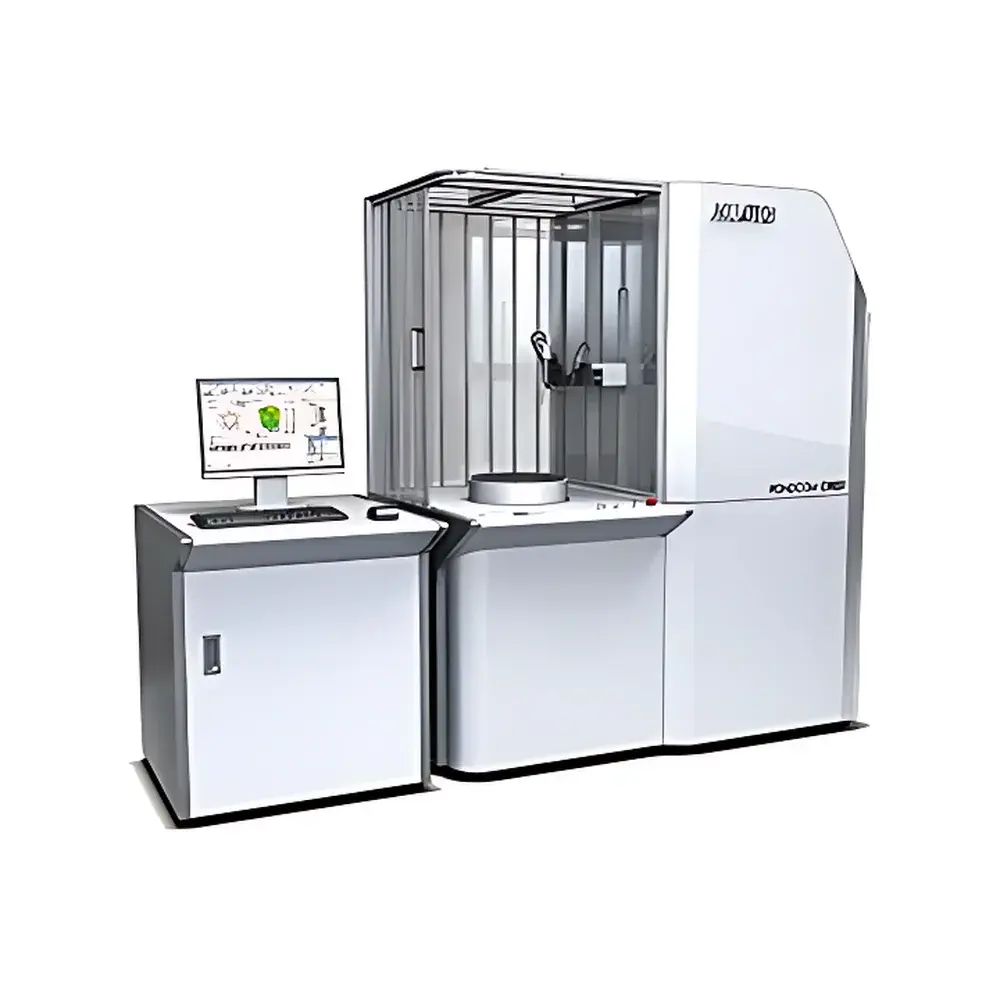
ACCRETECH Rondcom 65B High-Precision Roundness and Cylindricity Measuring Instrument
| Brand | ACCRETECH (Tokyo Seimitsu) |
|---|---|
| Origin | Japan |
| Model | Rondcom 65B |
| Rotation Accuracy (Radial) | (0.01 + 4H/10,000) µm per JIS B 7451:1997 |
| Axial Accuracy | (0.03 + 4R/10,000) µm per JIS B 7451:1997 |
| Straightness (Z-axis, narrow range) | 0.05 µm/100 mm |
| Straightness (Z-axis, full range) | 0.2 µm/500 mm |
| Parallelism (Z-axis) | 1.5 µm/500 mm |
| Stylus Force | 30–100 mN (stepless adjustment) |
| Max Workpiece Diameter | φ68 mm |
| Max Height | 7800 mm |
| R-axis Travel | 220 mm |
| Z-axis Travel | 500 mm |
| Table Load Capacity | 60 kg |
| Power Supply | AC 100–240 V ±10%, 50/60 Hz |
| Air Supply | 0.5–0.7 MPa, consumption 49 NL/min |
Overview
The ACCRETECH Rondcom 65B is a high-precision, motorized roundness and cylindricity measuring instrument engineered for metrology laboratories and precision manufacturing environments requiring traceable geometric form evaluation. It operates on the principle of high-stability rotational axis metrology, where a precision air-bearing spindle rotates the workpiece while a diamond-tipped stylus traces its surface in orthogonal radial (R) and axial (Z) directions. The system captures high-density profile data—up to 14,400 points per revolution—with sub-micron resolution, enabling quantitative assessment of form deviations against international standards including JIS B 7451, ISO 1101, and ASME Y14.5. Its rigid granite column structure minimizes thermal drift and mechanical deformation, ensuring long-term repeatability and stability under controlled lab conditions. Designed for both manual and CNC-driven operation, the Rondcom 65B supports rapid, repeatable measurement cycles—achieving full-circle acquisition in under 60 seconds—without compromising metrological integrity.
Key Features
- Ultra-stable air-bearing rotary table with radial accuracy of (0.01 + 4H/10,000) µm per JIS B 7451:1997, where H is the distance (mm) from table center to measurement point
- High-rigidity granite column and base structure minimizing R- and Z-axis deflection; straightness specification of 0.05 µm/100 mm (narrow range) and 0.2 µm/500 mm (full Z-travel)
- Stepless stylus force control (30–100 mN) optimized for delicate surfaces and hardened materials, compatible with φ1.6 mm × 53 mm tungsten carbide probe
- CNC programmable motion control across θ (2–20 rpm), Z (0.6–30 mm/s), and R (0.6–20 mm/s) axes, supporting automated centering, tilting, and multi-step inspection routines
- Digital filtering options including Gaussian, 2RC, Spline, and ISO 13565-2 compliant “009” filter for robust separation of roughness, waviness, and form components
- Real-time shape visualization: 3D wireframe, grayscale contour maps, and elevation plots synchronized with live profile tracing
Sample Compatibility & Compliance
The Rondcom 65B accommodates cylindrical, disk-shaped, and stepped workpieces up to φ68 mm in diameter and 7800 mm in height—ideal for bearing races, hydraulic spools, optical lens mounts, and precision shafts. Its ±5 mm radial and ±1° tilt auto-centering function ensures optimal alignment without manual intervention. Measurement protocols comply with JIS B 7451 (roundness evaluation), ISO 12181 (roundness), ISO 12180 (cylindricity), and ISO 1101 (geometrical tolerancing). The system supports GLP/GMP-aligned audit trails when integrated with optional ACCRETECH Metrology Suite software, satisfying requirements for FDA 21 CFR Part 11-compliant environments where electronic records and signature validation are mandated.
Software & Data Management
Equipped with ACCRETECH’s proprietary Metrology Suite v5.x, the Rondcom 65B delivers comprehensive post-processing capabilities: MZC (Minimum Zone Center), LSC (Least Squares Center), MIC (Minimum Inscribed Circle), MCC (Maximum Circumscribed Circle), and N.C. (No Compensation) evaluation methods; composite analysis combining multiple form parameters; design nominal comparison with tolerance band overlay; and statistical process monitoring (SPC) export. Data is stored in vendor-neutral ASCII and XML formats, supporting seamless integration into enterprise MES or QMS platforms. All measurement logs—including operator ID, timestamp, environmental conditions (optional sensor input), and calibration status—are retained with immutable audit trails. Optional color thermal printer enables immediate hardcopy reporting compliant with internal QA documentation policies.
Applications
This instrument serves critical quality assurance functions across aerospace (turbine blade root geometry), medical device manufacturing (orthopedic implant stems), semiconductor equipment components (vacuum chamber flanges), and precision optics (lens barrel concentricity). It is routinely deployed for first-article inspection, incoming material verification, in-process validation, and capability studies (Cp/Cpk). Its ability to resolve sub-100 nm form deviations makes it suitable for evaluating ultra-precision components subject to ISO GPS (Geometrical Product Specification) tolerancing, particularly where cylindrical uniformity directly impacts functional performance—such as fluid sealing surfaces, rolling contact interfaces, or kinematic alignment features.
FAQ
What standards does the Rondcom 65B reference for roundness evaluation?
It conforms to JIS B 7451:1997, ISO 12181-1:2011, and ASME B89.3.1M–2018 for roundness and cylindricity assessment.
Can the system measure non-cylindrical parts such as flat disks or tapered surfaces?
Yes—its CNC Z- and R-axis coordination supports plane flatness, taper angle, cone angle, and coaxiality measurements across complex geometries.
Is air supply mandatory for operation?
Yes. A clean, dry compressed air source (0.5–0.7 MPa, 49 NL/min) is required for air-bearing spindle and pneumatic chuck actuation.
Does the system support automated report generation with company branding?
Yes—Metrology Suite allows customizable report templates, digital signatures, and PDF/CSV export with embedded metadata and revision control.
What is the recommended calibration interval for traceable use?
Annual calibration by an ISO/IEC 17025-accredited metrology laboratory is recommended; interim verification using certified reference artifacts (e.g., NIST-traceable roundness standards) is advised per ISO 17025 clause 7.7.