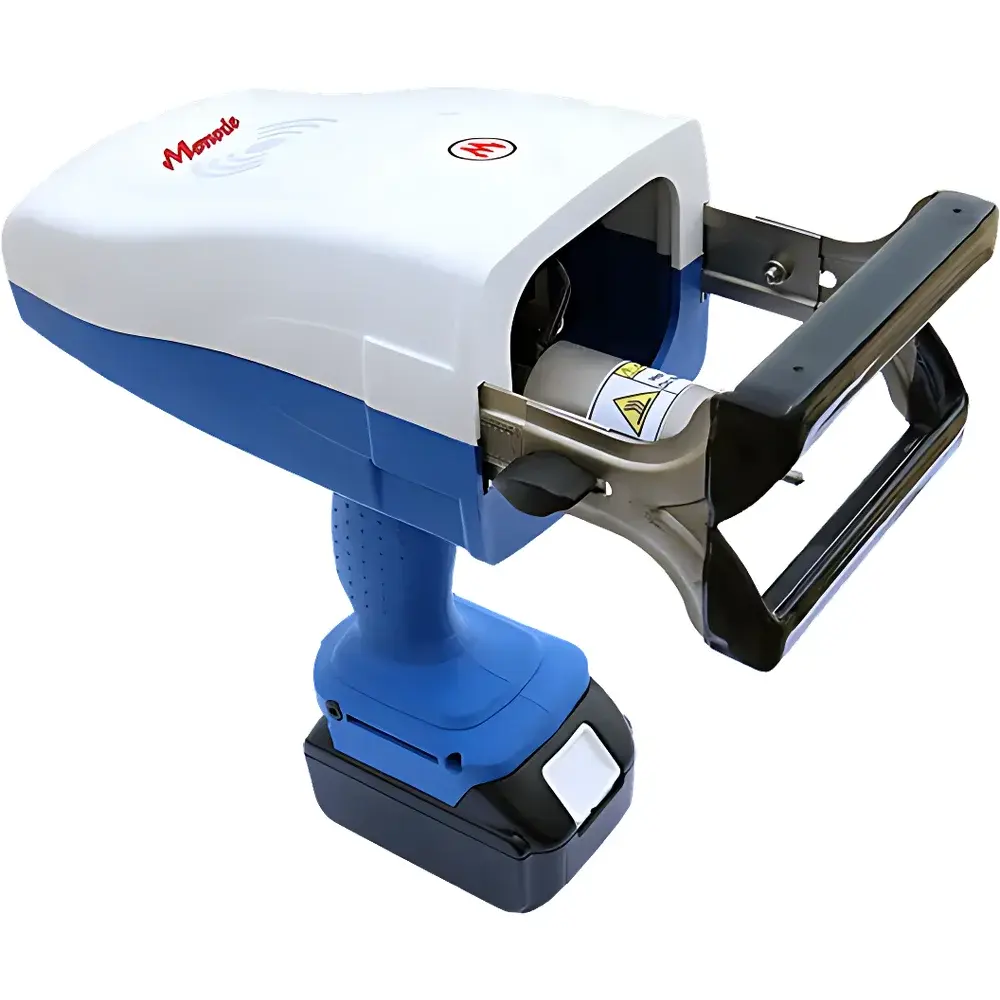
Monode Portable Pin Marking Machine
| Brand | Monode |
|---|---|
| Origin | USA |
| Model | Monode Portable Pin Maker |
| Power Source | Rechargeable Lithium-ion Battery (5 Ah) |
| Marking Window | 50 mm × 30 mm |
| Marking Force | Adjustable |
| Marking Speed | Variable (file-driven) |
| Battery Runtime | Up to 3 h continuous / ~8 h intermittent |
| Compliance | HPGL-compatible output |
| Included Accessories | 1 charger + 2 batteries |
| Enclosure | Industrial-grade portable carry case with linear guide rails on X/Y axes |
| Weight & Form Factor | Compact, cordless, handheld design |
Overview
The Monode Portable Pin Marking Machine is a precision-engineered, battery-powered dot peen marking system designed for high-reliability identification of semiconductor components, IC packages, lead frames, and other micro-fabricated parts requiring permanent, traceable surface marking. Operating on the mechanical principle of controlled impact—where a hardened tungsten carbide or ceramic stylus strikes the workpiece surface under programmable force—the system delivers consistent, non-destructive alphanumeric characters, logos, Data Matrix codes, and 2D barcodes. Unlike laser or inkjet alternatives, pin marking produces tactile, metallurgically stable marks that withstand aggressive cleaning, thermal cycling, and chemical exposure typical in back-end semiconductor packaging and wafer-level testing environments. Its compact, handheld architecture enables direct integration into cleanroom workflows, manual station setups, or mobile QA inspection points without fixed mounting or compressed air supply.
Key Features
- Cordless operation powered by dual hot-swappable lithium-ion batteries (5 Ah capacity), supporting up to 3 hours of continuous marking or approximately 8 hours of intermittent use—ideal for shift-based production lines and field service applications.
- High-precision X–Y linear motion system with hardened steel linear guide rails ensures repeatable stylus positioning and uniform indentation depth across the full 50 mm × 30 mm marking field.
- Digitally adjustable marking force (typically 1–100 N range, calibrated per material hardness) enables optimization for soft aluminum substrates, hardened steel carriers, or brittle ceramic packages without cracking or deformation.
- HPGL-compatible command interface allows seamless integration with legacy MES, ERP, or traceability software via standard RS-232 or USB virtual COM port; supports native import of vector-based mark files (.plt, .dxf) and serialized data streams.
- Ruggedized industrial carry case meets IP54 ingress protection standards and includes shock-absorbing foam inserts—designed for transport between Class 1000 cleanrooms, packaging labs, and final test bays.
- On-device barcode scanner (integrated or optional add-on) enables real-time verification of part IDs prior to marking, reducing mis-marking incidents and supporting ISO 9001/TS 16949 traceability requirements.
Sample Compatibility & Compliance
The Monode Portable Pin Marker accommodates flat, slightly curved, or recessed surfaces on semiconductor substrates including silicon wafers (with carrier fixtures), molded plastic ICs (e.g., QFP, BGA, SOIC), metal lead frames (Cu, Fe–Ni alloys), and ceramic packages (Al₂O₃, AlN). It complies with industry-standard durability benchmarks defined in MIL-STD-130 for UID marking and satisfies minimum mark readability thresholds per SEMI E10 (Specification for Definition and Measurement of Equipment Reliability) and JEDEC J-STD-020 (Moisture Sensitivity Levels). All firmware and control logic are validated for GLP/GMP-aligned audit trails when paired with compliant host software supporting FDA 21 CFR Part 11 electronic signature functionality.
Software & Data Management
The system operates with Monode’s proprietary MarkStudio™ configuration utility (Windows-based), enabling offline job creation, font library management (including OCR-A/B, ISO/IEC 15415-compliant Data Matrix fonts), and batch serialization with counter increment, date/time stamping, and database lookup via ODBC. Optional API modules support RESTful integration with factory floor systems (e.g., Siemens Opcenter, Rockwell FactoryTalk). All marking events—including timestamp, operator ID, force setting, battery level, and checksum-verified serial output—are logged locally and exportable as CSV or XML for SPC analysis and regulatory submission.
Applications
- Permanent UID marking on bare die carriers and wafer trays per MIL-STD-130N requirements.
- Lot/batch code engraving on lead frames pre-encapsulation to enable downstream process tracking.
- Final test labeling of packaged devices (e.g., “PASSED”, “FAIL”, “RMA”) directly at burn-in or functional test stations.
- Traceability marking on RF shields, heat sinks, and substrate interposers used in advanced packaging (2.5D/3D IC stacks).
- Field-service re-marking of legacy components during repair or requalification cycles under ISO 13485 medical device guidelines.
FAQ
Is the Monode Portable Pin Marker certified for use in ISO Class 5 cleanrooms?
Yes—when operated with optional static-dissipative stylus tips and housed in its ESD-safe carry case (surface resistivity < 1 × 10⁹ Ω), it meets ANSI/ESD S20.20 requirements for cleanroom tool qualification.
Can the marking force be calibrated in-situ without external tools?
Yes—the built-in force calibration routine uses internal load cell feedback and requires only a certified reference weight (supplied); no third-party metrology lab intervention is needed.
Does the system support GS1 DataMatrix with AIM DPM grade verification?
Yes—when configured with the optional vision-assisted verification module (sold separately), it achieves ≥ Grade B per ISO/IEC TR 29158 (AIM DPM) under low-contrast lighting conditions typical of post-molded plastic surfaces.
What is the expected stylus lifetime under typical semiconductor marking conditions?
With proper maintenance and use on aluminum or copper alloys, the standard tungsten carbide stylus delivers >500,000 impacts before replacement; ceramic variants extend this to >1 million cycles on harder materials like stainless steel carriers.