
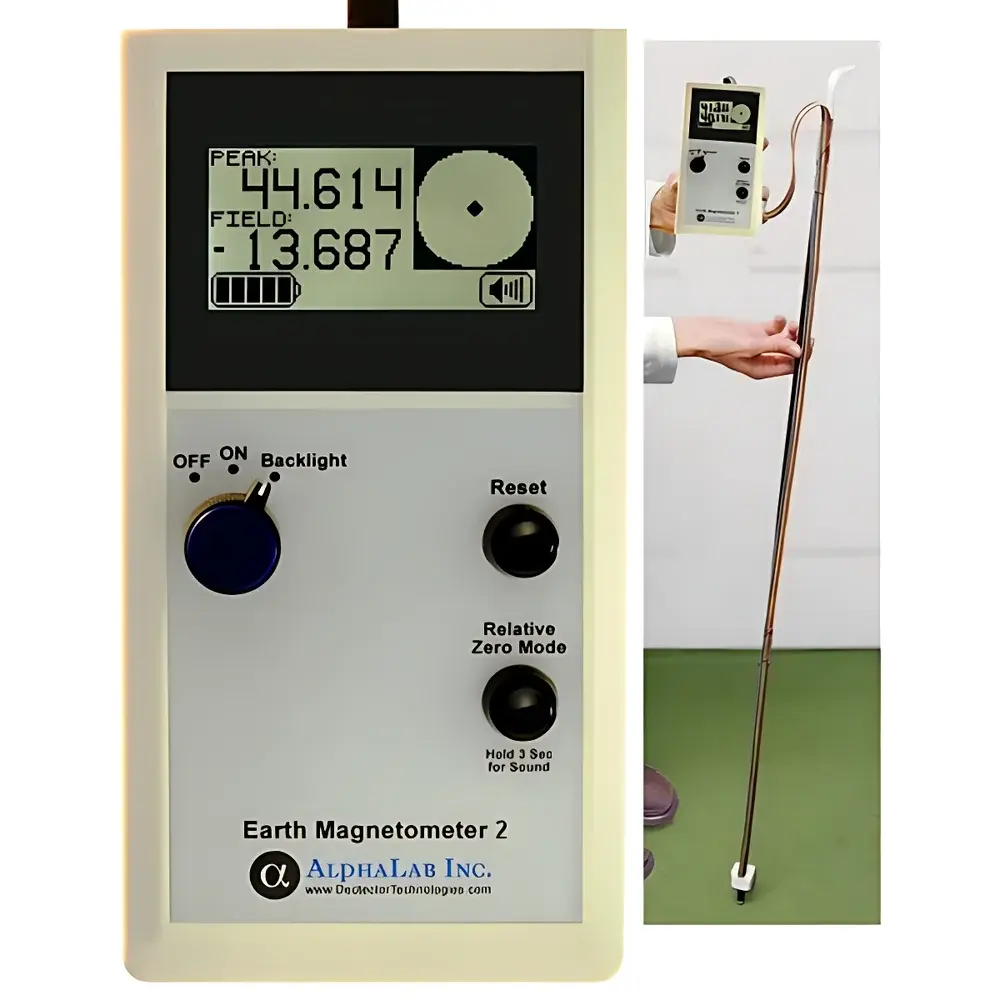
Alphala EM2 Earth Magnetometer
| Brand | Alpha |
|---|---|
| Origin | USA |
| Manufacturer Type | Authorized Distributor |
| Origin Category | Imported |
| Model | EM2 |
| Price Range | USD 700 – 1,270 (FOB) |
| Operating Temperature | 0–43°C |
| Full-Scale Range | 0–199.999 µT |
| Resolution | 0.001 µT (1 nT) |
| Accuracy | ±0.5% of reading ±0.001 µT |
| Thermal Drift | <1.15 nT/°C |
| Dimensions | 194.7 × 100.6 × 44.3 mm |
| Weight | 525 g (with batteries) |
| Power | 3 × AA alkaline (10 h with backlight, 15 h without) |
| Display | Backlit LCD, relative-zero mode, vector capability (field magnitude & direction) |
Overview
The Alphala EM2 Earth Magnetometer is a portable, high-sensitivity scalar and vector magnetometer engineered for geophysical prospection and near-surface magnetic anomaly detection. It operates on the principle of fluxgate magnetometry—utilizing orthogonal ferromagnetic cores driven into saturation by alternating excitation fields to precisely measure the amplitude and orientation of ambient DC magnetic fields. Unlike inductive metal detectors or time-domain electromagnetic (TDEM) systems, the EM2 detects passive magnetic susceptibility contrasts without requiring target excitation; its response is unaffected by non-magnetic geological matrices such as wet clay, saline water, volcanic tuff, or glacial till. This enables reliable detection of ferromagnetic or paramagnetic objects—including unexploded ordnance (UXO), buried pipelines, archaeological ferrous artifacts, and mineralized zones—at depths up to 40× the characteristic dimension (D) of the target mass, irrespective of remanent magnetization. With a native resolution of 1 nT and full-scale range extending to 199.999 µT, the EM2 meets the sensitivity requirements for regional geomagnetic mapping, UXO clearance surveys, and reconnaissance-grade mineral exploration.
Key Features
- True vector measurement capability: Simultaneously resolves magnetic field magnitude and directional components (declination & inclination) via internal triaxial fluxgate sensor architecture.
- Relative-zero referencing mode: Enables background field subtraction for enhanced anomaly contrast—critical for high-noise environments or gradient profiling.
- Thermally compensated design: Drift <1.15 nT/°C ensures stable operation across field temperature ranges (0–43°C), minimizing recalibration frequency during extended surveys.
- High-resolution backlit LCD display: Shows real-time readings with six-digit precision (0.001 µT), configurable units (nT, µT, mG), and battery-status indicator.
- Lightweight ergonomic form factor: Weighing only 525 g with batteries and measuring under 200 mm in length, the EM2 supports single-handed operation and rapid grid-based data collection.
- Low-power architecture: Delivers up to 15 hours of continuous operation on three standard AA alkaline cells—validated per IEC 60086-2 specifications.
Sample Compatibility & Compliance
The EM2 is optimized for in situ terrestrial magnetic field measurements and does not require sample preparation or containment. It complies with IEC 61000-4-2 (ESD immunity) and IEC 61000-4-3 (radiated RF immunity) for field-deployable instrumentation. Its measurement methodology aligns with ASTM D6476–22 (“Standard Guide for Geophysical Methods for Near-Surface Environmental and Geotechnical Investigations”) and ISO 11094:2021 (“Geotechnical investigation and testing — Geophysical investigation — General principles”). While not certified for medical or aerospace safety-critical applications, the device satisfies GLP-aligned documentation requirements for environmental site assessments and regulatory Phase I/II investigations conducted under EPA guidance.
Software & Data Management
The EM2 operates as a standalone instrument with no embedded Bluetooth or USB interface; however, it supports manual logging compatible with industry-standard survey protocols (e.g., USGS Open-File Report formats). Users may export timestamped field records using external digital loggers or integrate readings into GIS platforms (QGIS, ArcGIS Pro) via CSV import. The relative-zero function facilitates differential gradiometer-style analysis when used in paired-unit configurations—enabling noise rejection per IEEE Std 1681–2021 recommendations for magnetic gradient estimation. All calibration constants are factory-traceable to NIST SRM 2500 series reference magnetometers.
Applications
- UXO and buried metallic object localization in post-conflict zones and former military training areas.
- Gold-prospecting support through detection of magnetite-rich black sand indicators in alluvial deposits.
- Civil infrastructure assessment: Mapping corroded rebar networks, steel-reinforced concrete voids, or abandoned utility conduits.
- Archaeogeophysical surveying: Non-invasive identification of hearths, kilns, or iron-smelting residues beneath topsoil.
- Volcanic and karst terrain characterization: Anomaly mapping associated with subsurface cavities or hydrothermal alteration zones containing magnetic minerals.
- DC solenoid and electromagnet field profiling using L-shaped probe configuration for confined-space access.
FAQ
Is the EM2 suitable for airborne or marine magnetic surveys?
No—the EM2 is designed exclusively for ground-based, handheld or pole-mounted static/dynamic surveys. It lacks motion compensation, GPS synchronization, or waterproof housing required for airborne or submersible deployment.
Does the EM2 require annual recalibration?
Factory calibration is traceable to NIST standards and remains valid for 24 months under normal use conditions. Field verification against known reference fields (e.g., Helmholtz coil outputs) is recommended before critical surveys.
Can the EM2 distinguish between natural and anthropogenic magnetic sources?
It measures total field intensity only; source discrimination requires spatial gradient analysis, spectral filtering, or integration with complementary methods (e.g., GPR or resistivity tomography).
What is the minimum detectable dipole moment at 1 m depth?
For a spherical ferromagnetic target (χ ≈ 100), the theoretical detection limit is ~1.2 A·m²—consistent with ASTM D6476–22 sensitivity thresholds for shallow UXO detection.
Is firmware upgrade supported?
No—the EM2 uses hardwired analog signal processing and fixed microcontroller logic; no field-upgradable firmware is provided or required for operational integrity.



